





Last year, I wrote an article for the Wall Street Journal about a federal government scheme to save owls by killing them. As absurd as that sounds, the federal government also has a scheme to save States’ Rights by killing them.
At a time when talking foundational principles and constitutionality seems to yield a collective eye roll from both political parties, States’ Rights discussion can seem particularly outmoded. But States’ Rights are at the center of a controversial provision worked into the version of the Farm Bill that recently passed the House.
Ironically, both sides of the debate are claiming to champion States’ Rights. In the Wall Street Journal, columnist Kimberley Strassel makes the case that a provision called the “Save Our Bacon (SOB) Act” that has been added to the Farm Bill is actually the pro-States’ Rights position, because the law it seeks to kill “doesn’t concern itself with only California”.
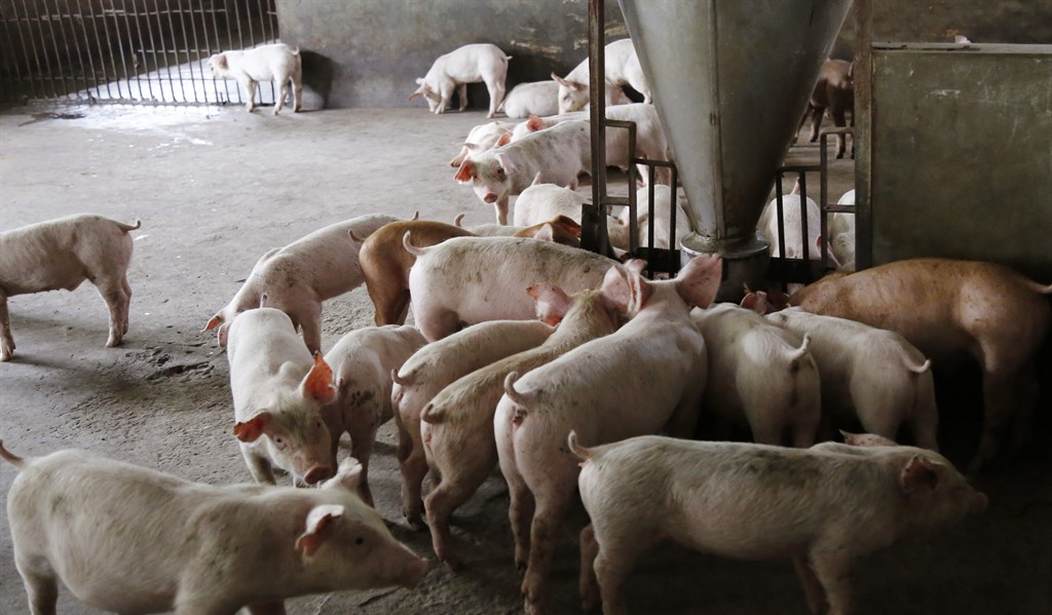
The law in question is California’s Proposition 12 (Prop. 12), which establishes minimum space standards for confining farmed pigs and requires all pork products sold in California to meet these same standards.
And so, the argument goes, the federal government must pass federal legislation to nullify this and any other state laws pertaining to farmed animal welfare. In other words, the federal government must expand its regulatory power over the states and replace state laws with federal regulations … for States’ Rights.
This argument attempts to use the interstate commerce clause, which exists to prevent states from discriminating against out-of-state commerce, as a rationale for the SOB Act. But this doesn’t work: California’s law applies the same standard to every producer who wants access to the California market, regardless of where they’re located.
The Supreme Court actually already ruled on this in 2023. Strassel inaccurately paraphrases the Supreme Court decision as declining “to kill the law, saying it was Congress’s job to clean up this interstate mess,” which is a confounding interpretation, considering the court’s opinion argues consistently against the claims made in her article.
Nowhere is this more clear (and quotable) than when Justice Neil Gorsuch writes, “Assuredly, under this Court’s dormant Commerce Clause decisions, no State may use its laws to discriminate purposefully against out-of-state economic interests. But the pork producers do not suggest that California’s law offends this principle. Instead, they invite us to fashion two new and more aggressive constitutional restrictions on the ability of States to regulate goods sold within their borders. We decline that invitation. While the Constitution addresses many weighty issues, the type of pork chops California merchants may sell is not on that list.”
This is a clear repudiation of not only the applicability of the interstate commerce clause, but even of the federal government having any role in the issue at all.
In his 1960 classic book, “Conscience of a Conservative,” Barry Goldwater dedicates a full chapter to States’ Rights and their erosion emanating from federal encroachment. The sad and striking part reading this nearly 70 years from its publication is that not much has changed, except that the federal government is no longer limited to surreptitiously absorbing State powers by clever funding machinations and the like, they can now, apparently, be overt and simply pass bills to grow their jurisdiction.
In this chapter, he writes of arguments that are reminiscent of those made for the SOB Act, about the federal obligation to step in when they deem state law unsatisfactory, which he says treat “the Constitution of the United States as a kind of handbook in political theory, to be heeded or ignored depending on how it fits the plans of contemporary federal officials. The Tenth Amendment is not ‘a general assumption,’ but a prohibitory rule of law.”
He acknowledges that the States have obligations and responsibilities, but concludes that these and the recourse for their not being met belong to the people:
“States’ Rights means that the States have a right to act or not to act, as they see fit, in the areas reserved to them. The states may have duties corresponding to these rights, but the duties are owed to the people of the States, not to the federal government. Therefore, the recourse lies not with the federal government, which is not sovereign, but with the people who are, and who have full power to take disciplinary action. If the people are unhappy with, say, their State’s disability insurance program, they can bring pressure to bear on their state officials and, if that fails, they can elect a new set of officials.”
The SOB Act is certainly a States’ Rights issue. But these rights are protected by its removal, not its passage.
Too often, we can all succumb to the impulse to try to underpin our arguments we already believe with principles that fit them found after the fact. This is dangerous and it is imperative that we identify these biases and guard against this impulse. I have my own biases in this case that I do not hide: I run a conservative animal advocacy nonprofit organization, and I believe that all life is sacred, that animals deserve our protection, and that our society is best judged by how we treat our most vulnerable.
But as someone who swore an oath to uphold and defend the Constitution when I enlisted in the Army nearly two decades ago, I believe the first test of legislation must always be its constitutionality and consistency with our foundational principles.
Prop. 12 protects animals in a way that I believe is good, meaningful, and becoming of our American values. But the question of the “Save Our Bacon Act” isn’t whether or not Prop. 12 (or any of the other countless state farmed animal welfare laws across the country that would be impacted by this) is a good law. The question is whether the federal government has the explicit Constitutional authority to override it.
Otherwise, per the 10th Amendment and Barry Goldwater, the goodness determination (and recourse if necessary) “lies not with the federal government, which is not sovereign, but with the people who are.”
Editor's Note: Do you enjoy Townhall's conservative reporting that takes on the radical left and woke media? Support our work so that we can continue to bring you the truth.
Join Townhall VIP and use promo code FIGHT to receive 60% off your membership.


Join the Conversation
VIP members get the ability to comment on articles.