





"In times of universal deceit, telling the truth is a revolutionary act." This bit of wisdom is often attributed to the English novelist George Orwell. Though the statement is an excellent summation of a central theme in his satirical works "1984" and "Animal Farm," Orwell has never been confirmed as the source. Whoever originated the phrase must have been smiling down on the events of last week in the U.S. Supreme Court and the U.S. Senate.
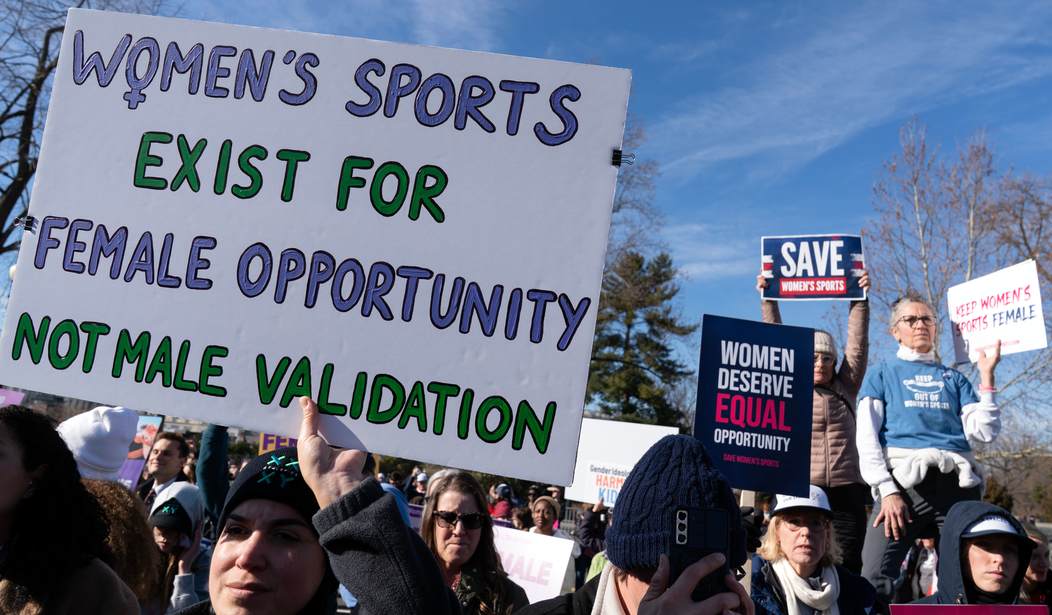
The Supreme Court heard oral arguments in the cases of State of West Virginia v. B.P.J. and Little v. Hecox. Both cases arrived at the court via challenges by the ACLU to laws in West Virginia and Idaho protecting women's and girls' opportunities, fairness, and safety in sports. During one exchange, Justice Samuel Alito asked the attorney for Hecox to provide the court with a definition of boy and girl or man and woman. She could not. Alito then pointedly noted, "Title IX prohibits discrimination on the basis of sex. It is a statutory term. It must mean something. How can [the court] decide [whether there is discrimination on the basis of sex] without knowing what [sex] means?"
The elephant in that ornate room full of highly educated men and women was the fact that they all knew the difference between boys and girls, men and women, but only some were willing to speak this fundamental truth. For others, doing so would dismantle a wispy legal argument and a political agenda that has occupied far too much space in the American cultural landscape for far too long.
Meanwhile, over in the U.S. Senate, there was a hearing of the Health, Education, Labor, and Pensions Committee on "Protecting Women: Exposing the Dangers of Chemical Abortion Drugs" that featured another noteworthy exchange. This one was between Sen. Josh Hawley and expert witness Dr. Nisha Verma.
Hawley: "Can men get pregnant?"
Verma: "I take care of many women that can get pregnant. I do take care of people that don't identify as women that can get pregnant."
Hawley: "Can men get pregnant?"
Verma: "…yes-no questions like this are a political tool."
Hawley: "No — yes-or-no questions are about the truth, Doctor… For the record, it's women who get pregnant, not men."
Different ornate room, same elephant.
Politicians and pundits from both ends of the ideological spectrum often lament various issues such as partisanship, socio-economic status, or sexuality as divisive. But the greatest divide in America is not between Republicans and Democrats, rich and poor, or heterosexual and everything else under the rainbow flag. The most dangerous divide is between those who still maintain their grip on reality and those who have willingly let go.
Twenty years ago, it would not have been considered controversial to publicly assert that there are physical differences between men and women or that boys cannot become girls. Today, telling the truth is a revolutionary act. Moreover, Americans who dare point out the emperor has no clothes (or, in this case, secondary sex characteristics) find themselves targets for censorship, cancellation, de-platforming, or, in the most heinous case of Charlie Kirk, assassination.
George Orwell may not have described telling the truth as a revolutionary act, but another revolutionary, Aleksandr Solzhenitsyn, did say, "The simple act of an ordinary brave man is not to participate in lies, not to support false actions!"
Cowardice and courage share the element of fear but differ in response. More importantly, the commonality between cowardice and courage is that they are both contagious. The female athletes who stood up for themselves and other girls in West Virginia, Idaho, and other states across the nation have inspired countless others. By simply asking to keep what is theirs by right—a safe and equal playing field, privacy in their locker rooms, and the dignity of womanhood—they remind us of all of the inescapable choice of humanity: we can curse the darkness or light a candle. And the darker it becomes in the world, the easier it becomes to see where the light is coming from.
We saw where the light was coming from in the U.S. Supreme Court and the U.S. Senate last week.
Editor’s Note: Do you enjoy Townhall’s conservative reporting and opinion? Support our work by joining Townhall VIP! Use the promo code POTUS47 to get 74% off your VIP membership!



Join the Conversation
VIP members get the ability to comment on articles.