





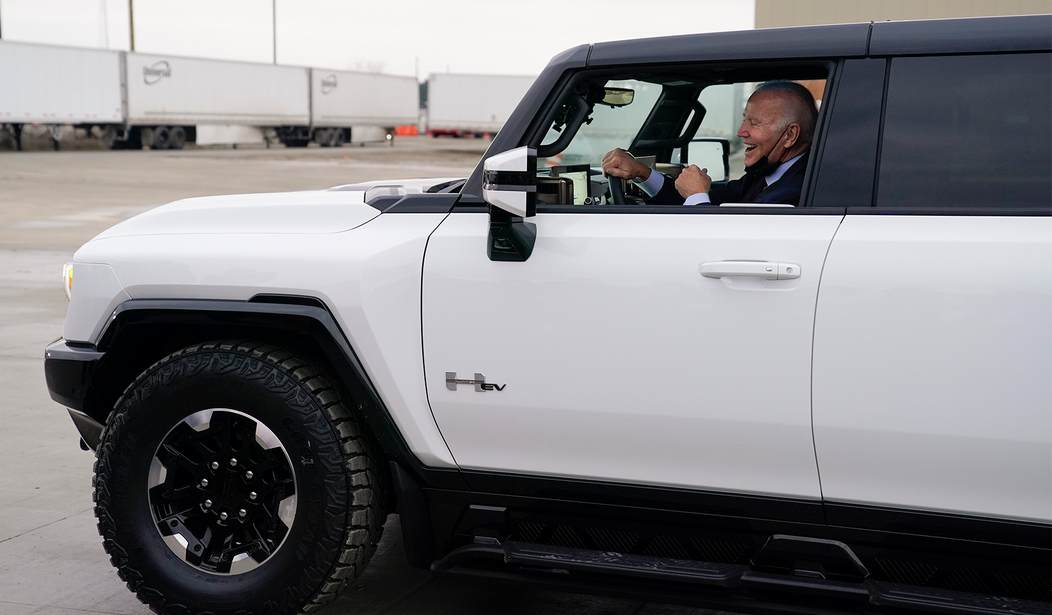
In a move that should surprise no one, President Trump announced a “reset” of Corporate Average Fuel Economy (CAFE) standards put in place by the Biden administration. CAFE has been politically weaponized by bureaucrats to fight climate change, and the proposed reversal will spell relief for car manufacturers, auto dealers, and consumers.
Established in 1975, CAFE’s original purpose was to reduce U.S. dependence on foreign oil, not be used as a tool to combat global warming. What began as moderate increases in a vehicle’s gas mileage, and for years remained relatively unchanged, ballooned over the last few decades, by politicians hoped to alter the Earth’s temperature. The reset aims to return “the program’s fidelity to the legal restrictions set forth by Congress.”
The new Trump rule would roll back the unattainable average fuel economy of 50.4 miles per gallon for passenger cars and light trucks by 2031 to 34.5 miles per gallon, lifting the federal de facto EV mandate; there was no other way to reach an impossible standard except through compulsory EV adoption.
Auto dealers were urging the Biden administration to “hit the brakes” on the “completely unrealistic” mandate. The penned letter by nearly 5,000 U.S. dealers came after an unanswered initial request for President Biden to “slow down” his crusade for two out of every three cars sold be electric. EV inventories have been piling up on lots; customers are not that interested.
Consumers are leery of the EV’s steep price tag, limited range, inadequate charging infrastructure, and impractical use in colder climates. Outside of mandates, the likelihood of the average consumer choosing an EV for their next vehicle purchase remains fairly low.
EV market share in total U.S. sales barely hit double digits for the first time this year. But that was right before the $7,500 tax credits were eliminated at the end of September. EV sales then cratered in October, plummeting roughly 30 percent. Turns out government subsidies are not a successful business model.
EV mandates are costing taxpayers trillions through rebates, tax credits, and utility rate increases. Researchers found that over a 10-year time frame, each 2023 EV would cost society between $94,000 and $152,000 in hidden subsidies.
Gas-powered car buyers are also paying more for their vehicles to cover the penalties and extra expenses incurred by manufacturers, who must purchase credits from EV makers, pay fines, or produce their own EVs. Ford, for example, raised prices on their 2024 F150 trucks to absorb the $3 billion loss from their EV line.
The stringent CAFE standards are costing families more money. The economic hardship falls heavily on middle- and lower-class households, who not only have tighter budgets but are unfairly subsidizing wealthier Americans’ EV purchases: A large portion of EV owners are more likely to be higher-income.
Forcing automakers to create technologies or expedite their development to meet nonexistent consumer demand distorts market realities and costs manufacturers extensive resources, which in turn costs consumers. Many car companies fully support the new initiative.
Ford’s CEO believes the new standards are “aligning fuel economy standards with market realities” and believes “this is a win for customers and common sense” by giving car buyers choice and affordability. Stellantis CEO agrees that the initiative is in step with “real-world market conditions….for a growing U.S. automotive industry,” and GM states it “upholds customer choice and provides the auto industry long-term stability."
The EV mandate is perhaps the largest and costliest government intervention the automotive industry and driving public have seen, especially for a populace whose majority does not want to own one.
Consumers, not government bureaucrats, should make decisions about the cars they drive. If car buyers value saving money on gas, they will choose to purchase more fuel-efficient vehicles, and automakers will meet those demands (without federal mandates). If consumers value other facets like cost, size, engine, safety, or utility, the government should not force automakers to ignore those preferences. Manufacturers need the freedom to make the cars Americans want at prices they can afford.
Draconian fuel-economy standards are strangling the auto industry. The CAFE reset will put manufacturers, dealers, and consumers back in the driver’s seat, where they belong.
Kristen Walker is the energy policy manager for the American Consumer Institute, a nonprofit education and research organization. For more information about the Institute, visit www.theamericanconsumer.org or follow us on X @ConsumerPal.
Editor’s Note: Do you enjoy Townhall’s conservative reporting that takes on the radical left and woke media? Support our work so that we can continue to bring you the truth.
Join Townhall VIP and use the promo code FIGHT to get 60% off your VIP membership!


Join the Conversation
VIP members get the ability to comment on articles.