





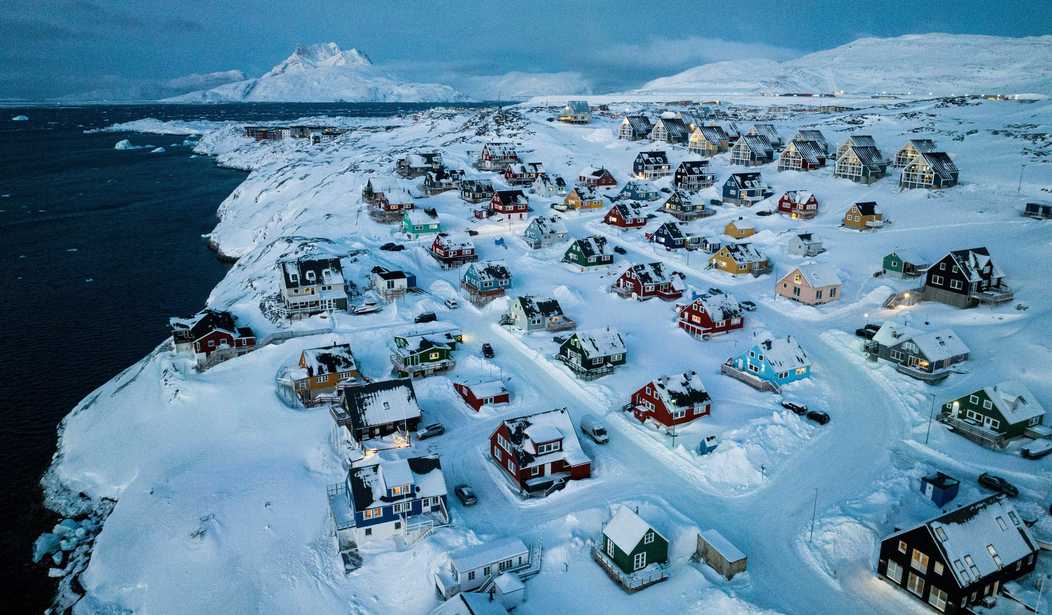
You have to admit it. He outfoxes just about everyone, just about every time. And it keeps landing the same way: to America's gain.
Remember when Trump first floated the idea that America might make Greenland more prosperous, more secure, and do something Denmark hadn't managed in generations — actually invest in the welfare of Greenland's own people? Remember the freakout that followed? Trump wouldn't rule out taking the island by force, even against a NATO ally, and for a while it genuinely rattled the alliance. Cable news ran segment after segment treating the whole thing as evidence the president had lost the plot entirely. Danish officials issued stern statements. Pundits reached for words like "unhinged" and "imperialist."
This week, we found out what the noise was actually covering for.
On Friday, the United States, Denmark, and Greenland announced a finalized security agreement — to be formally signed by all three governments next week at the United Nations General Assembly, pending expected parliamentary approval in Copenhagen and Nuuk. Trump described it as giving the U.S. "permanent control over security, and all other needs" in Greenland, and said his administration would "immediately" begin developing a larger American military footprint on the island, in whichever locations make the most strategic sense. Secretary of State Marco Rubio called it a "historic deal" and a "huge win," and for once that's not just White House spin. The agreement bans any non-NATO nation from building a base in Greenland. It blocks adversary investment in the territory. And it guarantees, in writing, that China and Russia — both of whom have spent years eyeing the Arctic as their next great-power staging ground — get locked out entirely.
Denmark's Prime Minister, Mette Frederiksen, made a point of noting the deal "recognizes the sovereignty and territorial integrity" of Greenland and Denmark both. That detail matters, and conservatives should be glad of it. This was never actually about America annexing anybody's homeland. It was about forcing a slow-walking ally to finally take the Arctic security threat as seriously as Washington already did, without the U.S. having to fire a shot or spend a decade in fruitless committee meetings to get there.
Now think past this news cycle, because the real significance of this deal isn't measured in weeks. It's measured in decades.
Greenland already hosts Pituffik Space Base, home to one of the most important early-warning radars America possesses — a system built to detect and track ballistic missiles the moment they leave the ground, whether they're fired from Russia's Arctic bastion or new Chinese silo fields aimed at our Eastern Seaboard. Geography made Greenland strategically priceless long before anyone in Washington said the words "Golden Dome" out loud. The shortest path for a nuclear-tipped missile between Moscow and Minot, North Dakota, or between Beijing and our coastlines, runs directly over that island. Trump himself put it plainly: if there's ever a war, much of it gets fought in the sky above that piece of ice. Now, with this agreement locking in a permanent, expanded American presence and permanently excluding Russia and China from ever gaining a foothold there, that early-warning and tracking capability becomes something our children and grandchildren inherit rather than something future administrations have to renegotiate from scratch every few years.
That's not abstract. Every additional minute of warning time an ICBM detection system buys the president of the United States is a minute spent deciding how to protect American cities rather than reacting blind. A system with eyes over the Arctic doesn't just watch Russia and China — it's part of the same layered architecture meant to eventually track and intercept threats from anyone racing toward long-range missile capability, rogue regimes included. Locking that infrastructure onto secured, allied ground for the long haul is exactly the kind of decision that doesn't pay off in a single news cycle. It pays off in 2045, in 2060, in whatever decade some future adversary decides to test how seriously America still guards its own skies.
That's the pattern worth noticing, because it's not new. Trump floats something that sounds outrageous. The press treats it as proof of instability. Foreign governments posture for the cameras. And then, quietly, out of the spotlight, actual diplomats spend months doing the unglamorous work of turning outrage into a signed agreement. By the time the ink dries, the loudest critics have usually moved on, and nobody circles back to admit the "unhinged" idea just became official U.S. and NATO policy.
Look at what America actually walks away with here. A permanent, expanded military presence in one of the most strategically vital regions on the planet — the exact stretch of Arctic that both Moscow and Beijing have spent the last decade maneuvering to exploit as polar ice recedes and new shipping lanes open. A binding guarantee that neither adversary gets so much as a toehold there. A NATO ally who finally put real security commitments on paper instead of vague reassurances. And Trump gets to walk into the midterms with a genuine foreign policy win in his pocket — a deal that strengthens the alliance rather than fracturing it, precisely the opposite of what every talking head predicted 18 months ago.
Canada benefits from a more secure Arctic. Europe benefits from a check on Russian ambitions creeping toward the pole. Greenland's own residents get the investment and security architecture Denmark alone was never going to provide. And American taxpayers get all of it without writing a check to buy an island outright, which was never realistically on the table no matter how many headlines insisted otherwise.
This is the part of Trump's negotiating style his critics still refuse to understand after nearly a decade of watching it work. He's willing to look reckless for a news cycle or two if it moves the actual negotiation to where it needed to land anyway. He's run this play more times than anyone can count, and it keeps producing the same result: America more secure, adversaries more boxed in, and the people who mocked the opening bid conveniently quiet once the deal gets signed.
Say what you want about the method. The outcome speaks for itself, and it's sitting on a signing table at the U.N. this week for anyone willing to actually look.
Editor’s Note: Thanks to President Trump and his administration’s bold leadership, we are once again respected on the world stage, and our enemies are being put on notice.
Help us continue to report on the administration’s peace through strength foreign policy and its successes. Join Townhall VIP and use promo code FIGHT to receive 60% off your membership.



Join the Conversation
VIP members get the ability to comment on articles.