





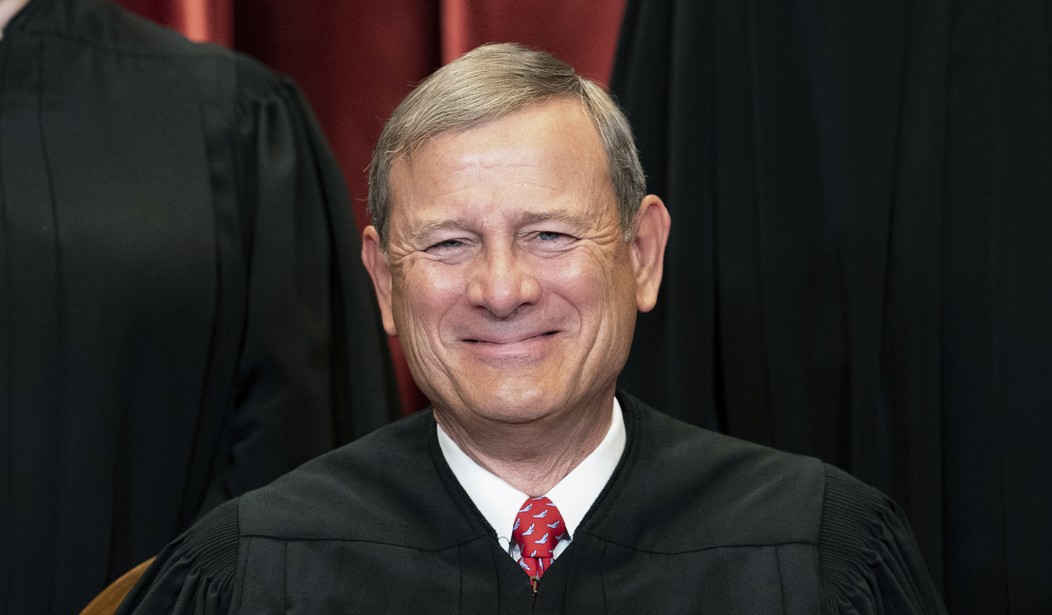
At his 2005 Senate confirmation hearing to be chief justice of the United States Supreme Court, John Roberts famously invoked America's national pastime in describing his view of the judicial role in our constitutional order: "Judges are like umpires. Umpires don't make the rules, they apply them. The role of an umpire and a judge is critical. They make sure everybody plays by the rules, but it is a limited role. Nobody ever went to a ball game to see the umpire."
If only!
Unfortunately, Roberts' actual career on the high court has been one extensive repudiation of his lofty "umpire" proclamation. In exalting above all other concerns his personal conception of the institutional integrity of the Supreme Court, and by extension the entire judiciary, Roberts has ironically done more than anyone else to delegitimize the courts. His recent wildly out-of-line criticism of President Donald Trump's call for impeachment of a rogue lower-court judge is just the latest example. For the court's own sake, in these politically tense times, Roberts must change course immediately.
Roberts first showed his hand in the landmark 2012 Obamacare case, National Federation of Independent Business v. Sebelius. As was initially reported by CBS News's Jan Crawford in the immediate aftermath of the decision and subsequently reported in later years by other court watchers such as CNN's Joan Biskupic, Roberts initially intended to rule against the constitutionality of the health care law's individual mandate -- its most controversial feature.
But at some point during the court's deliberations, Roberts changed his mind. He decided that he could throw a bone to the court's conservative bloc by ruling against the mandate on Commerce Clause grounds, which the law's drafters and the Obama administration alike had cited as its constitutional basis. But Roberts threw an even larger bone to the court's liberal bloc, unilaterally opting to rewrite the statute so as to construe the mandate as a "tax" -- which then-President Barack Obama himself had repeatedly told a skeptical public that it was not. Obama's signature domestic achievement was thus upheld.
That is not what a judicial "umpire" calling legal "balls and strikes" looks like. Making matters worse, the timing of Roberts' flip coincided with Obama's spring 2012 Rose Garden speech, in which he ludicrously described the possibility that the Supreme Court could nullify his health care law as "unprecedented" or "extraordinary." Did the chief justice conveniently switch his vote in a historically important case so as to mistakenly attempt to maintain the high court's "institutional integrity" in the face of an imperious president? It certainly seems so.
In the years since Sebelius, there have been any number of additional examples of Roberts ruling in a high-profile case in a way that can only be construed as a clumsy attempt to make "both sides" of the court -- and both sides of the broader American public -- happy. In the 2022 abortion case of Dobbs v. Jackson Women's Health Organization, which mercifully overturned the Roe v. Wade decision of 1973, Roberts notably refused to join the Justice Samuel Alito-written majority opinion, opting to write separately and merely concur in the judgment. It was a classic Roberts move: He argued the court could uphold Mississippi's underlying 15-week abortion ban statute without overturning Roe.
Roberts' Dobbs stunt was legally incoherent to the point of outright intellectual dishonesty, but it was politically convenient for Roberts' idiosyncratic conception of the role of the Supreme Court chief justice -- that of a jurist who should somehow attempt to "rise above the fray" and steer the ship of the court in a way that preserves the court's public image and integrity. But once again: That is certainly not what a judicial "umpire" calling legal "balls and strikes" looks like.
Roberts' pointed criticism this week of Trump's call for the impeachment of Judge James Boasberg, who last weekend ruled that midair flights deporting Tren de Aragua thugs had to be turned around, is in line with his history of prioritizing -- in ham-handed and self-aggrandizing fashion -- what he believes to be the judiciary's integrity. But on this particular score, Roberts is dead wrong.
Judicial impeachment is a well-established remedy for rogue judicial behavior that goes back to the Jefferson presidency in the early 1800s. It is explicitly countenanced by Article III of the constitutional text, which states that federal judges shall sit only "during good Behaviour." And impeachment is here, there and everywhere a fundamentally political judgment: It is appropriate, Alexander Hamilton wrote in The Federalist No. 65, where there has been "abuse or violation of some public trust." That is not a legally justiciable standard -- it is the bailiwick of politicians, who must exercise prudence and discernment.
Roberts' most recent outburst is even more absurd given the specific legal context of Boasberg's standoff with Trump. In this instance, Boasberg ruled against the president's ability to enforce the nation's immigration laws. But the "plenary power doctrine" of constitutional law has long held that the judiciary has no business getting involved when the political branches wish to secure our sovereignty. As the notes to the U.S. government's official online Constitution, available at Congress.gov, state: "(T)he Supreme Court's jurisprudence reflects that ... the Court will accord substantial deference to the government's immigration policies, particularly those that implicate matters of national security."
It seems Boasberg and Roberts need a remedial legal lesson or two.
Fortunately for Roberts, there is something he can do to actually help the judiciary regain credibility in the eyes of the public: He must expedite the Supreme Court's review, and overturning, of outrageous lower-court decisions that are based less in law than they are in paroxysms of frothing Trump hatred.
It is true, as it is often now said, that we are in the throes of a constitutional or legal crisis. It just isn't coming from the direction those claiming as much think it is. The true crisis is coming from an unhinged lower-court judicial insurrection.
If only there were a person uniquely situated to bring these judges to heel and thereby bring the crisis to a halt, thus re-legitimizing the judiciary in earnest. If only!



Join the Conversation
VIP members get the ability to comment on articles.