





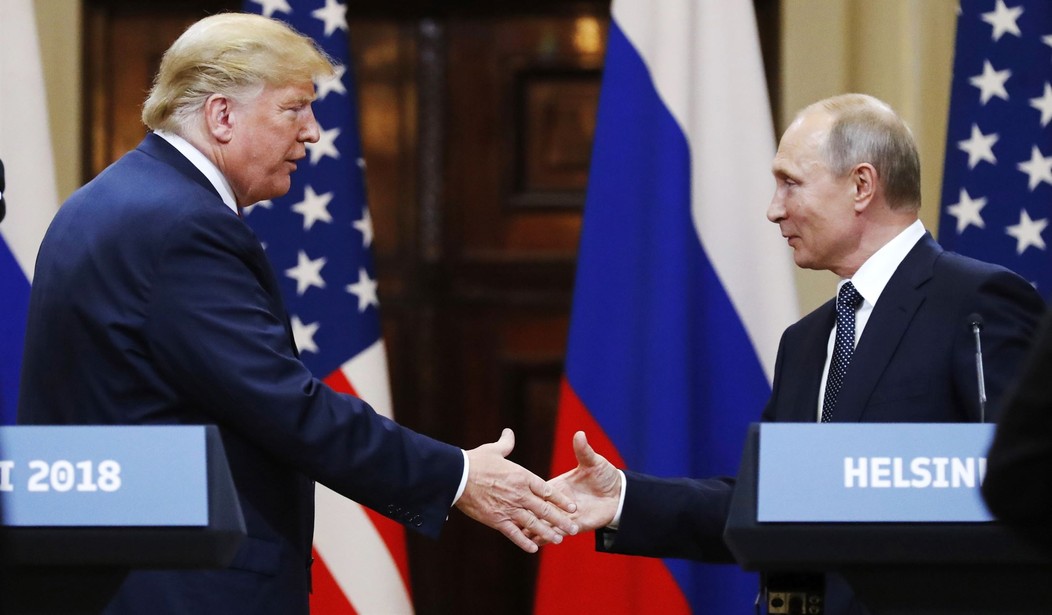
I think I can say, without fear of inviting reasonable correction, that the Helsinki summit did not go swimmingly.
And yet, some 66 percent of Republicans told ABC News-Washington Post pollsters that they support President Trump's objectively disastrous performance.
I don't buy it.
No doubt there are a few people who believe Trump's claims that he knocked it out of the park in Finland, and that, were it not for the "fake news" saying otherwise, everyone else would agree. But two-thirds of Republicans? No way.
I'm not borrowing a page from Trump and yelling, "Fake polls!" They're real. They just may not be measuring what we think they're measuring.
Polls often gauge partisan commitment more than concrete opinions on a specific controversy or issue. When Republicans are asked about the president's Helsinki performance, I suspect many hear, "Do you still support Trump?" or, "Do you think the media is blowing this out of proportion?" And I suspect they calibrate their responses accordingly: "Go suck eggs, enemy of the people!"
In other words, people lie to pollsters. This is not news. Public Policy Polling once found that 4 percent of Americans believe that lizard men are running the Earth. Another 7 percent said they weren't sure.
I, for one, do not believe that one in 10 Americans either truly think, or cannot rule out, that our globalist overlords are lizard people.
The more subtle and complex dishonesty takes the form of what psychologist Scott Alexander terms "poll answers as attire." Motivated by what social scientists call "social desirability bias," people use polls to virtue-signal.
This surely explains at least some of the findings showing surging popularity for socialism, particularly among millennials. No doubt many are sincere, but some probably just think it sounds cool to say such things.
It's a flawed analogy, but I'm reminded of the early days of the Iraq War, when polls showed strong support for President George W. Bush and his foreign policy even as evidence mounted that the conflict was going to be much tougher and uglier than many (including yours truly) had hoped. If you went solely by the polls and what elected Republicans said on TV, you'd have had a poor understanding of what was really going through the minds of many Republicans.
Bush's approval ratings among Republicans were unnaturally held aloft by many of the same factors boosting Trump today. The overheated rhetoric from Trump's opponents, their veering leftward on issue after issue, and the increasing partisanship of the media: These things encourage Republicans to stick it out with Trump, and to stick out their middle finger to his critics.
During the Iraq war, conservative dissenters and critics were often demonized or ostracized for their supposed treason or disloyalty. Similarly, the biggest and most common complaint I get from conservatives around the country now is not that I am wrong in my criticisms of Trump, but that I'm lending aid and comfort to the "enemy" by offering these criticisms publicly.
Many on the right either hope or fear that Trump is transforming the GOP into a nationalist-populist party. I think it's too soon to say. The first time conservatives seriously turned on Bush was not over the war, but over his attempt to put Harriet Miers on the Supreme Court in 2005.
That is how the camel's back gets broken -- not by the heavy load, but by the last straw.
Trump may succeed in permanently MAGA-fying the GOP. But making straight-line predictions about the future based on snapshots of the present is always folly in politics, because events get in the way.
Indeed, events don't just change the future; they change the past. In early 2003, 63 percent of Americans supported the Iraq war. Twelve years later, a YouGov poll found that only 38 percent of Americans said they had favored the war at the time.
One can easily envision a world a dozen years hence in which very few Republicans even remember supporting the Helsinki bromance.
Join the Conversation
VIP members get the ability to comment on articles.