







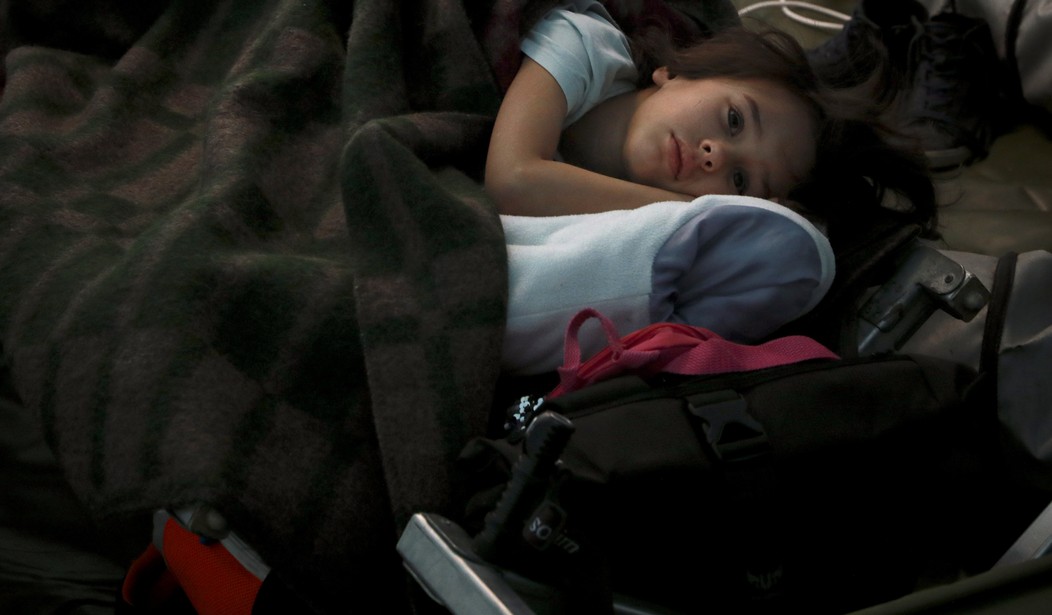
Millions flee Ukraine.
Where will they go?
Some want to come to America. But doing that legally is hard. A complex system is supposed to determine which people deserve to get in line to get in.
"The line is broken," explains Reason Magazine editor at large Matt Welch in my new video.
For example, America has a nursing shortage, but immigration authorities turn away foreign nurses. A Mexican teenager who wants to help build houses might be admitted, but he'd have to wait 100 years. No wonder people sneak across the border.
This month, President Joe Biden announced the United States would take in 100,000 refugees from Ukraine.
"He could snap his fingers and make it 250,000 if he chose," says Welch, and he should, because "we're a refugee country, and the people who come here tend to be the best."
"But they could be the worst," I point out.
Even the supposed "worst of the worst," Welch replies, made America better.
That's a reference to 1980, when Fidel Castro let 100,000 people out of jail and encouraged them to go to America. Some were his political opponents, but most were, as a Miami TV anchor put it, "bums off the streets of Havana -- murderers, thieves, perverts, prostitutes."
Castro assumed they'd cause problems in America.
But "that was wrong," says Welch. Despite their past problems, "they enriched Miami. They added to the economy and didn't detract from the people who lived there." A study showed that the Cuban exodus (SET ITAL)raised(END ITAL) wages of low-skilled Miamians.
Immigrants improved America even when we took in people who'd tried to kill us, and who we had tried to kill. Ronald Reagan and Jimmy Carter eagerly took in refugees from Vietnam and Cambodia. Reagan, campaigning for the presidency, said immigrants make us better. "They share the same values, the same dream."
"He was bragging on this as a conservative and American value," says Welch. "It is no longer a conservative value."
Today, conservatives are more likely to argue against letting in refugees, saying, as Ann Coulter put it, "Things can turn overnight when you're bringing in these masses of people from very, very different cultures." Then she joked, "And make it a hate crime to ask them to assimilate."
It wasn't entirely a joke. Some leftists call asking Latinos to assimilate "racist repression."
More reasonably, many Americans fear that crime will rise if we let in more immigrants. But that's unlikely.
"They commit far less crime than native-born Americans," Welch points out. He's right. Native-born Americans were 11.6 times more likely to be jailed than Afghan immigrants.
"It's hard for us to process that fact," says Welch. "It feels like it should be wrong, but it isn't. People who go to the lengths to get to this country tend to be less criminal than the native-born population."
"What if they just feed off welfare?" I ask.
"Then they would be the exception," he responds. Immigrants, overall, collect less welfare than native-born Americans.
Still, people feel threatened when large numbers of foreigners arrive. Polish people protested when Syrian refugees came to Poland.
But now Poles welcome Ukrainians.
Some call that racism.
"Maybe it is racism," Welch responds. "But maybe when someone you speak a common language with, and have a common history with ... lives right next door, it's just a different story. ... Can we spare a moment and say, they've just assimilated an astonishing number of refugees. And they're not in tents in camps, shivering. They're staying with people in their apartments!"
That sure seems like a good thing.
Soon more refugees will come to America. Welch argues that we should let more in.
"America is an assimilation machine," he says. "It's something that we should do more of because we're really good at it!"
I agree.
As long as people are peaceful, let them come.

Join the Conversation
VIP members get the ability to comment on articles.