







LAST WEEK, from opposite ends of the political spectrum, two of America's most prominent Black elected officials affirmed that the United States is not a racist nation.
The first was Senator Tim Scott, the conservative South Carolina Republican who delivered the GOP response to President Biden's address to Congress on Wednesday.
"Hear me clearly: America is not a racist country," Scott said. He acknowledged that racial bigotry has not been eradicated — indeed, he said, he has himself "experienced the pain of discrimination." But he insisted that race not be deployed as "a political weapon" and that "it's wrong to try to use our painful past to dishonestly shut down debates in the present."
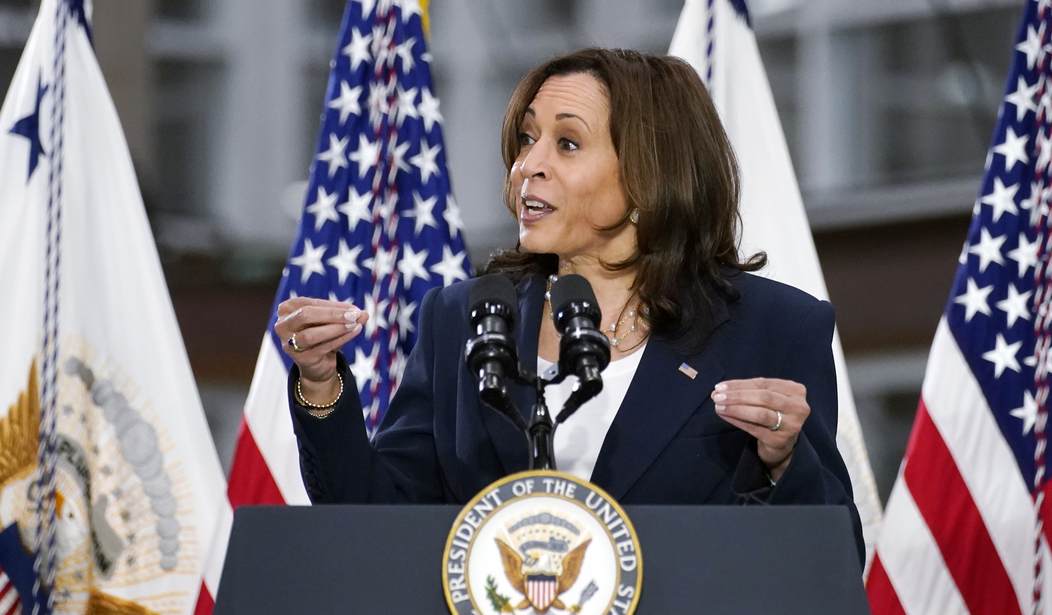
On Thursday morning, Vice President Kamala Harris, a liberal Democrat and until recently a California senator, agreed with her former colleague.
Asked during an ABC interview to comment on Scott's remarks, Harris answered clearly. "Well, first of all, no, I don't think America is a racist country," she said. "But we also do have to speak truth about the history of racism in our country and its existence today."
Her answer was noteworthy. It came as Scott was being savaged on the left for rejecting the idea that America is fundamentally racist. In progressive strongholds — the press, academia, much of social media, and what Howard Dean memorably called "the Democratic wing of the Democratic Party" — the hard-wired racism of America is taken as a self-evident truth. When Scott repudiated that claim, Twitter erupted with so much liberal mockery and venom that the racial slur #UncleTim became a trending hashtag.
Nonetheless, Harris made a point of seconding Scott's motion. President Biden did the same on Friday. "I don't think America is racist," he said on NBC's Today show, "but I think the overhang from all of the Jim Crow and before that, slavery, have had a cost and we have to deal with it."
Harris, Biden, and Scott are right: While America used to be a society in which racism was entrenched by habit and enforced by law, and while it still contains people who spew racial bigotry, this is no longer a racist country. Until fairly recently, that would not have been a controversial proposition. For the first decade and a half of the 21st century, according to Gallup, large majorities of adults consistently said that relations between white and Black Americans were good.
That began to change in 2014, after the police killings of Michael Brown in Ferguson, Mo., and Eric Garner in New York fueled the rise of the Black Lives Matter movement. When George Floyd was murdered in 2020, support for the movement skyrocketed. Among mainstream journalists and in many professional settings, the belief that American racism is systemic and largely responsible for all racial inequities became unassailable.
But the "misperception that bigotry is everywhere," to quote Coleman Hughes, a scholar at the Manhattan Institute who writes extensively on race and public policy, is belied by data that "tell a different story: Racism exists, but there has never been less racism than there is now." Racist attitudes like opposition to interracial marriage, once pervasive in America, have been relegated to the fringe. Black elected officials, once unheard-of, now exercise power at every level of government, from city hall to the White House. Black voters, once ruthlessly suppressed in many states, today participate in elections at rates equal to or greater than white voters.
Most Americans are skeptical of the "America-is-racist" narrative that has so captivated liberal and media elites. Liberal demographer and strategist Ruy Teixeira, co-author of 2002's prescient "The Emerging Democratic Majority," has been warning his party that at "the center of gravity of American public opinion" are convictions that are "clearly at odds" with those of Democratic activists. One of those convictions, he writes, is that "discrimination and racism are bad but they are not the cause of all disparities in American society." Another is that "calling all white people racists ... and American society a white supremacist society is not right or fair." If Democrats hope to hold or expand their narrow congressional majorities in 2022, Teixeira says, it is vital that they "make a conscious effort to steer back to the center on these cultural issues."
Biden and Harris are making that effort: That is why, far from rejecting what Scott said, they repeated it. The president and vice president agree that America, for all its racial flaws and grievous history, is not a racist country. Our national conversation about race remains contentious, but it just got a little better.
Join the Conversation
VIP members get the ability to comment on articles.