





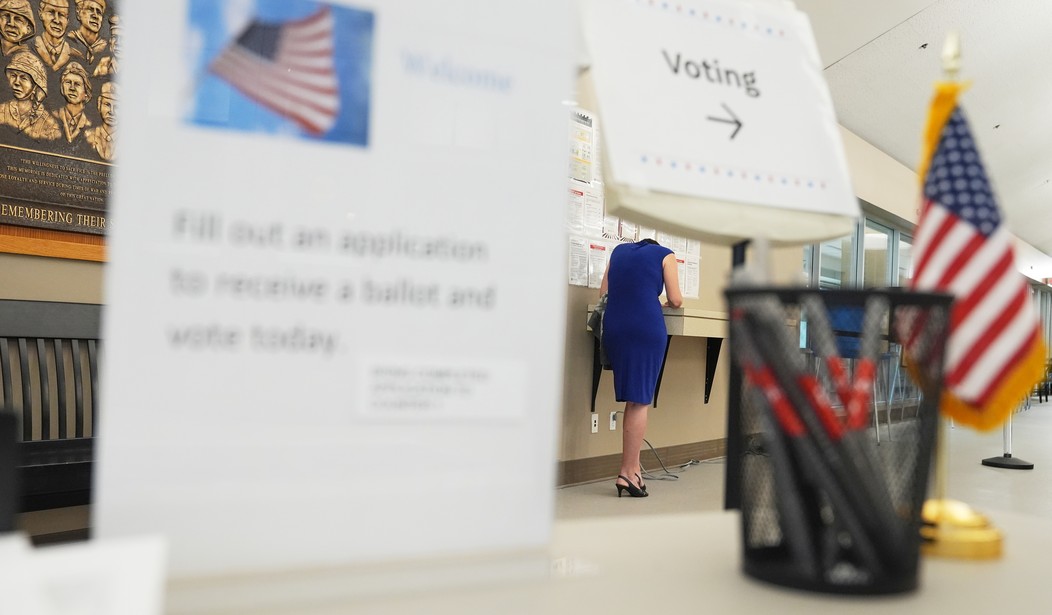
To attend the 2024 Democratic National Convention in Chicago, delegates appeared in person with valid identification to collect credentials. Certain areas required a name- and photo-specific Secret Service credential. The party that has spent years characterizing voter ID laws as voter suppression ran one of the most credentialed events in recent American political history. I've always found the gap between what they practice and what they prescribe worth noting. But the ID argument is the small fight. The one that landed in the Supreme Court today is bigger.
The Court's majority issued an emergency order staying the injunction that had blocked DHS's revamped Systematic Alien Verification for Entitlements program, SAVE, from being used for state voter citizenship checks. "The Federal Government has an obligation to respond to requests from state and local election officials seeking to verify the citizenship of voters," the majority wrote. The statutory basis is 8 U.S.C. § 1373(c), which requires federal immigration authorities to respond to lawful citizenship inquiries from state and local agencies. SAVE runs while the underlying case continues. Both parties immediately declared the order proves their point, which is generally a sign that neither read it carefully.
Democrat politicians aren't generally opposed to election integrity as a concept. They verbally support accurate voter rolls, post-election audits, cybersecurity, ballot tracking, prosecution of actual fraud, and defense against foreign interference. But they also actively defend third-party ballot collection — California legalized ballot harvesting in 2016, and several other states have followed. Their objections are specific: strict photo ID laws, documentary citizenship requirements at registration, and the use of databases to remove or challenge voters without proper verification and due process. Those are legitimate concerns, as long as they don't become a standing excuse to block every enforcement mechanism on the table.
SAVE has real limitations. It was built to verify immigration status for benefits programs, not to function as a master roster of every American citizen. Native-born citizens, naturalized citizens with incomplete federal records, and people with name-and-date mismatches can generate inconclusive results. Texas officials referred 117 people for investigation but also acknowledged that nearly 600 flagged voters were U.S. citizens. In Travis County alone, between 10 percent and 21 percent of SAVE-flagged voters were citizens. One more thing today's order doesn't change: the National Voter Registration Act generally prohibits systematic voter roll removals within 90 days of a federal election. States can run checks and pursue individual cases. Mass purges before November aren't coming.
The underlying problem is real, though. On Sept. 18, DOJ announced charges against 16 people involving illegal voting and related election crimes across Texas and Georgia, most involving noncitizens who registered while falsely attesting U.S. citizenship. Among them: Monica Carzoli, a Mexican national and lawful permanent resident, charged in Del Rio, Texas, with voting in the 2024 election. Reuters reported that DOJ charged roughly 20 people that month under the federal prohibition on noncitizen voting, representing about 13 percent of all prosecutions under that statute in roughly three decades. Florida officials announced 20 more charges Wednesday for voter fraud. These aren't database anomalies. They're named defendants with attorneys.
Noncitizen registration is only one thread. Investigators have documented voter registrations filed to vacant lots and abandoned addresses in multiple states, exploiting the honor-system attestation model the NVRA depends on. Separately, prosecutors have alleged that homeless individuals were paid to register and vote in coordinated schemes, with organizers supplying false addresses to anchor the registration. That's not a database mismatch or an immigration gray area. It's vote buying, and it's prosecutable under 52 U.S.C. § 10307. The fact that ballot harvesting makes these schemes easier to execute isn't a partisan talking point. It's a design problem.
The broader ID picture is still worth the paragraph. Since May 7, 2025, adults 18 and older need a REAL ID-compliant credential to board a domestic flight. Buying a firearm from a licensed dealer requires a government-issued photo ID and a federal background check. Thirty-six states have some form of voter ID law. Free photo ID, broad document acceptance, and a provisional ballot option make the access objection manageable — if anyone funds the infrastructure to back it up. According to Pew Research, 83 percent of Americans favor requiring all voters to show government-issued ID to vote.
An honest election integrity package doesn't force a binary choice. Require citizenship attestation under penalty of perjury at registration, backed by prosecution where evidence supports it. Use SAVE as an investigative lead, not a final determination, and give flagged voters prompt notice and a genuine opportunity to correct the record. Fund accessible photo ID with broad acceptance standards. Regulate third-party ballot collection with chain-of-custody requirements and criminal penalties for paid collection schemes. Conduct roll maintenance well ahead of election deadlines with public audit records and bipartisan oversight. Draw a clean line between evidence of actual illegal votes and database mismatches, as conflating the two produces bad policy and gives both sides cover to misrepresent what's happening.
The government carries two obligations, not one: keep ineligible voters off the rolls and protect every eligible citizen's right to vote. Those aren't competing goals unless you need them to be. The noncitizens charged this month are real. So are the 600 Texas voters falsely flagged as suspects. So are the people allegedly registered to empty lots. All of it is happening in the same country at the same time. A political culture that treats one set of facts as urgent and another as inconvenient has made its priorities clear, and they don't include elections that actually work. Heraclitus said character is destiny. That applies to political parties, too.
Jay Rogers is a financial professional with more than 30 years of experience in private equity, private credit, hedge funds, and wealth management. He writes about issues in finance, constitutional law, national security, human nature, and public policy.
Editor’s Note: Do you enjoy Townhall’s conservative reporting that takes on the radical Left and woke media? Support our work so that we can continue to bring you the truth.
Join Townhall VIP and use promo code FIGHT to receive 60% off your membership.


Join the Conversation
VIP members get the ability to comment on articles.