







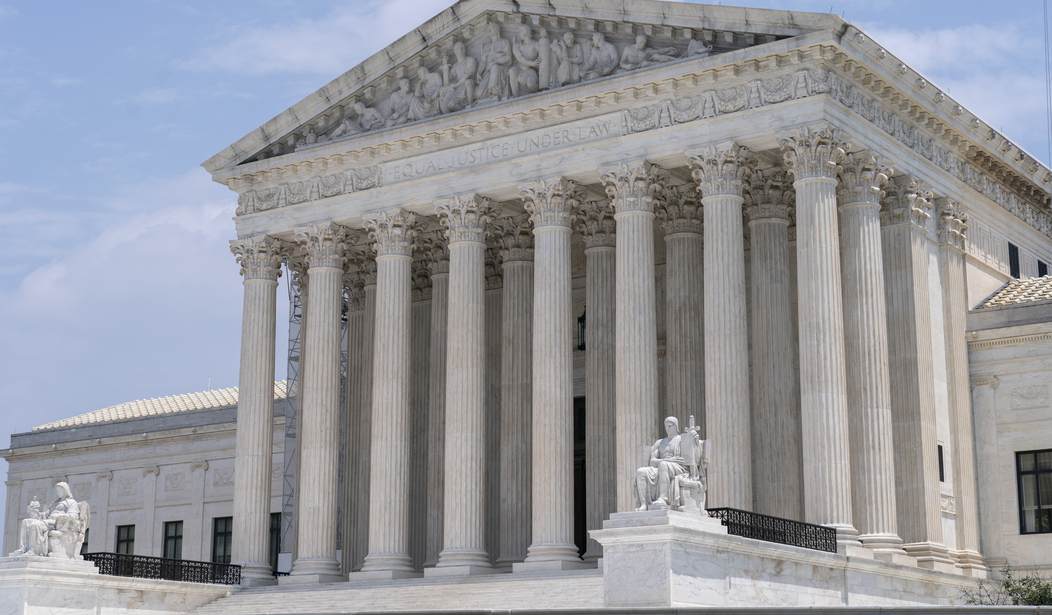
After the U.S. Supreme Court curtailed the powers of federal agencies in two cases last week, progressive critics predictably complained that the decisions favored "big business," "corporate interests" and "the wealthy and powerful." That gloss overlooked the reality that people with little wealth or power frequently are forced to contend with overweening bureaucrats who invent their own authority and play by their own rules.
In the more consequential case, the court repudiated the Chevron doctrine, which required that judges defer to a federal agency's "permissible" interpretation of an "ambiguous" statute. The majority said that rule, which the court established in 1984, was unworkable, creating "an eternal fog of uncertainty" about what the law allows or requires, and fundamentally misguided, allowing the executive branch to usurp a judicial function.
Although People for the American Way perceived a win for "the corporate interests that have been itching to gut the power of federal agencies to protect our health and welfare," the dispute at the center of the case complicates that picture. Two family-owned fishing operations objected to onerous regulatory fees they said had never been authorized by Congress.
In a concurring opinion, Justice Neil Gorsuch noted other examples of vulnerable supplicants who suffer when agencies are free to rewrite the laws under which they operate. He cited cases involving a veteran seeking disability benefits and an immigrant fighting to remain in the country.
Because of an arbitrary rule the Department of Veterans Affairs invented for its own convenience, Thomas Buffington lost three years of disability benefits the government owed him. Alfonzo De Niz Robles faced deportation and separation from his American wife and children after the Board of Immigration Appeals overturned a judicial precedent on which he and many other immigrants had relied for relief.
"Sophisticated entities and their lawyers may be able to keep pace with rule changes affecting their rights and responsibilities," Gorsuch noted. They can lobby for "reasonable" agency interpretations and "even capture the agencies that issue them."
By contrast, Gorsuch added, "ordinary people can do none of those things. They are the ones who suffer the worst kind of regulatory whiplash" when the law changes according to bureaucratic whims.
In another case, the court ruled that the Seventh Amendment requires jury trials for people accused of securities fraud. The majority said the Securities and Exchange Commission had violated that right by imposing civil penalties via internal proceedings in which the agency itself served as investigator, prosecutor and judge, with only minimal independent review after the fact.
The petitioner in that case was a hedge fund manager accused of lying to clients and inflating his fees. The progressive outlet Common Dreams decried a "victory for the wealthy and powerful." But the SEC's rigged process, in which the agency almost always prevailed, also affected people of modest means facing more dubious allegations.
Consider accountant Michelle Cochran, a single mother of two who was hit with a $22,500 fine and a five-year ban on practicing before the SEC after in-house proceedings in which she represented herself. When the agency investigated her former employer, it concluded that she had "failed to complete auditing checklists," leaving some sections blank, although there was "no evidence" that the incomplete paperwork had caused "monetary harm to clients or investors."
The SEC, Gorsuch noted, sought to "penalize citizens without a jury, without an independent judge, and under procedures foreign to our courts." That approach, he said, violated constitutional constraints that "ensure even the least popular among us has an independent judge and a jury of his peers resolve his case under procedures designed to ensure a fair trial in a fair forum."
Defenders of the administrative state seem to assume that federal agencies inerrantly target greedy villains who bilk the unwary, undermine public safety or threaten the environment. But "while incursions on old rights may begin in cases against the unpopular," Gorsuch observed, "they rarely end there."



Join the Conversation
VIP members get the ability to comment on articles.