







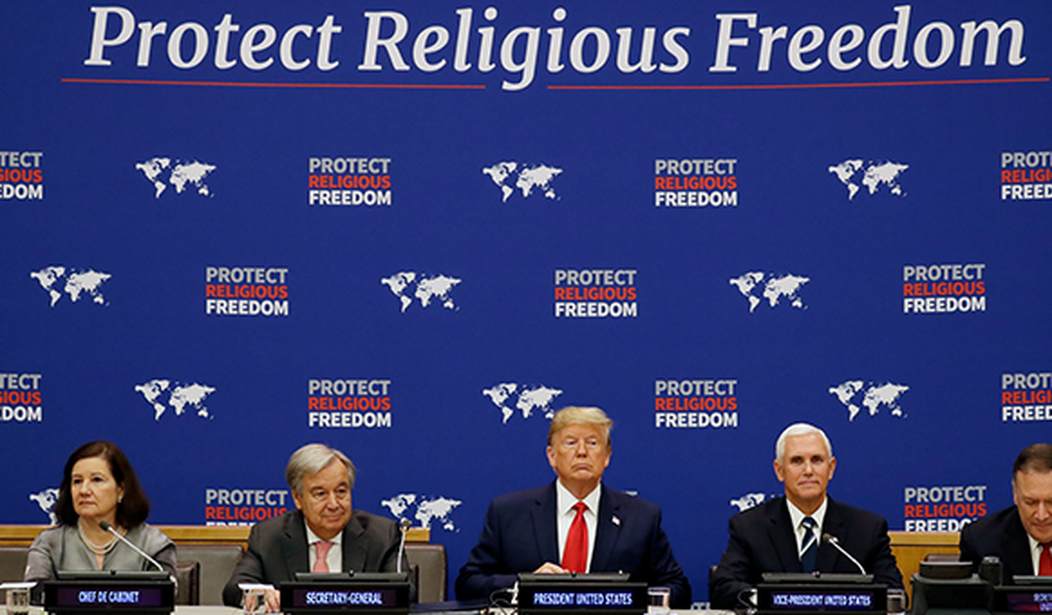
The celebration of Easter this week was conspicuously constrained by government policies aimed at limiting the spread of COVID-19, which affected travel, family gatherings and church services throughout the country. But in an encouraging sign that the Constitution still means something in these extraordinary times, one of those policies was defeated by the First Amendment's guarantee of religious freedom.
On Saturday, a federal judge issued a temporary restraining order against Louisville, Kentucky, Mayor Greg Fischer, who had unilaterally banned drive-in Easter services, even when they complied with social distancing rules. "On Holy Thursday, an American mayor criminalized the communal celebration of Easter," U.S. District Judge Justin Walker wrote. "The Mayor's decision is stunning. And it is, 'beyond all reason,' unconstitutional."
Walker's decision allowed On Fire Christian Center to proceed with its plan for an Easter service in the church's parking lot. The plan, as described by Walker, required congregants to remain in their cars, parked at least six feet apart "with windows no more than half open for the entirety of the service," led by a pastor standing outside "at a distance from the cars."
Those precautions should have been enough to address legitimate concerns about virus transmission. But they did not satisfy Fischer, who last Friday decreed that drive-in services would not be allowed and said Louisville police would enforce his ban by recording the license plate numbers of violators and reporting them to the city's public health department.
As it happens, this week marks the 30th anniversary of a decision in which the Supreme Court said the First Amendment does not relieve Americans of the duty to obey a "neutral, generally applicable law" that prohibits religiously motivated conduct. That case involved the Native American Church's ritual use of peyote, which the Court said Oregon could constitutionally ban under a general law prohibiting drug possession.
But as the Court made clear three years later, when it overturned a ban on ritual animal sacrifice that Hialeah, Florida, enacted in response to the establishment of a new Santeria church, a law can be neutral and generally applicable on its face but religiously discriminatory in practice, which makes it inconsistent with the First Amendment. Fischer's ban on drive-in Easter services, which was ostensibly a disease control measure but explicitly targeted Christian churches, was neither neutral nor generally applicable.
As Walker pointed out, Louisville allows "drive-through restaurants and liquor stores," and it has not imposed any general restrictions on cars in parking lots. The disparate treatment illustrates the arbitrary distinctions drawn by many lockdown orders. "If beer is 'essential,'" Walker suggested, "so is Easter."
A policy that applies specifically to religious activities, the judge said, is subject to "the most rigorous of scrutiny." That means the policy must be "narrowly tailored" to achieve a "compelling" government interest.
Walker concluded that Fischer's edict was "not even close" to satisfying that test. It would be even harder for the ban to pass muster under Kentucky's Religious Freedom Restoration Act, which prohibits any legal restriction that "substantially burden(s)" religious freedom unless the government can show by "clear and convincing evidence" that the policy is "the least restrictive means" to further a compelling interest.
The same constitutional analysis would apply to Greenville, Mississippi, Mayor Errick Simmons' campaign against drive-in churchgoers there, who on Sunday received $500 citations. Simmons now says those fines will not be collected.
Bans on regular church services, imposed as part of broad rules against large public gatherings, present different issues, given their general applicability and the increased risk of virus transmission in such situations. But they still might be vulnerable under state laws like Kentucky's, depending on the precautions churches are prepared to take.
In the meantime, Walker's decision gives hope to those of us who worry that politicians are too quick to sacrifice civil liberties on the altar of public health. Although "the COVID-19 pandemic has upended every aspect of our lives," he declared, "constitutional rights still exist."
Jacob Sullum is a senior editor at Reason magazine. Follow him on Twitter: @JacobSullum. To find out more about Jacob Sullum and read features by other Creators Syndicate writers and cartoonists, visit the Creators Syndicate webpage at www.creators.com.


Join the Conversation
VIP members get the ability to comment on articles.