





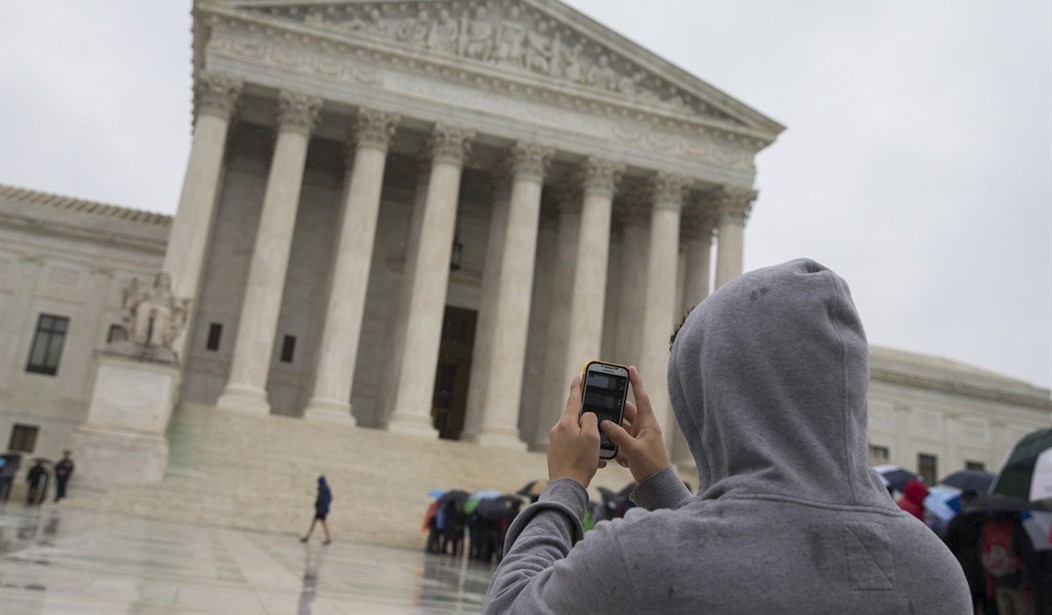
That is the implication of a recent federal appeals court decision that said the government needs a warrant to obtain cellphone location records. While the conclusion is welcome, it can be reconciled with Supreme Court precedents concerning voluntarily disclosed information only by assuming that people do not understand that their cellphones are also tracking devices.
Cellphones have to know where you are in order to work. They are in constant communication with a network of transceivers through the nearest one, and when you make or receive calls, the location of that cell site is part of the information retained by your carrier for billing purposes.
Those records are a trove of personal information because they reveal where you've been throughout the day, every day, for the past year (and possibly longer, depending on your carrier's retention policy). A string of Supreme Court decisions dealing with business records nevertheless suggests that the Fourth Amendment, which bans "unreasonable searches," imposes no restrictions on the government's ability to peruse this information.
That was the conclusion reached by the U.S. Court of Appeals for the 5th Circuit last year. "Cell site data are business records and should be analyzed under that line of Supreme Court precedent," the 5th Circuit said. The Supreme Court repeatedly has held that "a person has no legitimate expectation of privacy in information he voluntarily turns over to third parties."
According to the "third party doctrine," such information has only as much protection as legislators decide to give it. A 2012 investigation by the American Civil Liberties Union found that police often obtain cellphone location data, including real-time tracking as well as records, without a court order of any kind.
Last week the U.S. Court of Appeals for the 11th Circuit ruled that such warrantless surveillance is unconstitutional because "cell site location information is within the subscriber's reasonable expectation of privacy." The case involved a robbery suspect, Quartavious Davis, who was linked to various crime scenes through data obtained from his cellphone company, and the decision hinged on Davis' technological cluelessness.
During Davis' trial, the 11th Circuit noted, a prosecutor conceded that Davis and an accomplice "probably had no idea" they were revealing their whereabouts by using their cellphones. If so, the court said, it hardly seems reasonable to say they voluntarily shared that information.
Instead of being treated like business records, the 11th Circuit said, cellphone location data should be viewed as similar to the information at issue in U.S. v. Jones, the 2012 case in which the Supreme Court ruled that tracking a suspected drug dealer's car by attaching a GPS device to it amounts to a search under the Fourth Amendment. In fact, the appeals court said, obtaining cellphone data is even more intrusive, because cars generally remain in public places, while mobile phones go everywhere.
"The exposure of the cell site location information can convert what would otherwise be a private event into a public one," the court said. "When one's whereabouts are not public, then one may have a reasonable expectation of privacy in those whereabouts. ... There is a reasonable privacy interest in being near the home of a lover, or a dispensary of medication, or a place of worship, or a house of ill repute."
The 11th Circuit is right that people reasonably expect to keep such details private, which is why the Supreme Court should reconsider the misguided notion that information shared with anyone is thereby shared with the government. But the appeals court's solution, which relies on the principle that you can't agree to disclose information when you do not realize you are disclosing it, is viable only as long as people remain ignorant of the ways in which their constant electronic companions can betray them. If you have read this column, it's too late for you.



Join the Conversation
VIP members get the ability to comment on articles.