







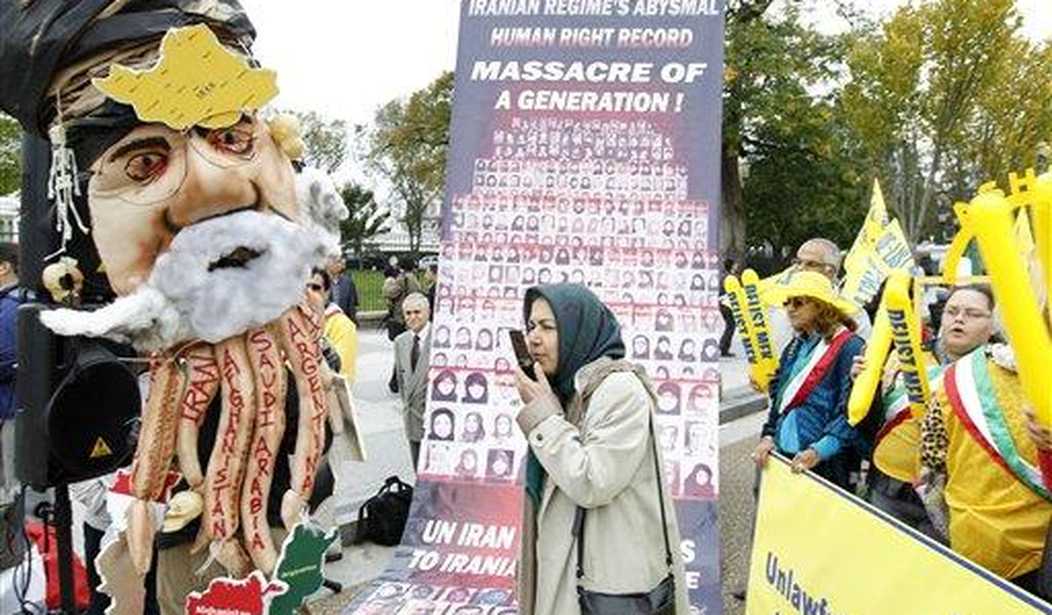
In the summer of 1988, the Iranian regime committed genocide. That is one of the key takeaways from the final report issued by Javaid Rehman, the UN special rapporteur for the situation of human rights in Iran, who concludes his mandate this month before passing the baton to Japanese lawyer Mai Sato. Rehman’s report focused in part on the 1988 massacre of political prisoners, which claimed as many as 30,000 victims. He noted that this and a series of underlying mass killings were justified by the clerical regime as attacks on “enemies of Islam,” therein signaling a goal of religiously motivated extermination in keeping with the definition of genocide.
The main target of the 1988 massacre was the leading pro-democracy opposition group, the People’s Mojahedin Organization of Iran (PMOI/MEK). Although this group was and remains political in its construction, Rehman’s report observed that “in so far as the Iranian theocracy was concerned, the PMOI was perceived as a religious group,” namely one that posed a challenge to the regime’s fundamentalist and statist interpretation of Islam. The report also quoted a former clerical judge in the regime’s “revolutionary court” as saying in 1980 that the PMOI “are worse than the infidels” and not entitled to so much as the right to life, partly because of the appeal they were able to demonstrate among Iran’s “pure, credulous, truthful young people.”
This remains a motivator for crackdowns on the PMOI even today. Since 2014, the opposition movement has maintained a nationwide network of “Resistance Units,” comprised mostly of youths, to advocate for open revolt against the theocratic dictatorship. The efforts of those Resistance Units have since paid off in the form of multiple nationwide uprisings, including the one that was sparked in September 2022. It was widely recognized as the greatest challenge to the ruling system since its establishment in the wake of the 1979 revolution.
Javaid Rehman’s final report underscores the tremendous horrors that the Iranian regime is capable of, while the historical context serves as a warning as to how easily those past horrors could be repeated. According to the PMOI, the regime’s initial crackdown on the 2022 uprising killed at least 750 people, and although this is nowhere near the level of mass killing seen in the 1980s, it is alarmingly coincidental that the number of people arrested during the uprising was roughly equivalent to the number killed in the summer of 1988.
At least nine protesters were executed, several of them for “enmity against God,” the same charge that then-Supreme Leader Ruhollah Khomeini cited to justify the indiscriminate execution of PMOI members all across Iran in 1988. Dozens of similar death sentences are believed to remain pending. Meanwhile, the regime is in the midst of an overall surge of executions that human rights organizations attribute to the goal of intimidating the public into silence.
More than 850 people were executed for various charges in 2023 alone. Around two dozen more executions have been carried out just since this past Saturday – a clear indication that even as the two-year anniversary of the latest uprising approaches, the regime remains deeply concerned about the renewal of public unrest, especially as organized by the PMOI and the nation’s activist youth.
The persistence of that dissent should inspire the international community with hope regarding the triumph of democracy in Iran. But the latest killings, carried out against the backdrop of a history of human rights abuses including genocide, should also raise concerns about the possibility of future massacres of political prisoners by an increasingly panicked and vulnerable regime. Rehman’s report arguably encourages those concerns, but also provides the international community with guidelines for how to respond to them.
“The Special Rapporteur has consistently called for the establishment of an independent international investigative and accountability mechanism to advance truth, justice and accountability for the victims including by gathering, consolidating and preserving evidence with a view towards future prosecutions,” the report concludes.
Rehman laments the fact that no one has been held legally accountable for the 1988 massacre, with the sole exception of former prison guard Hamid Noury, and he was released in an ill-considered prisoner exchange for two Swedish nationals this year. The outgoing rapporteur’s findings also serve to illustrate how such decisions have encouraged a sense of impunity within the regime that reinforce the underlying culture of human rights abuses, including the cover-up of the massacre itself and the longstanding harassment of victims’ families.
But the report also conveys well-founded optimism about the prospect of the international community confronting Tehran over its past and ongoing crimes against humanity. The establishment of a formal commission of inquiry is perhaps the first and most essential step in that direction, but in order to truly hold the Iranian regime accountable for its historical willingness to commit genocide, Western powers must be prepared to take the findings from that inquiry and invoke the principle of universal jurisdiction to arrest culpable Iranian officials and file charges either in their own court systems or at the International Criminal Court.

Join the Conversation
VIP members get the ability to comment on articles.