





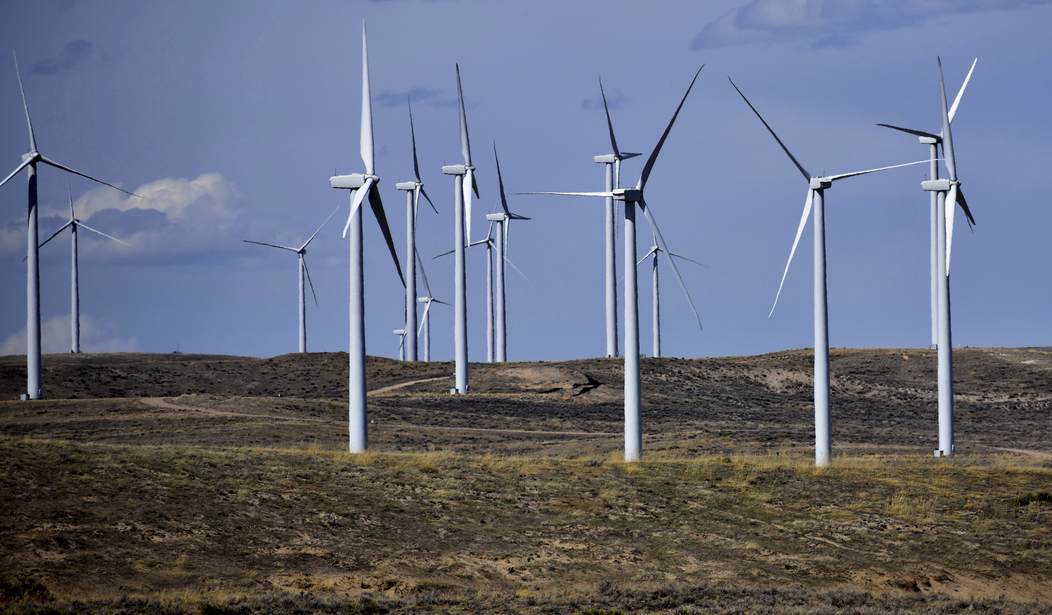
For more than a decade, the United States has been guided by a story about energy that presents wind power as one of the few responsible paths forward. The idea has been repeated so often that it eventually stopped sounding like a policy proposal and began to sound like a moral duty.
Wind energy was described as the answer to climate change, the way to rebuild American manufacturing, and even a strategy to strengthen national security. Once that view became popular in national politics, questioning it was treated as a refusal to accept science rather than an effort to understand the actual costs and tradeoffs.
The problem is that this story never came from a neutral scientific study. It came from a mix of international institutions, corporate lobbying efforts, and foreign governments that realized they could benefit from it. China benefited more than anyone else. What American leaders described as a clean-energy transition became, in practice, a significant transfer of industrial power to a competing nation that understood the economic opportunities far earlier than the United States did.
China's rise in the renewable-energy market was a direct result of Western governments focusing more on climate politics than on common sense. While American and European leaders focused on emissions pledges and public messaging, China built the factories and rare-earth mining operations needed to dominate the global wind-turbine market.
Today, Chinese companies control more than 70 percent of the world's wind-turbine supply chain and more than 80 percent of the rare-earth materials needed for turbine generators and other green-energy technologies. That dominance was built through state subsidies, centralized financing, and government direction that enabled Chinese producers to undercut American and European manufacturers, leaving most unable to compete.
This created an apparent contradiction: The United States now relies on China for the equipment that supposedly underpins American "energy independence." Democrats rarely acknowledge this because it raises an uncomfortable question. How can a country strengthen its strategic position by depending on a foreign rival for the core parts of its energy system?
The question only grows once China's own energy system is considered. While the United States has closed more than 300 coal plants since 2010, China has expanded coal use on a massive scale, adding roughly two new coal plants per week in recent years.
Those plants provide the power needed to run the factories that build wind turbines for export. As a result, American emissions fell on paper while global emissions continued to rise, simply shifting from one country to another.
This is the difference between symbolic climate policy and real environmental change, and for years, the United States has chosen symbolism.
A significant reason the Green Scam continues is the way climate science is communicated. Many people assume the United Nations' climate reports are released exactly as written by scientists. In reality, draft reports are reviewed and edited by government officials before publication.
The summaries—usually the only parts the public sees—are negotiated line by line to ensure the final language supports specific policy priorities.
Science relies on open debate, repetition of results, and the ability to test conclusions, not on political negotiation. When science is filtered through policymakers before reaching the public, it becomes messaging rather than fact, and messaging cannot guide a country's energy strategy.
This problem becomes even clearer when looking at who speaks publicly about climate science.
Many of the most visible voices do not work in climate modeling, atmospheric physics, or geophysics. Their backgrounds are often in unrelated fields, but because their views align with the dominant narrative, they are presented as experts. The scientific method requires observation and evidence. Public debates often rely on authority and repetition.
Wind energy shows what happens when climate policy is shaped by politics instead of evidence. In practice, U.S. wind turbines operate at capacity factors between 32-35 percent, meaning they produce far less energy than their maximum output most of the time.
Because wind is intermittent, states still depend on natural gas or coal to keep the grid stable. That dependence increases system-wide costs. States that built wind energy the fastest—notably California and New York—saw retail electricity prices rise far above the national average over the past decade. Taxpayers also fund new transmission lines, grid upgrades, and the costs of turbine retirement.
Wind turbines are often placed along major bird-migration pathways, leading to significant declines in bird populations, including protected species such as golden and bald eagles. Estimates from the U.S. Fish and Wildlife Service indicate wind turbines kill between 500,000 and 700,000 birds in the United States each year, with some studies suggesting totals above one million.
China benefits from all of these outcomes. It exports turbines, grows its industrial power, and expands its influence in global supply chains. The United States, meanwhile, accepts higher energy costs, greater grid instability, and increased dependence on foreign manufacturing, all while believing it has taken the lead on climate issues.
For extended commentary, listen to "Brief America With Gregory Lyakhov" here.
Editor’s Note: Do you enjoy Townhall’s conservative reporting and opinion? Support our work by joining Townhall VIP! Use the promo code FIGHT to get 60% off your VIP membership!


Join the Conversation
VIP members get the ability to comment on articles.