





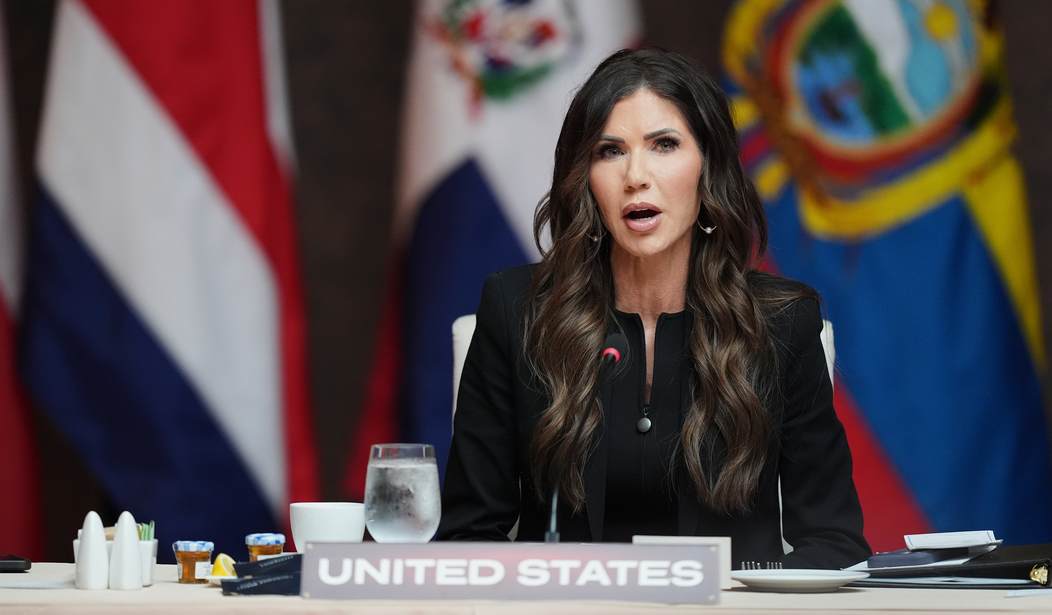
The rapid evolution of U.S. national security strategy in the Western Hemisphere has taken a decisive turn with the launch of the “Shield of the Americas”—a multinational initiative that is already reshaping diplomatic, military, and law enforcement cooperation across the region.
In the wake of former Homeland Security Secretary Kristi Noem’s reassignment as Special Envoy and her engagements over the past weeks with Ecuadorian leadership, in addition to meeting with leaders across Latin America, the importance of this initiative has come into sharper focus.
Far from a symbolic gesture, the Shield represents a strategic recalibration grounded in urgent realities: transnational crime, migration pressures at their origin, and, in the process, intensifying geopolitical "soft power" competition.
But at its core, the Shield of the Americas is a coordinated security coalition designed to combat drug cartels, disrupt trafficking networks, and address illegal migration through joint intelligence and military cooperation. Its formation in March 2026 brought together more than a dozen nations from Latin America and the Caribbean, signaling a renewed emphasis on hemispheric alignment, truly at a time when these threats have become unprecedentedly transnational.
The timing is not coincidental. The United States continues to face unprecedented challenges tied to fentanyl and synthetic opioid trafficking—much of it linked to cartel networks operating across borders. These organizations are no longer localized criminal enterprises; they are sophisticated, multi-billion-dollar operations with global reach.
The Shield’s emphasis on intelligence sharing and coordinated enforcement acknowledges a simple truth: no single country can address this threat alone.
And this is where Noem’s visit becomes especially significant.
Her final stop of Ecuador, for example, has emerged as a frontline state in the fight against narcotrafficking, with its geographic position making it a key transit hub for drugs moving from South America to North American and European markets. Recent joint U.S.-Ecuador operations underscore both the urgency of the challenge and the necessity of partnership.
In turn, the Shield provides the institutional framework to scale such cooperation—transforming ad hoc engagements into sustained, strategic collaboration.
Critically, the initiative also reflects a broader geopolitical imperative. The Western Hemisphere is increasingly contested terrain, with China expanding its economic and political influence through infrastructure investments, telecommunications, and resource extraction. The Shield of the Americas explicitly seeks to counter this influence by strengthening alliances and reinforcing U.S. leadership in the region.
In this sense, the initiative is not only about security—it is about shaping the future alignment of the Americas in a rapidly evolving global order.
Skeptics have raised concerns about the militarized aspects of the Shield, noting that its emphasis on coordinated military action represents a departure from more traditional, law enforcement–centric approaches. Yet this critique overlooks the scale and sophistication of the threat landscape.
Cartels today operate with capabilities that rival those of insurgent groups, leveraging advanced technology, financial networks, and paramilitary tactics. Addressing such threats requires a commensurate response.
Moreover, the Shield is not solely a military construct. It is a platform for comprehensive engagement—encompassing intelligence sharing, economic cooperation, and governance initiatives. By aligning participating countries around shared objectives, it creates the conditions for more effective, coordinated action across multiple domains.
Noem’s role as Special Envoy is central to this effort. Her mandate is not merely diplomatic; it is operational, tasked with translating high-level agreements into actionable partnerships on the ground. Her track record has her primed for success. And this week, her engagement with Ecuadorian leadership exemplified this approach, reinforcing bilateral ties while advancing the broader objectives of the coalition.
Ultimately, the importance of the Shield of the Americas lies in its recognition of interconnected realities. Drug trafficking fuels migration; migration strains border systems; geopolitical competition exploits instability. Addressing these challenges in isolation is no longer viable.
The Shield offers a different model—one rooted in collective action, shared responsibility, and strategic alignment. In doing so, it marks a significant evolution in U.S. foreign policy toward the region, one that acknowledges both the risks and the opportunities of a more integrated hemispheric approach.
As Noem’s visit demonstrates, the success of this initiative will depend not on rhetoric, but on execution.
If the Shield can translate its ambitious vision into tangible results—disrupting cartels, strengthening partnerships, and stabilizing key regions—it may well prove to be one of the most consequential security initiatives in the Americas in decades.
Editor’s Note: Thanks to President Trump, illegal immigration into our great country has virtually stopped. Despite the radical left's lies, new legislation wasn't needed to secure our border, just a new president.
Help us continue to report the truth about the president's border policies and mass deportations. Townhall VIP and use promo code FIGHT to receive 60% off your membership.


Join the Conversation
VIP members get the ability to comment on articles.