





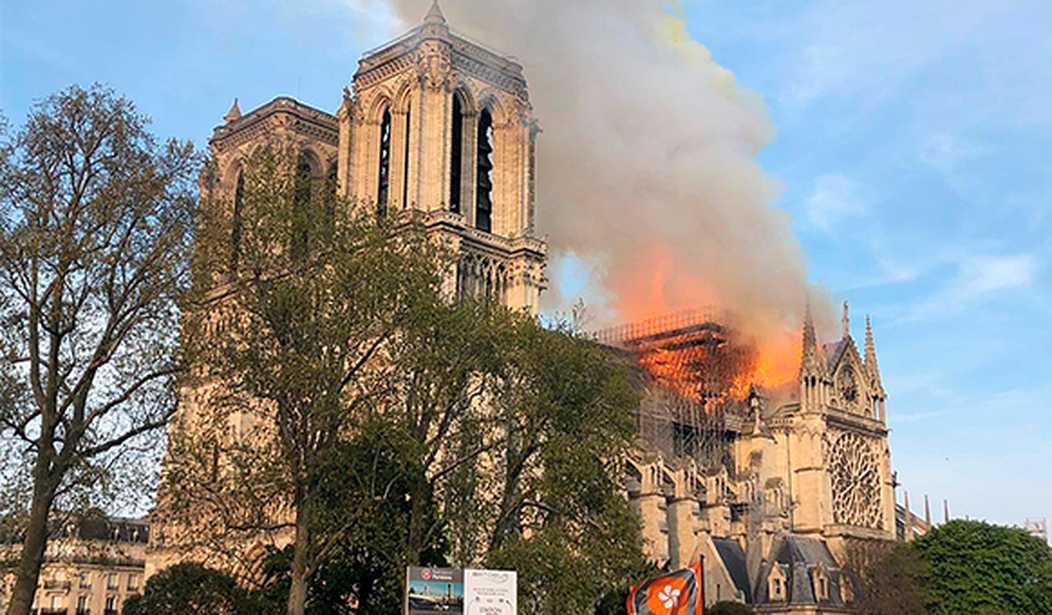
It was shocking to watch Notre Dame Cathedral burning up 800 years of history on live TV, but that’s exactly what happened on Monday. Cable news went wall-to-wall with the devastation, replaying the moment the spire fell like it was the Zapruder film in Oliver Stone’s “JFK.” A total loss, they declared. Only it wasn’t, not even close. What was reported as the worst thing ever wasn’t all that bad, or at least not nearly as bad as it looked or could have been. So why the pearl-clutching and declarations?
Early on in my career and fresh out of college, I dated a 19-year-old intern when I was working at the Heritage Foundation. The difference between my age and hers is only relevant in that it fell in the time between where the Internet was available everywhere and where it was not. I could check my email at school, though I never really got any because it was barely used. She came of age with chat rooms, AOL instant messenger, LiveJournals, Friendster, MySpace, etc. It was a major generation gap based solely on technology.
It wasn’t called social media at the time, but it was the beginning of the anti-social behavior that new genre would usher in.
We dated for two and a half years and that difference between her and other girls I’d dated, those who did not grow up immersed in the immediacy of the Internet, was stark.
Everything was turned up to 11 for dramatic effect. If we were going somewhere and she was dragging her feet getting ready, I’d remind her we have to go and her response was to tell me to stop yelling. I wasn’t. She didn’t dislike anyone or not enjoy something, it was always “hate.” Not literal hate, but always painted as such.
There was something about growing up with the immediacy of everything at your fingertips, even over dial-up, that had changed the culture and the people immersed in it that I had difficulty recognizing.
It’s been awhile since 2002, when we started dating, and I’ve become immersed in that culture myself, as has everyone else. But I was reminded of that “generation gap” watching the coverage of the Notre Dame fire and the social media reaction to it.
A friend posted on Facebook their sorrow over the “fact” that their kids would never see the cathedral. Universally there was nothing but despair that the 12th century structure was lost forever.
Watching the story and reading the reactions Monday, I knew that wasn’t the case. Less than 80 years ago, even though Paris was spared, the rest of Europe was flattened; destroyed during World War II. But today, you’d barely notice it. If you didn’t know Munich was rubble, you’d swear it was exactly the way it’d always been. Berlin was gone, but Berlin looks like it always had.
After WWII, citizens of Europe not only committed themselves to rebuilding, they committed to rebuilding pretty much the way it was. Of course, some things are irreplaceable, but human beings have the ability to replicate nearly anything. This reality was exchanged for dramatic effect and ahistorical hyperbole Monday. That, in no small part, is due to the mentality ushered in by social media.
People don’t seem to want to hear that everything will be alright. They don’t even seem to want to hear that things might not be as bad as they seem or be told to have patience and wait before jumping to any conclusions. Monday became a rush to be the most saddened, the most upset, and to declare the worst possible outcome.
Social media has replaced what used to be a dimmer switch with a toggle switch. No longer are reactions measured, the emotions are either on or off. How much that has to do with the immediacy of the Internet culture and how much that has to do with the fact that everyone has an audience at their disposal is something for people smarter than me to figure out, but our culture has changed significantly, and not for the better.
The damage to Notre Dame was, thankfully, not anywhere near as bad as the coverage of it live insisted it would be, which makes sense since stone does not burn and the flammable material was hundreds of feet up. Something no one even dared point out at the time.
Wealthy Parisians stepped up with nearly a billion dollars pledged to repair the roof, and the French government promised to have it back in 5 years. Naturally, this idea was poo-pooed by the same Internet that had gotten everything up to that point wrong. But this beautiful testament to western civilization and Catholicism will be back because it never really was destroyed, only damaged.
Human beings can fix anything physical, no matter how old it is (though hopefully the new roof won’t be made of wood, only made to look like wood). What we might not be able to fix is the damage done to a culture that demands immediacy when patience is required. The next tragedy will again quickly be declared the worst thing ever before anyone knows how bad it is. But when it comes to the culture transformed by the likes of Facebook, Twitter, and the desire for attention and validation, if we don’t get a handle our use of that, it could actually be devastation from which we are unable to recover.

Join the Conversation
VIP members get the ability to comment on articles.