








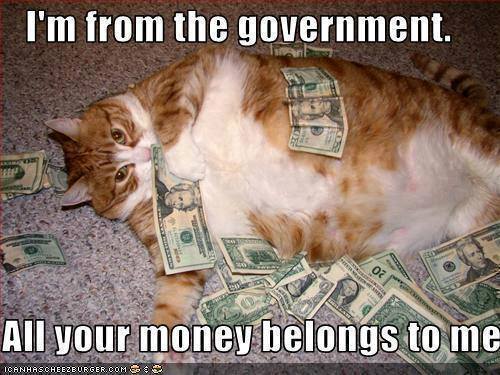
I’ve sometimes asserted, only half-jokingly, that statists believe all of our income belongs to the government and that we should be grateful if we’re allowed to keep any slice of what we earn.
This is, at least in part, the mentality behind the “tax expenditure” concept, which creates a false equivalence between spending programs and provisions of the tax code that allow people to keep greater amounts of their own income.
Here’s how I characterized this moral blindness when criticizing a Washington Post columnist back in 2013.
Hiatt presumably thinks that the government’s decision not to impose double taxation is somehow akin to a giveaway. But that only makes sense if you assume that government has a preemptive claim to all private income. …Hiatt wants us the think that there’s no moral, ethical, or economic difference between giving person A $5,000 of other people’s money and person B being allowed to keep $5,000 of his or her own money.
Today, I have a particularly absurd real-world illustration of this statist mindset.
Two writers for the Wonkblog section of the Washington Post recently wrote an article entitled, “The rich get government handouts just like the poor. Here are 10 of them.”
Did their list of 10 “handouts” include the Export-Import Bank, which lines the pockets of big corporations? Nope.
Did it include agriculture subsidies, which provide unearned goodies for big agribusiness firms? Nope.
Did it the TARP bailout, which shielded Wall Street fatcats from capitalism? Nope.
And how about subsidized terrorism insurance, ethanol goodies, and green energy subsidies? Nope, nope, and nope.
Or the handouts in Obamacare for major pharmaceutical companies and big insurance companies? Nope and nope.
Instead, every single “handout” that the rich “get” from government is nothing more than a provision of the tax code that lets people keep more of their own money.
I’m not joking. Here’s the list, followed by my two cents.
1. The mortgage interest deduction for big houses and second homes.
As I’ve previously explained, I don’t think the tax code should be tilted in favor of residential real estate. But a handout is when the government takes money from Person A and gives it to Person B.
2. The yacht tax deduction.
There actually isn’t a yacht tax deduction, but if you can live in something, it can be eligible for a mortgage interest deduction. I don’t think that’s wise tax policy, but it’s not an example of government taking from Person A and giving to Person B.
3. Rental property.
The authors appear to be upset that people running a business get to subtract costs from gross income when calculating net income. But that’s exactly how businesses are supposed to be taxed. And even if one thought, for some odd reason, that gross income was the right tax base, this still isn’t an example of government taking from Person A to give to Person B.
4. Fancy business meals.
As just noted, businesses should be taxed on profits rather than gross receipts. Well, profits are the difference between total income and total costs, including the cost of business-related meals. And even if one thinks that folks in business are lying and mischaracterizing personal meals, they’re not spending other people’s money. No funds are being taken from Person A and being given to Person B.
5. The capital gains tax rate.
In a good tax system, there’s no double taxation of income that is saved and invested, so the capital gains tax should be abolished. As such, the “preferential” rate in the current system is more accurately characterized as a mitigation of a penalty. But even if one believes that saving and investment should be double taxed, a lower capital gains tax rate doesn’t take money from Person A to give to Person B.
6. The estate tax.
The death tax is triple taxation, so it also should be abolished. Regardless, letting a family hold onto its own money is not the same as taking from Person A to give to Person B.
7. Gambling loss deductions.
The government taxes gamblers on their net winnings (if any), which is the proper approach. And even if the government gave a deduction for net losses (which isn’t the case), this wouldn’t be an example of taking from Person A and giving to Person B.
8. The Social Security earnings limit.
The Social Security system is supposed to be social insurance, and one of the implications of this approach is that there’s a limit on the benefits one can receive and the payments one has to make. As such, it’s silly to assert that the “wage base cap” is somehow improper. But even if one believed in turning Social Security into a pure redistribution scheme, the existing earnings limit simply means a cap on what the government takes. There’s no coerced handout from Person A to Person B.
9. Retirement plans.
The bad news is that we have pervasive double taxation in the internal revenue code. The good news is that some forms of retirement savings, such as IRAs and 401(k)s, are protected from double taxation. That protection does not require any money being taken from Person A and given to Person B.
10. Tax prep.
I’m not a fan of companies like H&R Block that benefit from an unfair and convoluted tax code. Under a simple and fair system like the flat tax, they would go out of business. But a deduction for tax preparation costs simply allows a taxpayer to keep more of his or her income. There’s no handout from Person A to Person B.
In case you didn’t notice, there’s a strong moral component to my argument. The leftists think you’re getting a handout if you get to keep more of your own money.
And it’s also economically illiterate when applied to provisions of the tax code that make sense, such as companies getting to subtract expenses when calculating taxable income.
Or individuals not being subjected to double taxation.




Join the Conversation
VIP members get the ability to comment on articles.