








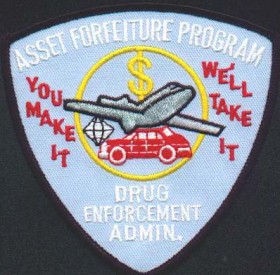
I’ve already written about the despicable practice of “civil forfeiture,” which allows governments to confiscate the property of innocent people who have not been convicted of any crime.
And I’ve cited great columns on the issue from George Will and John Stossel., as well a sobering report on the topic from the Wall Street Journal.
Now the Institute for Justice has a video that should outrage any decent person.
It’s examples of government thuggery like this that make me a libertarian. You should be one as well.
If you need more convincing, check out these horror stories of statist abuse.
- A story of vicious IRS persecution.
- A women jailed overnight because she let her kids play outside.
- Threatening to send a woman to jail because someone whistled at a whale.
- Two stories of innocent people who were victimized by the idiotic Drug War.
- A video about how the EPA tried – and fortunately failed – to destroy a family.
- A story about the Justice Department’s discriminatory attack on a hapless homeowner.
- The government treating child molesters more leniently than people who accidentally omit irrelevant info from forms
But let’s end on a happy note, with a few jokes about cops, one sympathetic, one mocking, and one political.
Free Markets Protect Consumers with “Mutually Reinforcing” Private Regulation
I’ve written before about the heavy costs of regulation, including these rather sobering statistics. Or, to be more accurate, here are some staggering numbers.
- Americans spend 8.8 billion hours every year filling out government forms.
- The economy-wide cost of regulation is now $1.75 trillion.
- For every bureaucrat at a regulatory agency, 100 jobs are destroyed in the economy’s productive sector.
But a lot of people don’t focus on the cost of regulation. They are motivated instead by a desire to protect themselves against unknown risks, which they assume are exacerbated by companies that are greedy for short-run profits.
I acknowledged this concern in the November issue of Townhall magazine.
…it is difficult—or even impossible—for the average consumer to gauge safety. Are we flying on a well-maintained plane? Are we eating food that is free of salmonella and botulism? Is our workplace protected against dangerous machinery? Are our children vulnerable to chemical exposure? Since the vast majority of people have no way of answering these questions, we shouldn’t be surprised that many of them want some sort of independent oversight—especially since they suspect that businesses will be tempted to cut corners. After all, less money spent on health and safety means more profit for shareholders.
But I also explained how the free market produces very effective forms of private regulation.
…the desire for profits creates a big incentive for businesses to use good practices while producing safe and effective products. Imagine you’re the CEO of a major airline, and one day all the regulatory agencies disappear. Are you going to stop maintaining your planes? At the risk of stating the obvious, the answer is no. One disaster could be the death knell for an airline, particularly if there were the slightest hint that the company was skimping on upkeep. Moreover, it’s highly unlikely that investors would plow money into an airline when share value could disappear overnight because of an accident. And banks presumably would be leery about lending to an airline that faced the risk of quick bankruptcy. Moreover, insurance companies would have a very strong incentive to monitor the safety practices of the airline— and keep in mind no bank would lend money to an airline that lacked insurance. In other words, the competitive marketplace can be viewed as a very effective form of regulation. Instead of rules and red tape from Washington, the profit motive creates mutually reinforcing oversight.
This “mutually reinforcing oversight” does not guarantee that business won’t cut corners and/or make mistakes. But, then again, regulation from politicians and bureaucrats don’t stop that from happening either.

The key question to ask is which approach achieves the best results at the lowest cost.
The answer is the free market, though augmented by government regulations that pass a cost-benefit test, the tort system to discourage bad business behavior such as negligence, and the criminal justice system to fight behaviors such as fraud.
There will be a debate, of course, on where to draw the line. But one thing I can say for sure is that an intelligent system will never produce these examples of bureaucratic idiocy.
- Putting a store out of business for selling toy guns.
- Regulations making it difficult for trucking firms to weed out drunk drivers.
- Year-long sting operations by federal milk police.
- Rules harassing coffee shops with bikini-clad sales staff.
- OSHA requirements for expensive safety harnesses for people working 11 feet off the ground.
- Rules from the EEOC for “pee-shy” employees.
- The IRS making banks put foreign tax law above US tax law.
Remember, if government is the answer, you’ve asked a very strange question.


Join the Conversation
VIP members get the ability to comment on articles.