





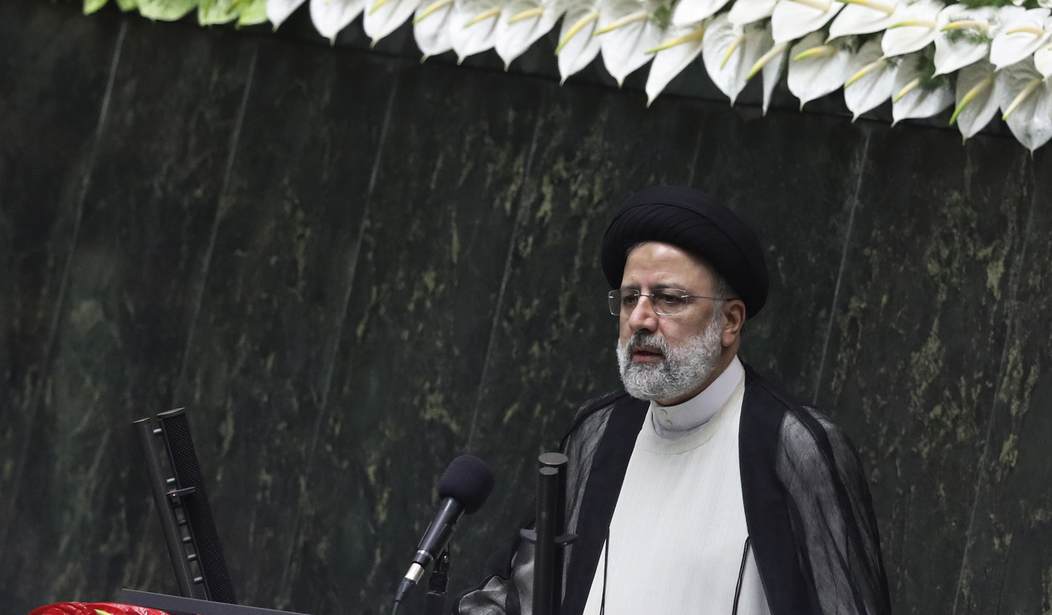
Last week, Ebrahim Raisi officially took over the government of Iran.
With blood still dripping from his hands from the 1988 massacre of political prisoners,
he is recognized as the most hated president in Iran. Unfortunately, Western countries
have turned a blind eye to the crimes committed by Raisi, and the European Union has sent
Enrique Mora, its deputy secretary-general of the External Action Service to Tehran as the EU representative for the inauguration ceremony.
Amnesty International issued a statement protesting the dispatching of an EU envoy to attend the inauguration of Ebrahim Raisi. On June 19, 2021, the organization called for a UN inquiry into Raisi’s leading role in crimes against humanity.
On November 4, 2019, the US Treasury Department placed Ebrahim Raisi on a sanctions list along with eight other close associates of Ali Khamenei for their role in "repressions inside and outside Iran" and human rights abuses.
Nevertheless, both Europe and the United States are still seeking to negotiate with the regime and have stated that they are ready to negotiate with the new Iranian government, instead of using this leverage of the illegitimate presidency to increase pressure on the Iranian regime - which is what most Iranians want.
They should force the regime to respect human rights, withdraw from plans to acquire
nuclear weapons and ballistic missiles, and to adhere to non-interference in the affairs
of other countries through proxy terrorists.
On the one hand, 42 years of experience has proven that this regime understands no language
other than that of force, and if the world tries to reconcile with this regime by appeasement,
the result will be none other than what we are witnessing these days: a frail but power-hungry
a regime that is carrying out terrorist acts against merchant ships and tankers in international waters.
On the other hand, the Iranian regime is almost completely paralyzed due to widespread government corruption as well as the pressures of sanctions and is losing control inside Iran.
The Iranian people are in the worst living conditions due to unemployment, skyrocketing prices, and inflation above 50%, which they did not face even during the Iran-Iraq War or World War II,
and now 80% of the people live below the poverty line. That is why Iranian society is like a barrel of gunpowder that can explode with any spark.
Last month, angry people in most cities of the oil-rich Khuzestan province staged large-scale
protests over the unprincipled policies of the Revolutionary Guards to build dams in the province, which has dried up the province's rivers and destroyed agricultural products and livestock.
Khamenei, who is unable to respond to the demands of the people due to institutionalized corruption in all his apparatuses, sent his repressive forces to disperse them by beating and shooting. As a result of his reaction, dozens of people in different cities of the province were killed or wounded and hundreds were arrested and sent to prisons.
This reaction of the regime, however, did not silence the people of Khuzestan. Instead,
it made the people of other provinces take to the streets in support of the people of Khuzestan,
staging large demonstrations and chanting "Death to the dictator" and "Death to Khamenei"
to show their disgust with this government.
This frightened Khamenei, who, in a propaganda speech to absolve himself of fault for shortcomings, admitted that the people had the right to be dissatisfied with the situation and to protest.
The government was also forced to open sluices of the dams to allow some water to flow back into the rivers and temporarily silence the protests.
Prior to that, the deprived people of Sistan and Baluchestan province in eastern Iran,
especially in the city of Saravan, had revolted due to poverty and unemployment, but again faced the repressive forces of the Revolutionary Guards, and a number of people were killed, wounded, and arrested.
Additionally, the spread of COVID-19 throughout Iran has gotten out of control and has reached a slaughter point, to the extent that Iran currently has the highest mortality rate of this disease compared to its population in the world.
According to reliable reports, more than 350,000 people have died due to this disease in Iran and now between 2 and 3 thousand people die in different cities of Iran every day.
All hospitals are full of patients and they cannot accept any more patients.
In addition, there is a shortage of oxygen and even dextrose saline. In addition to corruption in all government agencies, this situation arose especially in the Ministry of Health,
due to Ali Khamenei's opposition to importing vaccines and his empty promises about the production of domestic vaccines. Now, while most countries are getting close to over 50% vaccination only less than 4% of the Iranian population has been fully vaccinated, most of whom being repressive security forces, the Revolutionary Guards, the mullahs, the regime leaders, and their families.
All these reasons and evidence indicate that the vast majority of Iranians want regime change and its replacement with a democratic system based on the separation of religion and state,
and this demand was clearly expressed in the boycott of the recent elections. In this election,
only about 10% of eligible voters went to the polls, most of whom were either members and affiliates of the security forces and the Revolutionary Guards, or affiliates of the regime and those who benefited the most from these conditions.
It is obvious that no regime with such conditions can last long. Sooner or later, the Iranian people, who revolted against the dictatorship of the Shah hoping to have freedom and a better life, but now are disillusioned with the mullahs' regime and they have nothing to lose and will rise in masses against it.
Western governments, especially the United States, can play an important role in this and stand by the Iranian people. The right policy is not carried out by re-establishing economic relations and injecting blood into the dying body of the dictatorship of the mullahs. The right policy is not achieved through direct intervention, nor by appeasing and giving respiratory relief to a dying regime, on the contrary by not only continuing the sanctions but adding to them.
Cyrus Yaqubi is a Research Analyst and Iranian Foreign Affairs Commentator investigating the social issues and economy of the middle east countries in general and Iran in particular.
The Right Policy Towards the New President of Iran, Ebrahim Raisi
Opinion
The opinions expressed by columnists are their own and do not necessarily represent the views of Townhall.com.
Advertisement
Advertisement

Join the Conversation
VIP members get the ability to comment on articles.