





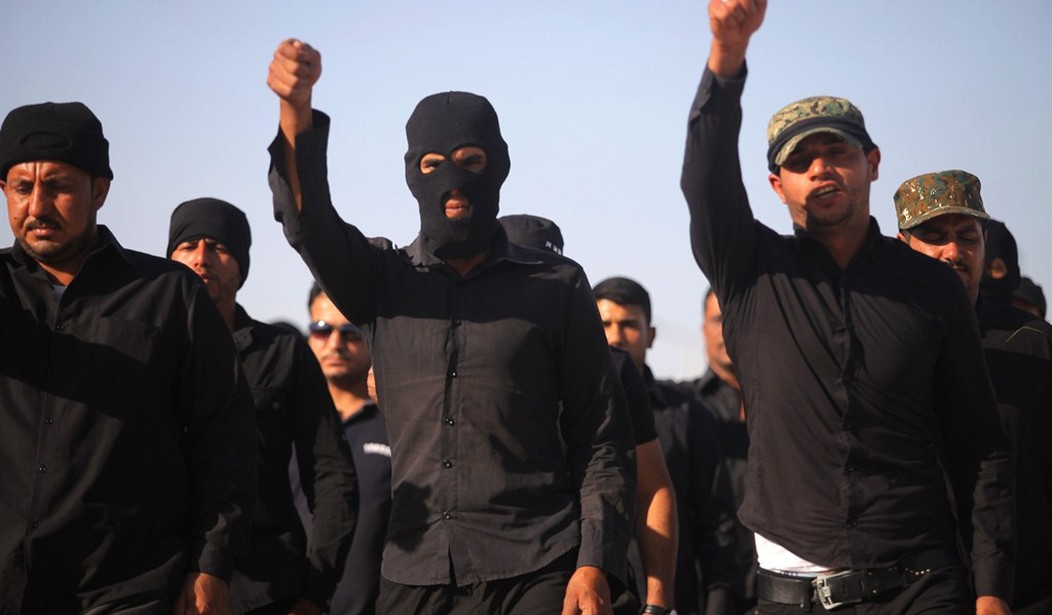
The largest and most expensive embassy in the world is in Baghdad. President George W. Bush built it in the hope, perhaps the expectation, that before long, it would house envoys to the first democratic American ally in the Arab world. It hasn’t quite worked out that way. With terrorists on the march throughout an expanding swath of Iraq, the State Department last weekend began to evacuate “substantial” numbers of diplomats. Meanwhile, dozens of Marines are being sent in.
Many blame Mr. Bush for this failure: In the aftermath of the attacks of Sept. 11, 2001, they say, he should have kept his eye on the ball — the ball being al Qaeda, and perhaps the terrorist-sponsoring regime in Iran. Instead, he toppled Iraqi dictator Saddam Hussein.
Others argue that after the “surge” — which dealt devastating defeats to both al Qaeda in Iraq and Iranian-backed Shia militias — Mr. Bush left behind a relatively stable and increasingly democratic land. Further progress required that President Obama maintain at least a residual U.S. military presence in Iraq — just as American presidents, Democrats and Republicans alike, have maintained a military presence in South Korea, Japan and Germany long after wars in those countries ended.
This debate will continue, not without acrimony, for years to come. More urgent right now: identifying, preferably on a bipartisan basis, policies that stand the best chance of mitigating a growing, evolving threat.
It’s useful to name that threat, and it was encouraging that Mr. Obama did so last week: “We do have a stake in making sure these jihadists do not gain a permanent foothold in either Iraq or Syria,” he said.
The jihadists to which he refers, of course, belong to ISIS, the Islamic State in Iraq and al-Sham, which rose from the ashes of al Qaeda in Iraq. “Al Sham” implies the Levant: Syria, Lebanon, Jordan, Cyprus, Israel, the West Bank and Gaza. As the name also suggests, ISIS aims to create a state that will join others — al Qaeda-affiliated forces are currently fighting in no fewer than nine countries — to form a new caliphate, an Islamic empire that does not plan to peacefully coexist with “infidel” and Muslim “apostate” states.
Like most other jihadist groups, ISIS acts locally but thinks globally. Its leader, Abu Bakr al-Baghdadi, has promised America “direct confrontation. The sons of Islam have prepared for such a day.” He has added: “Soon we will face you, and we are waiting for this day.”
Some elite analysts and American officials have concluded that the U.S. should make common cause with Iran’s supreme leader, Ayatollah Ali Khamenei against ISIS. Can they really believe that Iran, for years ranked by the U.S. government as the world’s primary state sponsor of terrorism, would be a reliable ally in a war against terrorists? Would you stock a river with crocodiles to solve a piranha problem?
A better approach: Design a strategy to weaken and, over time, defeat all the various jihadist forces threatening us and competing among themselves for dominance over the barbaric new world they envision — a world of beheadings, amputations, crucifixions, summary executions and mass murders; a world in which women are chattel; a world in which religious, ethnic and sexual minorities are brutally persecuted if not “cleansed.”
Such a strategy would integrate multiple components — more than I can detail in a brief column. But economic diplomacy and, in some instances, economic warfare would certainly be among them. For example, The Daily Beast’s Josh Rogin reports that for years ISIS was funded by wealthy donors in Kuwait, Qatar and Saudi Arabia.” Our intelligence community should be able to identify such individuals and, one way or another, stem the flow. (At this point, it’s worth noting that ISIS may have become strong enough to fund itself the old-fashioned way: by taking booty. Last week, its fighters reportedly looted $430 million from a bank in Mosul.)
Energy policies that bolster national security — rather than ship trillions of dollars to people who despise us — are long overdue. It would be in our interest to support proxies willing and able to fight common enemies — as we did during the Cold War. For three years, Syrian nationalists have been asking for the means to fight both Mr. Assad’s forces and the Sunni jihadists. Refusing to support them was not strategic.
Finally, the lesson we learn from recent military interventions cannot be to never again use force — which also would prevent us from credibly threatening to use force. Our enemies need to be convinced that so long as they will not make peace with us, they will not be safe from us; not while they are fighting, not while they are resting, recuperating and plotting. Among other things, this implies that Congress must keep in place, and perhaps expand, the Authorization to Use Military Force.
Years of living dangerously lie ahead. The carnage in Iraq should be a wake-up call for those who haven’t grasped that. We can run — as some on both the left and right are advocating — but we really can’t hide from those who believe it is their religious duty to destroy us.
If we develop a smart strategy and implement it aggressively we still won’t win every battle. That’s an important point, too: In Iraq, as in Syria and Afghanistan, what we have been losing are battles. If we learn from our mistakes — Mr. Bush’s mistakes, Mr. Obama’s mistakes, others’ mistakes — this war is, without question, winnable.


Join the Conversation
VIP members get the ability to comment on articles.