





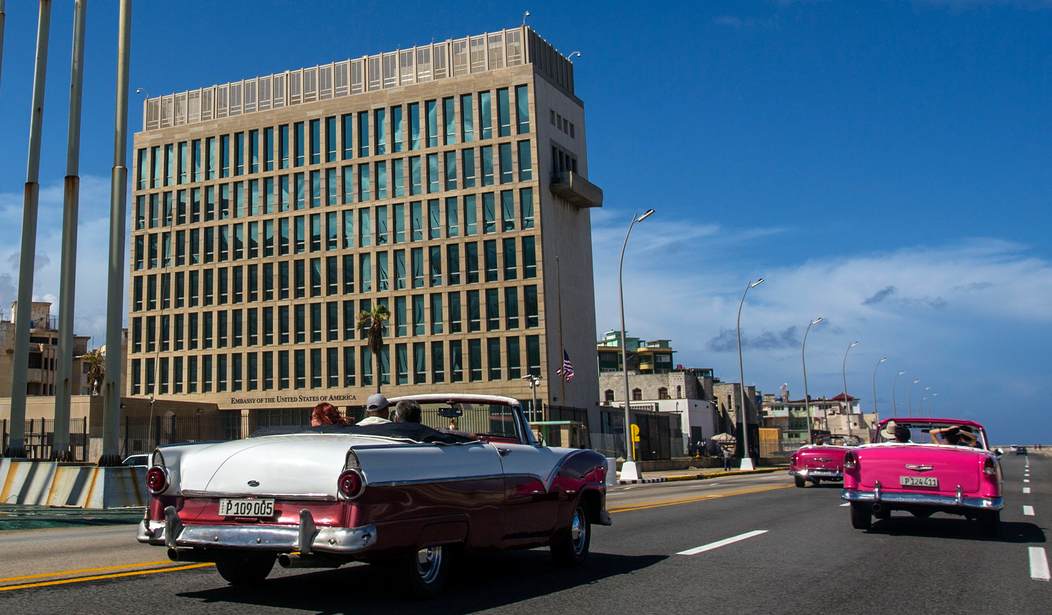
It has been 67 years since Fidel Castro’s communist revolution in Cuba, more than enough time for the regime to create the collectivist utopia it promised at the outset.
In January 1959, riding high after his coup, Castro told the people of Havana, “We have a free country. We do not have censorship and the people can meet freely. We will never use force and the day the people do not want me, I will leave.”
Cuba’s days as a “free country” did not last long.
On May 1, 1961, Castro celebrated May Day with a speech titled “Cuba is a Socialist Nation,” in which he declared the end of elections and the creation of a “new social system called socialism.”
Since then, the Cuban people have suffered massively under socialism.
On nearly every objective social and economic benchmark, the socialist government of Cuba has utterly failed its people.
First and foremost, the command-and-control socialist economic system has made the once-prosperous island a basket case.
The Cuban economy, after more than six decades of socialism, is on the brink of total collapse.
In recent weeks, much has been made of the fact that Cuba has had multiple island-wide power blackouts.
While the lack of electricity and gasoline are monumental problems for a modern economy, it must be noted that Cuba’s economy should not be classified as a modern economy after decades of socialist stagnation.
In truth, 67 years of socialism have mortally wounded the once-thriving island dubbed “America’s playground” before the revolution.
In 2025, the Cuban Observatory of Human Rights issued its eighth Study on the State of Social Rights in Cuba.
According to the report, 89 percent of Cubans live in “extreme poverty,” and 78 percent intend to “emigrate.” Among their top concerns, 72 percent of Cubans fear “blackouts,” 71 percent are worried about lack of “food,” 61 percent are concerned about the “cost of living,” and 42 percent are afraid they won’t have access to “health care and medicine.”
When Cubans were asked their views on the regime, 92 percent disapproved of the government.
Throughout the decades, especially after the collapse of the Soviet Union, which provided ample aid to Cuba, mass famines and other government-induced economic disasters have plagued the island.
For example, Cuba’s infrastructure, particularly its energy grid, is in dire need of repair and modernization. However, the socialist government cannot afford to spend precious resources on projects for basic services because it has no money.
Margaret Thatcher’s quip that “the problem with socialism is that you eventually run out of other people’s money” readily applies to an island like Cuba.
On a domestic level, the Cuban socialist government has already bled its citizens dry. Think of all the productive, enterprising Cubans who left just before Castro’s revolution. Then, consider all those who have risked their lives to escape Cuba over the past 67 years.
Without a doubt, Cuba, like all repressive regimes, has deteriorated due to “brain drain.”
More than half a century of socialism has created a place in which economic incentives do not exist. Cuba’s command-and-control economic system has resulted in 11 million people who are completely dependent on the benevolence of those in power for bare necessities like food, medicine, shelter, and water.
With this being the case, a common question arises: Why don’t the people of Cuba just revolt against the regime? Well, one good answer is that the government has all the guns. Another reason could be fear of retribution.
Under the current socialist system, Cuba is doomed. Just like the Union of Soviet Socialist Republics, which held on for 69 years.
Socialism is antithetical to natural law and human nature; therefore, it is only a matter of time before it implodes on itself.
In the vacuum that could arise in place of a Cuban regime change, it would behoove the good people of Cuba if they were granted their long-overdue freedom and the ability to participate in a market economy.
When the Cuban socialist nightmare finally ends, I hope the values and principles that so many Americans take for granted are finally bestowed upon the 11 million Cubans who deserve so much better than this. All people deserve the dignity of individual choice and the chance to chart their own course in life. Sooner or later, freedom will overcome socialism in Cuba.
Chris Talgo (ctalgo@heartland.org) is editorial director at The Heartland Institute.
Editor’s Note: Do you enjoy Townhall’s conservative reporting that takes on the radical Left and woke media? Support our work so that we can continue to bring you the truth.
Join Townhall VIP and use promo code FIGHT to receive 60% off your membership.

Join the Conversation
VIP members get the ability to comment on articles.