





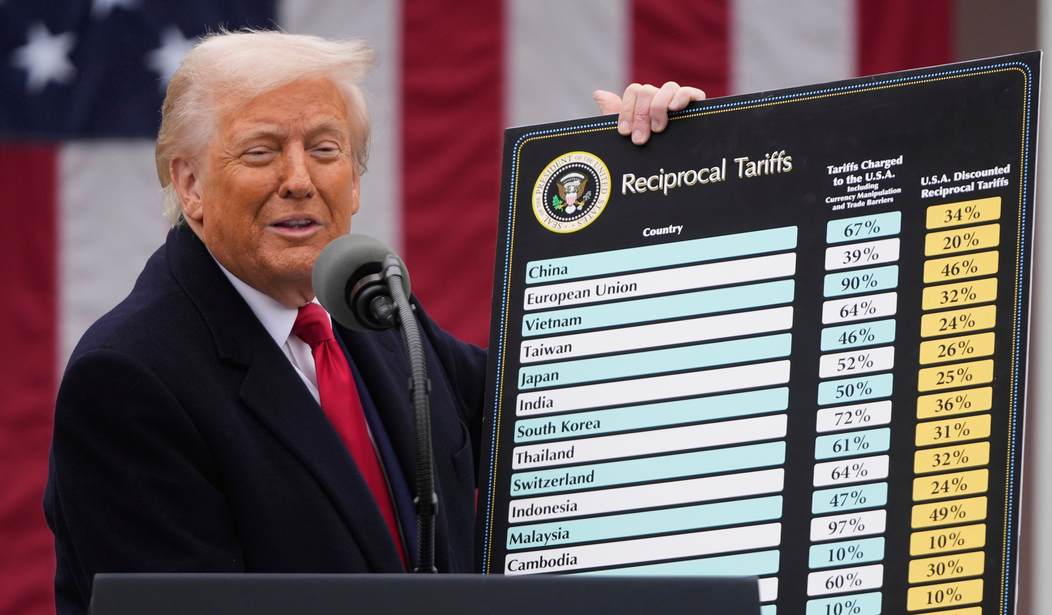
During the Supreme Court’s recent oral arguments regarding President Trump’s tariff policy, Justice Kavanaugh asked a profound question. And the answer should be the end of the debate.
What’s the difference between a tariff and an embargo?
No serious person disputes that a president may order a naval blockade or a full trade embargo in response to foreign threats. That authority flows directly from Article II control over foreign affairs and national defense. A blockade halts trade, disrupts supply chains, raises prices, and requires no prior approval from Congress.
Why? Because in a dangerous world, the executive must be able to act swiftly and decisively to protect the nation.
A tariff is simply the economic equivalent—a softer, more calibrated version of the same tool. A blockade stops goods at sea. A tariff slows dependency at the dock.
One uses force. The other uses price.
Both restrict flows. Both alter incentives. Both impose costs on adversaries. And both are designed to change hostile foreign behavior.
If a president can lawfully impose a 100 percent embargo—the most extreme trade restriction imaginable—then claiming he cannot impose a modest tariff without endless litigation or congressional permission is constitutionally incoherent.
China Shattered the Old Fantasy
For decades, Washington pretended trade was neutral and globalization harmless. China ended that illusion.
Beijing weaponized supply chains—subsidizing entire industries, dumping goods below cost, stealing intellectual property, and making the West dependent on adversaries for everything from pharmaceuticals to rare earths to semiconductors.
This is not free commerce. It is economic warfare.
When trade becomes a battlefield, the tools to counter it stop being “tax policy” and become defensive measures—precisely the domain Article II was designed to address.
Congress, by design, is slow, fragmented, and reactive. The Constitution never required the president to wait for committee hearings while a foreign power hollowed out American industry in real time.
Tariffs Buy Time — They Don’t Freeze Progress
Critics caricature tariffs as protectionist tantrums or backward nostalgia. That’s lazy—and wrong.
Tariffs are not meant to stop innovation or halt technological change. They are meant to buy time in an era of rapid automation and artificial intelligence.
The real danger is not progress. It is progress paired with mass offshoring.
When jobs, factories, and capital all leave at once, societies do not “transition.” They fracture.
Tariffs slow that shock. They give workers time to adapt. They give capital a reason to reinvest at home. They ensure innovation lands inside America’s legal, cultural, and security framework.
That isn’t protectionism. It’s statecraft.
Energy, AI, and National Survival
This is why tariffs must now be understood alongside energy dominance and technological leadership.
You cannot win the AI race, advance medicine, explore space, or maintain military superiority while dependent on adversaries for power, components, or manufacturing capacity. Energy is the bottleneck. Supply chains are the battlefield.
A president who uses tariffs to defend those choke points is not overreaching. He is fulfilling his core constitutional duty.
The Bottom Line
Justice Kavanaugh’s question laid bare the contradiction.
If a president can lawfully shut down trade entirely through an embargo or blockade, then he can certainly modulate trade through tariffs.
One is blunt force. The other is calibrated pressure.
Both are instruments of national defense. Both belong to Article II.
In a world where economic leverage has become the primary arena of conflict, refusing to use these tools is not constitutional restraint.
It is unilateral disarmament.
Editor’s Note: Do you enjoy Townhall’s conservative reporting and opinion? Support our work by joining Townhall VIP! Use the promo code MERRY74 to get 74% off your VIP membership!


Join the Conversation
VIP members get the ability to comment on articles.