





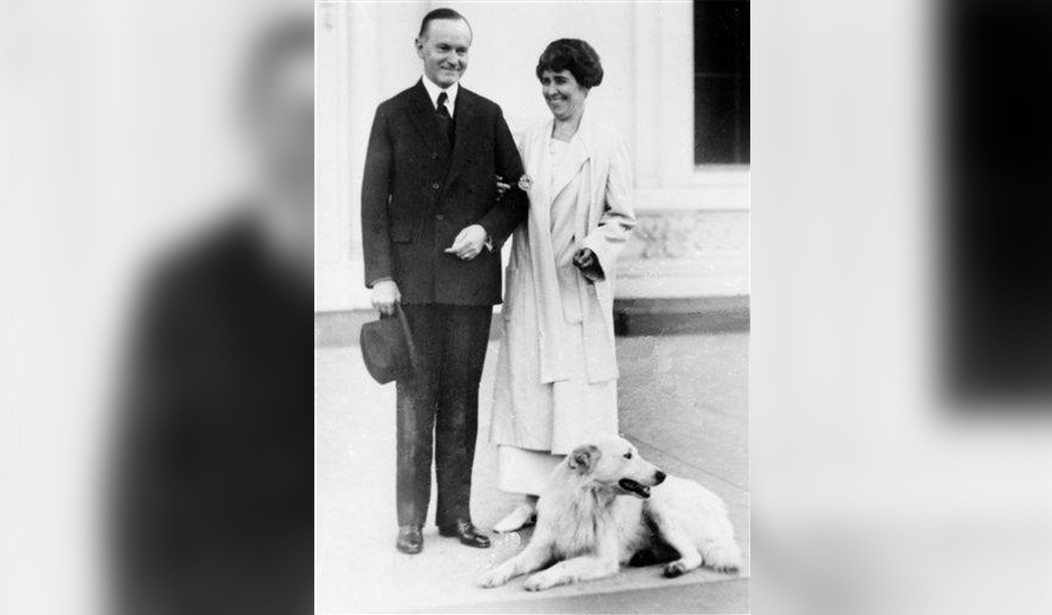
WASHINGTON - How people understand history largely depends on who writes it and from what perspective.
Calvin Coolidge, our 30th president, has received what might be called a raw deal from historians like Arthur Schlesinger Jr. and Henry Steele Commager, among others. They created a caricature of Coolidge that includes blaming him for the Great Depression, which began in 1929, the year after he left office. In fact, it was the policies of his successors, Herbert Hoover and Franklin Roosevelt that turned an economic downturn into a 10-year disaster.
A symposium at the Library of Congress on the occasion of the 100th anniversary of Coolidge's ascension to the presidency aims to change that perception. As a relative of the Coolidge family, I was among those invited to speak.
Coolidge cut taxes because he wanted the people to "have more," but as importantly, he radically reduced government spending. He took a knife to government agencies, believing that "The collection of taxes which are not absolutely required, which do not beyond reasonable doubt contribute to public welfare, is only a species of legalized larceny. Under this Republic the rewards of industry belong to those who earn them."
How odd that sounds in our era of entitlement and big government. I drive the streets of my hometown and see building after federal building, some consuming entire blocks, housing people who do what? Education? Energy? Transportation? What are they doing to improve young minds and acquire fuel at affordable prices? What is transportation doing in light of the train derailment in Ohio? The ineffective Transportation secretary, Pete Buttigieg, blames the Trump administration for the train wreck. Please!
Former Indiana governor and Purdue University president Mitch Daniels called Coolidge "counter cultural, misunderstood and misrepresented by statists." Statism in the 1920s (and again today) was rapidly advancing. Benito Mussolini ruled Italy, believing "Everything within the state; nothing outside the state; nothing against the state."
Joseph Stalin, head of the Soviet Union from 1924 to 1953, began his series of five-year plans, which led to a forced famine. Thus began a series of state interventions in all areas of life extending from Turkey to Saudi Arabia and including France and Belgium, as historian Paul Johnson has noted. Coolidge believed government should be restrained from such intrusions because the Constitution limits it.
William Beach, a commissioner at the Bureau of Labor Statistics, said Coolidge was "the greatest budget president in history," reducing the federal debt by one-fourth. Today that debt is $31 trillion and rising. Coolidge, not to mention the Founders, would be appalled at the lack of self-control and government's failure to live within the record amount of revenue taxpayers provide Washington.
As is the case today, progressivism was on the march in the 1920s. Between 1923 and 1929, President Coolidge, Treasury Secretary Andrew Mellon and Congress repeatedly cut taxes, reducing the top marginal tax rate from 73 percent in 1920 when Warren Harding was president, to 25 percent by 1925 when Coolidge was president.
You can't get more counter-cultural than that - then or today.
Speaking about the Declaration of Independence on its 150th anniversary, Coolidge said the Declaration at its core was a great "spiritual" document: "We cannot continue to enjoy the result if we neglect and abandon the cause."
From what we see today, it appears we are doing precisely that. Do we think America can escape the fate of other nations who have followed similar paths of statism, massive national debt, uncontrolled migration and the abandonment of shared and unchanging moral principles?
As Coolidge said: "Unless the people, through unified action, arise and take charge of their government, they will find that their government has taken charge of them. Independence and liberty will be gone, and the general public will find itself in a condition of servitude to an aggregation of organized and selfish interest."


Join the Conversation
VIP members get the ability to comment on articles.