





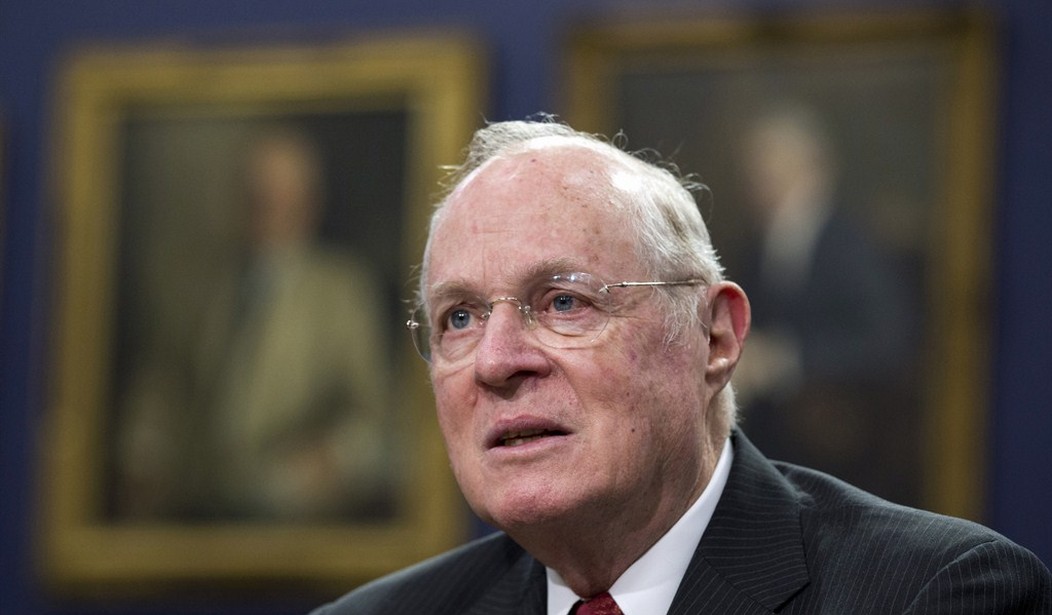
In 2-1/2 hours of oral arguments before the U.S. Supreme Court Tuesday, Justice Anthony Kennedy asked the right question: whether it is appropriate for the Court to discard a definition of marriage that "has been with us for millennia," adding, "it's very difficult for the court to say, 'Oh, well, we know better.' "
Kennedy, who is regarded as the swing vote on this and many other controversial issues, may not answer his own question the way proponents of traditional marriage wish, but the question is not rhetorical. Should this court, or any court, re-define and force the states to accept a new definition of marriage that will not only affect same-sex couples, but open the door to other petitioners, for example, polygamists, who wish to "marry" more than one person?
If human history, tradition, the Bible, the Constitution and biology are to be ignored or re-defined, on what basis do courts say "no" to anything? If "equality" and "fairness" are the new standard, one might as well have no standard at all because such emotional appeals could justify any relationship or form of behavior.
The problem for traditionalists -- especially those who believe scripture is the sole authority in such matters -- is that in an increasingly secular society where younger people are less attuned to appeals about an Authority higher than themselves, how can they be persuaded that same-sex marriage is a bridge too far? After all, don't they "know" gay people, whom they regard as wonderful and kind? That "standard" becomes subjective and when it reaches the level of personal feelings it becomes a shifting boundary that is drawn in invisible ink rather than set in stone.
Only two years ago, in the case of "U.S. v. Windsor," which argued whether the IRS could give federal tax benefits to all legally married homosexuals, regardless of state law, Justice Kennedy warned it was wrong for courts to "put a thumb on the scales and influence a state's decision as to shape its own marriage laws." And now this court could do precisely that.
Chief Justice John Roberts told the plaintiff's attorneys on Tuesday, "But if you prevail here, there will be no more debate. ... People feel very differently about something if they have a chance to vote on it than if it's imposed on them by the courts."
Yes, they do, which is why, as Justice Antonin Scalia noted; only 11 states have done so by a "vote of the people or the legislature."
To the surprise of conservatives, liberal Justice Stephen Breyer echoed Kennedy's concern: "The opposite rule has been the law everywhere for thousands of years.... And, suddenly, you want nine people outside the ballot box to require states, that don't want to do it, to change what you've heard ... change what marriage is to include gay people."
That is precisely what the advocates for same-sex marriage want, just as the pro-abortion movement wanted the same court 42 years ago, in "Roe v. Wade," to discard state laws protecting the unborn. That 1973 decision continues to stir controversy and should be a lesson to the court not to make a similar mistake with marriage.
Here is the real problem: If people worship pleasure and material things, they are more likely to get leaders who give them what they want instead of what they need to hold society together. If we erase the boundaries that have guided humanity for generations, we weaken our society.
A verse from the Book of Judges seems to define America in 2015, as we sink deeper into a moral and cultural morass: "In those days Israel had no king; everyone did as he saw fit." (Judges 21:25)
Join the Conversation
VIP members get the ability to comment on articles.