





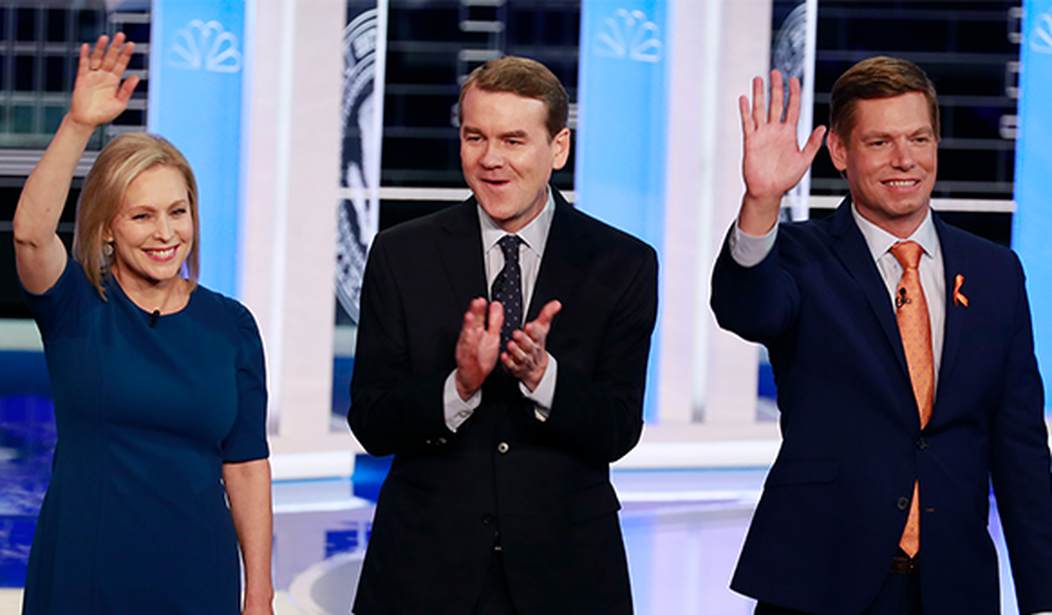
Twenty Democratic presidential candidates will debate Tuesday and Wednesday night. It will be the last time voters will see some of them on a debate stage.
The Democratic National Committee's rules for inclusion in early debates -- the first from NBC in late June in Miami, and the second from CNN this week in Detroit -- were quite generous. If Sen. Michael Bennet -- currently polling at 0.2 percent in the RealClearPolitics average of national polls -- got in both, then it's safe to say the rules were not terribly restrictive.
But that's over after Detroit. Party rules call for new qualification standards for candidates in the next debate, scheduled for September in Houston. Candidates will be required to meet a new polling standard and a new donations standard.
To make it onstage, candidates will have to "receive two percent or more support in at least four polls (which may be national polls, or polls in Iowa, New Hampshire, South Carolina, and/or Nevada)," according to the DNC. The committee went on to list several specifications for the polls themselves to make sure the candidates can cite support in legitimate surveys.
Beyond that, the DNC says, candidates must show they have received donations from at least 130,000 unique donors, plus at least 400 unique donors in at least 20 states. Together, those rules will eliminate a lot of current Democratic candidates.
Right now in the RealClearPolitics average of national polls, just seven candidates are polling at 2.0 percent or higher: Joe Biden, Elizabeth Warren, Bernie Sanders, Kamala Harris, Pete Buttigieg, Andrew Yang and Beto O'Rourke. If they stay that way, they will be in the September debate.
That means 13 candidates are below 2.0 percent: Cory Booker, Amy Klobuchar, Tulsi Gabbard, Julian Castro, Bill de Blasio, Kirsten Gillibrand, John Delaney, Marianne Williamson, Steve Bullock, John Hickenlooper, Tim Ryan, Michael Bennet, and Jay Inslee. (Two more candidates, Tom Steyer and Joe Sestak, entered the race too late to make the current field.)
A few of those might make it to September by hitting the 2.0 percent mark in an early-voting state. For example, Booker is currently at 2.5 percent in the RealClearPolitics average of Iowa polls. So he, and perhaps others, might make it in on that basis.
But even if a candidate can scratch his or her way to 2.0 percent, they must still meet the donations standard; the DNC is clear that candidates have to hit both marks to make it into the later debate.
The big field has left the first debates open to eccentricity. Marianne Williamson, a lecturer on spiritual growth and author of books with titles like "A Return to Love," "The Law of Divine Compensation" and "Enchanted Love," has added a touch of, well, something unusual to the debates. Andrew Yang, an entrepreneur whose main platform is a universal monthly income of $1,000 for every U.S. citizen over the age of 18, is another interesting voice. (Yang might make it to the next stage; he is currently at 2.0 percent in the RealClearPolitics average.)
Only one candidate has dropped out of the Democratic race so far -- Rep. Eric Swalwell of California. He took part in the first debate, but remained at an unmeasurable level in the polls. "We have to be honest about our own candidacy's viability," Swalwell said in announcing his departure.
Soon other candidates will have to reach that same level of honesty. If they don't make the cut for the September debate, they'll be instantly robbed of their only opportunity to reach a nationwide audience, and they'll be just as instantly relegated to the category of also-ran.
Republicans had a big field -- 17 candidates -- in 2016. They, too, started dropping out early. Back then, the first GOP debate was held on Aug. 6, 2015, the second on Sept. 16, and the third on Oct. 28 -- all months before the first primary or caucus votes.
Rick Perry dropped out between the first and second debates. Scott Walker dropped out a few days after the second debate. Bobby Jindal dropped out after the third, as did, later, Lindsey Graham and George Pataki.
Now, especially because they have an even bigger field than the GOP had in 2016, the time is coming for Democrats to start dropping out, too. It will certainly be a disappointment for those candidates who have to face the fact that they never caught fire. But it will be a good thing for voters. A smaller field will mean they get a better look at each candidate.
Primary contests are about narrowing the field. It's time that got started.
Byron York is chief political correspondent for The Washington Examiner.
Join the Conversation
VIP members get the ability to comment on articles.