





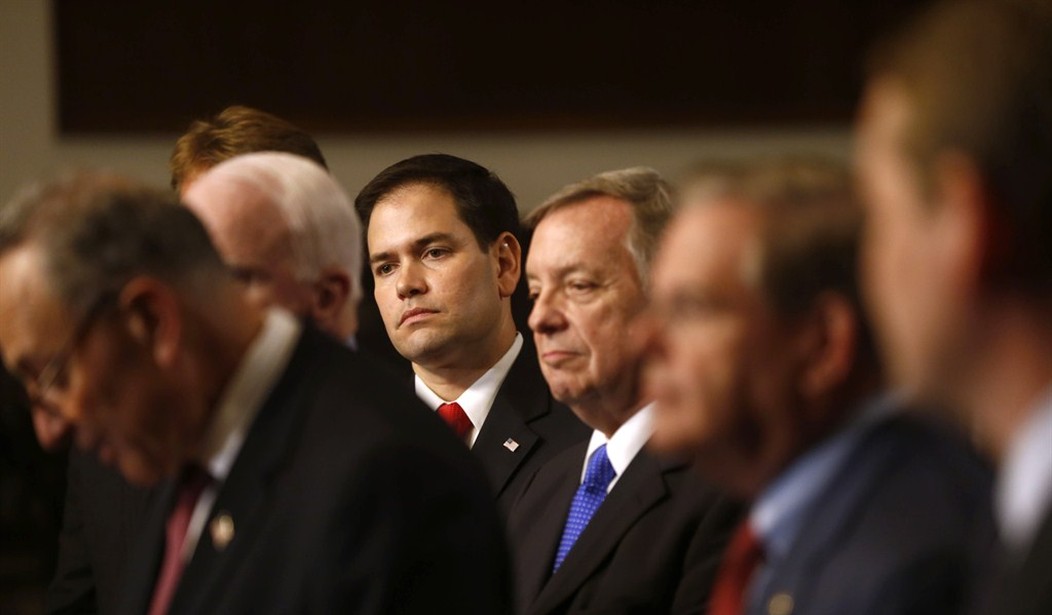
It has been said that the U.S. Senate is where good ideas go to die. In the context of immigration reform, the opposite is true: this week the Senate passed a bundle of mostly bad ideas, “comprehensive” immigration reform. Attention is now focused on the House of Representatives, where hopefully this bundle of errors will receive the fate it should have received in the Senate.
On the merits, the Senate bill is a non-starter for House conservatives. The most odious provisions are those that provide immediate and irreversible legalization, a path to citizenship, and eventual federal welfare benefits without any guarantees of border enforcement that can’t be waived by the Secretary of Homeland Security.
Most importantly: the Senate bill does not require an impassible fence be built across the most trafficked portions of the southern border. This leaves the Senate bill dead on arrival in the House, and rightly so. The 1986 immigration reform failed to install a fence and millions more came illegally. Failure to implement a fence now invites the same result.
The Senate bill is not all detritus however. The provisions mandating e-Verify, expanding visas for high skilled workers, the hiring of additional border patrol agents and installation of high tech anti-trafficking measures, such as drones, are meritorious. These can be the foundation of a security-first House bill.
However, House Republicans should be in no rush to pass any immigration reform bill. There is no public clamor for immigration reform from key 2014 constituencies, and Congress’ failure to act this summer will not exacerbate a problem that has been a generation in the making.
Moreover, Harry Reid is hoping members of Congress will get pressured by their constituents at town hall meetings during the August recess to pass the Senate bill, but that won’t happen. Given more time to inspect the Senate bill, Americans will likely sour on it, just as has happened with Obamacare.
Indeed, any GOP midterm worries are misplaced. Democrats haven’t done well in a midterm election since 2006, fewer Hispanics vote in midterm elections, and the raft of scandals besieging the White House should provide Republicans sufficient ammo to fight back against Democratic attacks.
So what specifically should the House do?
First, it should define “reform.” The word is thrown around in Washington so often that is has no meaning. House Republicans should define immigration reform to mean specific solutions to specific immigration-related problems.
Second, the House should pass a smaller bill that provides for (1) an impassable fence that covers all trafficked areas and cannot be undone by the Secretary of Homeland Security, (2) expanded visas for skilled immigrants, and (3) a guest worker program. Such a bill would likely pass because it would appeal to key constituencies such as the Chamber of Commerce, the tech industry, border conservatives and border state voters.
Third, the House should publicly tie any change in immigration status to fence completion, and thereby delay any vote on a path to legalization or citizenship until any legal hurdles to the fence have been cleared and the fence built. Practically speaking, this may kill any bill offering legalization or a path to citizenship because no one expects Janet Napolitano to build a border fence. But her intransigence will delay any meaningful steps on legalization. And it may force President Obama’s hand to make a real commitment to a secure border.
Fourth, Republicans should begin a massive voter outreach to Hispanics and Latinos coupled with a specific legislative agenda addressed to areas of concern to those groups (and all Americans), namely: education reform, crime reduction, healthcare modernization and prosperity. And, in light of this week’s Supreme Court rulings, the sanctity of man-woman marriage and the traditional family.
Republicans who think passing comprehensive amnesty will endear them to Hispanics and Latinos at the ballot box are kidding themselves. Agreeing to legislation co-sponsored by Democrats is never a good idea, in principle or in practice. Remember McCain-Feingold and Sarbanes-Oxley? The Senate immigration bill is equally bad policy and politics.
On immigration, the GOP will never out-pander the Democrats, and it shouldn’t start now. Our immigration challenges require serious solutions. The Senate bill provides none.



Join the Conversation
VIP members get the ability to comment on articles.