





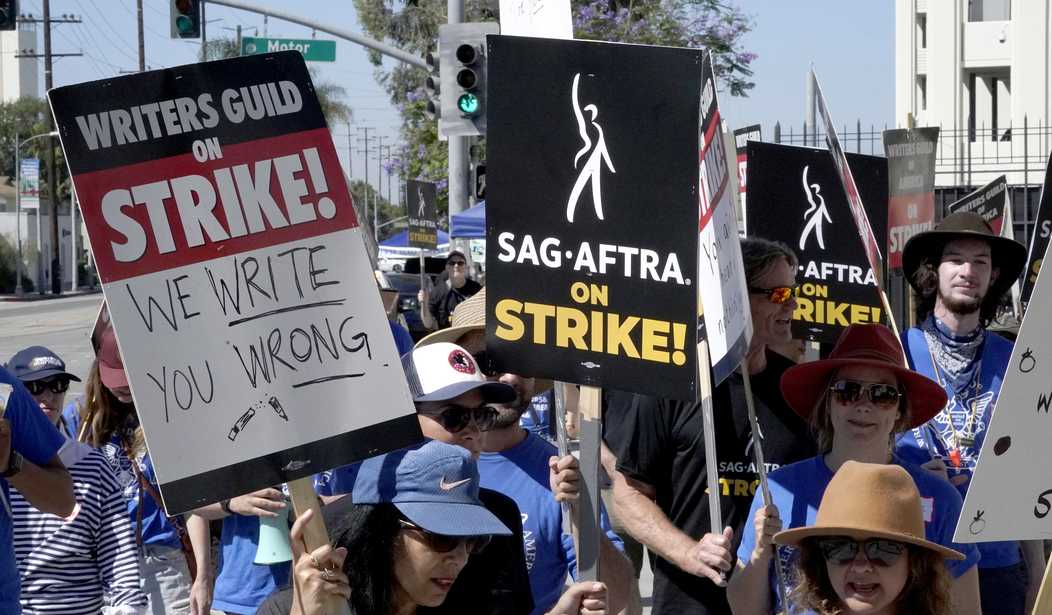
Today marks the unofficial shutdown of Hollywood as the Actors Guild has decided as of midnight that it will be going on strike for a number of labor issues. This follows the earlier strike called for by the Writers Guild of America (WGA), which currently is nearing 75 days since it staged its walkout at the end of its last contract. The announced work stoppage means that quite a lot of activities involving the members beyond performances are affected. (I give fuller details of the strike parameters here.)
Because of various layers of contractual standards, not all work in the entertainment arena is shutting down. Segments such as soap operas, game shows, commercials work, and other components can still have union members going to work. This is where something rather revealing was found. This strike actually has some direct involvement with the news industry. Among the listed portions of the membership unaffected by the picket lines will be news broadcasters:
The SAG-AFTRA strike will affect tens of thousands in the industry, but one part of the union’s membership will not be part of the walkout: news and broadcast members. SAG-AFTRA news and broadcast members will not be on strike, as member reporters, anchors. hosts and producers work under individual station or network contracts, not the TV and theatrical agreement. For those broadcast and news members, the terms and conditions of their employment remain the same and are not affected, according to SAG-AFTRA.
Yes, news anchors and other on-air personalities are members of the union via their inclusion with the American Federation of Television and Radio Artists (AFTRA). This is not a new wrinkle, as TV anchors and reporters have long been a part of the guild since they fall under the welcoming union umbrella as broadcasters. News anchors actually joined a union strike back in the 1960s. But their inclusion in AFTRA, while known and accepted, is still a curious one. Do they really consider themselves "artists," a definition usually affiliated with creativity and fictional presentations?
The larger issue of concern involves these broadcast journalists being active members of a union that is on strike, and therefore, becomes a question about integrity should any of them report on the SAG-AFTRA walkout. Can they be expected to cover the details and progress in an unbiased fashion, or should they refrain from any coverage at all? Given that the industry has been gradually abandoning the practice of objectivity over the years, it is more than proper to assume that covering this story is very likely to be tinged with bias.
CNN has already logged a number of reports on the work stoppage in Hollywood. Likewise, MSNBC has not been shy about covering the proceedings. An Andrea Mitchell segment on the strike described it as "historic." It would stand to both reason and propriety that these on-air journalists recuse themselves from covering this labor strife, which we frequently cover (daily, even).
Reason and propriety are challenging concepts for contemporary journalists.
There is another facet to all of this: the journos covering the movie industry. With so much in the way of movie content and promotions now forbidden from being addressed while there is a strike, those working at industry outlets are finding a challenge in front of them, as the spigot of content has been twisted way down to a trickle.
It’s not just actors affected by the strike. This list is catastrophic for all entertainment journalists, especially freelancers. Godspeed to us all. https://t.co/ippZq4JNMP
— Mara Reinstein (@MaraReinstein) July 13, 2023
This creates quite a curious nexus when it comes to the journalists and this walkout. Those who want to cover Hollywood right now cannot, and those who are covering the strike actually should not. And we, the audience and the news consumers, are left wading through the previous murky media waters made even more unfathomable.

Join the Conversation
VIP members get the ability to comment on articles.