







For over 40 years, the international community has treated Lebanon as a place where fiction was preferable to fact. United Nations resolutions declared that armed militias would not operate south of the Litani River. UN peacekeepers patrolled the area. Diplomats issued reassuring statements after every crisis. Ambassadors wagged their fingers sternly at corrupt officials who bankrupted the country. Meanwhile, Hezbollah built one of the largest terrorist arsenals in the world within sight of observation posts manned by peacekeepers from the feckless UN Interim Force in Lebanon (UNIFIL).
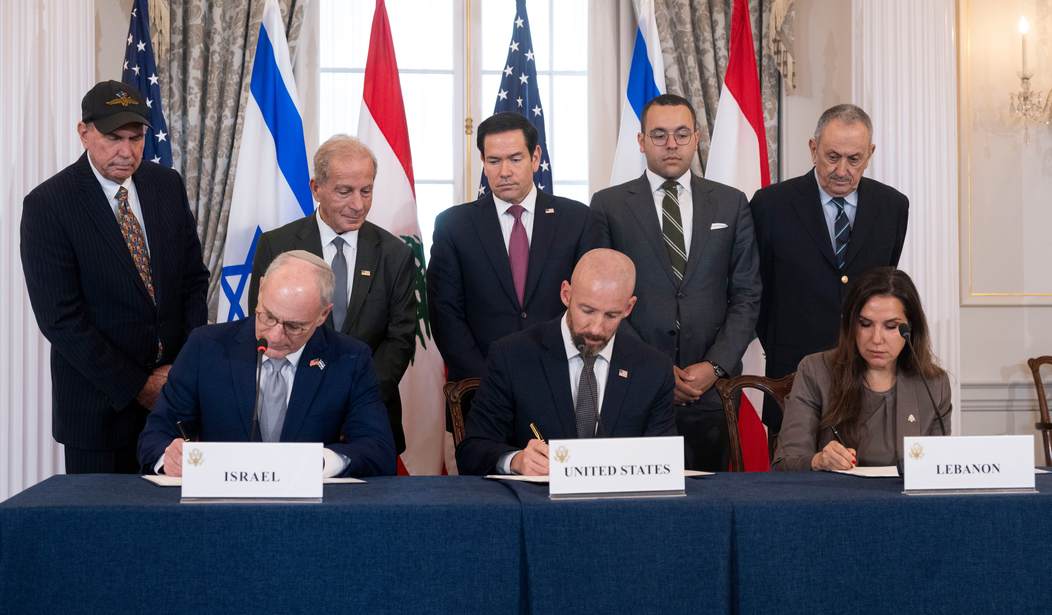
The trilateral Israel-Lebanon framework signed on June 26, 2026, represents a welcome departure from that failed model. Assuming its provisions are faithfully implemented, the agreement reflects an overdue recognition that stability is achieved not by pretending threats do not exist but by confronting them.
Secretary of State Marco Rubio deserves enormous credit for embracing that principle. Instead of treating negotiations as an exercise in preserving appearances, the administration pursued an agreement that places security—not diplomatic theater—at its center. That is how serious diplomacy is supposed to work. Agreements succeed when they reinforce strategic realities, not when they attempt to substitute optimistic language for them.
The greatest loser in this framework is Hezbollah. The second greatest loser is Hezbollah’s puppetmaster, the terror regime in Iran.
For decades, Hezbollah prospered because everyone else accepted an arrangement that defied common sense. Lebanon leaned into its “failed state” status and insisted it lacked the capacity to impose its authority in the south. International organizations claimed they lacked the mandate to act decisively. European governments urged Israeli restraint while demanding little and expecting even less from those responsible for the instability.
The only party that consistently paid the price was Israel.
Every ceasefire became an opportunity for Hezbollah to regroup. Every international appeal for "de-escalation" became an additional time to expand military infrastructure. Every declaration that the situation was under control concealed the reality that Iran-backed Hezbollah was becoming stronger, more sophisticated, and more deeply embedded inside Lebanese society.
Few institutions bear greater responsibility for normalizing that dangerous illusion than the United Nations and, through it, UNIFIL.
UNIFIL is the embodiment of an international approach that substituted observation for enforcement. Sipping tea in Beirut cafes is not the same as disarming terrorists, but effete peacekeepers from France and Italy clearly spent more time working the diplomatic circuit than spotting terror tunnels.
On occasion, UNIFIL documented violations. And then it filed reports. UNIFIL’s so-called peacekeepers conducted patrols when they were given permission, but didn’t protest when terrorists (whom they were supposed to demilitarize) told them they couldn’t proceed. At the same time, Hezbollah's military infrastructure continued to grow uninterrupted. Weapons depots multiplied. Launch positions expanded. Command networks deepened. Villages became military strongholds.
UNIFIL is a failure. As an international force, it was charged with helping prevent the militarization of southern Lebanon, but instead it became a permanent witness to it.
Rubio’s new framework offers an opportunity to move beyond that failed paradigm - he is moving from admiring a problem to addressing it. And none too soon, as Iran’s negotiators continue to try to hoodwink America into tying a ceasefire in the Gulf to Israel pulling back its security forces from a buffer zone in Lebanon.
For Rubio, this isn’t about the photo-op. The framework’s promise lies in the possibility that responsibility for security will finally rest with institutions expected to exercise real authority, backed by clear consequences for those who undermine it. That represents a significant change from an international strategy that rewarded delay, excuses, and ambiguity.
None of this guarantees success. It’s impossible to imagine that Hezbollah will abandon decades of investment in terror simply because a framework has been signed. Iran's regional ambitions have not disappeared. Enforcement will matter far more than aspiration. But if the Lebanese Armed Forces are worth their salt (and the over $100M they receive from America every year), this will be their job.
Washington's continued engagement will be indispensable. The agreement's credibility will ultimately depend on whether violations result in consequences rather than more meetings, but Lebanese President Aoun’s scheduled meeting at the White House on July 21 will strengthen Lebanon’s hand against Hezbollah.
For too long, the international community treated Hezbollah as a problem to be managed rather than defeated. It treated UNIFIL's presence as evidence of progress rather than asking whether the mission was accomplishing its purpose. It accepted Lebanon’s status as a bankrupt and failed state. And it expected Israel to place its security in mechanisms that repeatedly failed under pressure.
This agreement offers the chance to break with those assumptions. That alone makes it significant.
The real measure of success, however, will not be the signatures affixed to the document or the speeches delivered after its signing. It will be whether, years from now, southern Lebanon is no longer a sanctuary for an Iranian-backed terrorist army operating behind the façade of international diplomacy. If that happens, the agreement will be more than a diplomatic accomplishment. It will stand as proof that realism, backed by American leadership and unwavering Israeli security requirements, can succeed where decades of well-intentioned international complacency did not. It will be yet another masterstroke from Secretary of State Marco Rubio in which he demonstrates that this administration doesn’t side with terrorists over its allies.
Bonnie Glick served as the Deputy Administrator of USAID in Trump’s first Administration and is a Senior Fellow at the Foundation for Defense of Democracies.
Editor’s Note: Thanks to President Trump and his administration’s bold leadership, we are respected on the world stage, and our enemies are being put on notice.
Help us continue to report on the administration’s peace through strength foreign policy and its successes. Join Townhall VIP and use promo code FIGHT to receive 60% off your membership.

Join the Conversation
VIP members get the ability to comment on articles.