







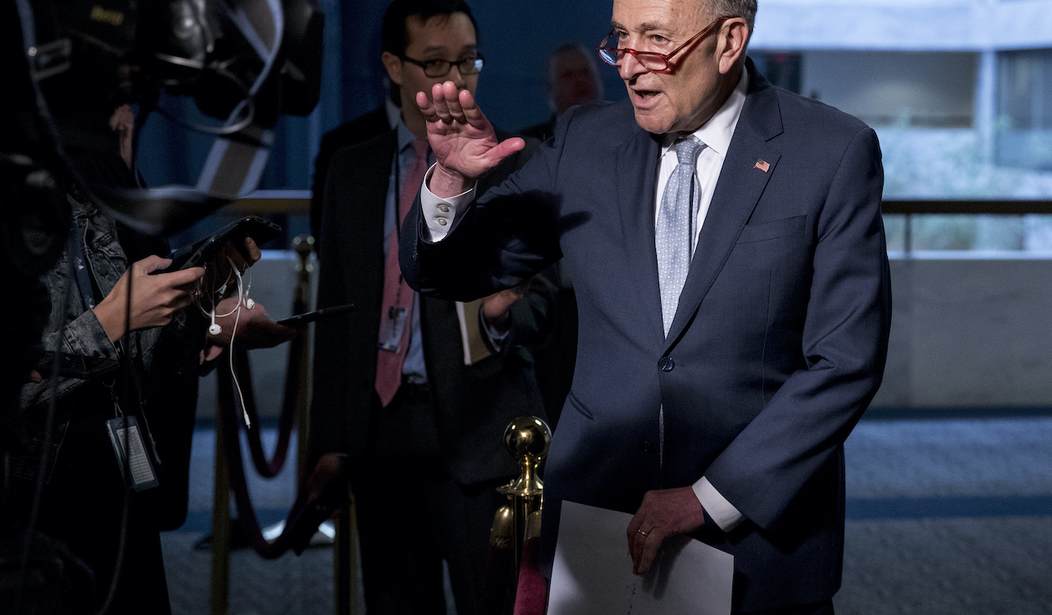
Everything New York Sen. Chuck Schumer says is political; and since President Trump took office in January 2017, everything Schumer says is political with an anti-Trump stinger. However, the Senator’s recent call for the President “to designate a senior military officer” to control the federal government’s COVID-19 response, is dead wrong. The proposal reflects a troubling perspective that, while perhaps popular to many citizens in times of crisis, cuts against the grain of how our country is governed; that is, if in accord with the principles and philosophy underlying our founding charter.
The United States is a constitutional republic governed by individuals accountable to the people. This principle is codified in the Constitution itself, and explained further and at length in documents from The Federalist Papers to Supreme Court opinions, and in extensive presidential commentary beginning with George Washington. As noted by Richard Brookhiser in his book, “George Washington on Leadership,” it was our very first Commander in Chief who “made the template for American military leaders and their civilian superiors” (emphasis mine). America at its core is a country led by civilians according to civil law, not military individuals operating according to martial law.
The distinction is not merely technical or strictly statutory (though such distinctions are extremely important). The “template” establishing the supremacy of civilian leadership over military in our country and in our culture, reflects also the civilian mind-set over the military.
Armed forces operate on strict chain-of-command. Navy Captain Brett Crozier, former commander of the nuclear aircraft carrier Theodore Roosevelt, recently learned that going outside the chain of command brings serious consequences.
Principles of civilian due process and equal protection are very different in that environment. This makes perfect sense. In the military, particularly during hostilities, failure to execute orders without question can, and probably will, result in loss of life and possible defeat on the battlefield.
It is this consistency and certainty that makes the notion of placing the military in control of federal government functions in times of emergency or crisis, appealable to many people. Having a military figure at the helm, barking out orders and demanding results without question, offers a sense of security and comfort. It is understandably easier for many people to be told what to do than for them to have to decide for themselves.
When Hurricane Katrina devastated New Orleans 15 years ago, for example, it was not any of the civilian officials involved who rose in stature and popularity. It was a military personality, Army Lt. Gen. Russel Honore.
The use of the National Guard to augment and assist state governments (and occasionally the federal government) in times of true emergency – whether caused by force of nature or of disease – is appropriate and in many circumstances, essential.
The propriety of employing military resources and administration in such domestic settings, however, comes with an important caveat – civilian authorities, whether under command of a state governor or the president of the United States, must remain in control of policy decision-making and -implementation. This may lead to some bad decisions being made, and it may appear far messier than the chain-of-command paradigm within which military operations are conducted; but it is the way things happen in a representative democracy – in a free country.
Placing our country’s response to the coronavirus pandemic under the command of a “designat[ed] senior military officer” as Schumer desires, may appear to him and to Trump’s critics as a way to fill what he claims is an “existing federal leadership void.” Such a move might even appeal to a large segment of the voting public and to many in the media. In their perspective, it makes sense – we are “at war” with a viral enemy, and who best to lead the defense against that enemy than a “senior military officer.”
After all, so the argument goes, over the centuries America has produced some of the best military leaders the world has seen (beginning with Gen. George Washington), and our armed forces remain the very best in the world.
It is a seductive argument that Schumer makes, even if prompted by his dislike for President Trump. But it is fundamentally wrong and reflects either a deep ignorance of the principles on which our nation was founded, or a conscious decision to brush those principles aside to make a partisan political point. Trump, who categorically rejected Schumer’s letter the same day it was sent, understands what is at stake, just as did George Washington before him.


Join the Conversation
VIP members get the ability to comment on articles.