





America is living through a moment difficult to describe without sounding a little unhinged.
But here goes: We are watching the United States do things that only the United States can do.
In the span of a few days, Americans have watched astronauts push farther into space than any human beings in history, while U.S. forces execute military operations so precise and technologically overwhelming that they look like something written for a Hollywood script. Pilots are being rescued in missions that resemble "Mission: Impossible." Terrorists are being eliminated with the kind of targeted strikes that only a modern superpower can carry out.
And somehow, this has become so normal that we barely stop to appreciate it.
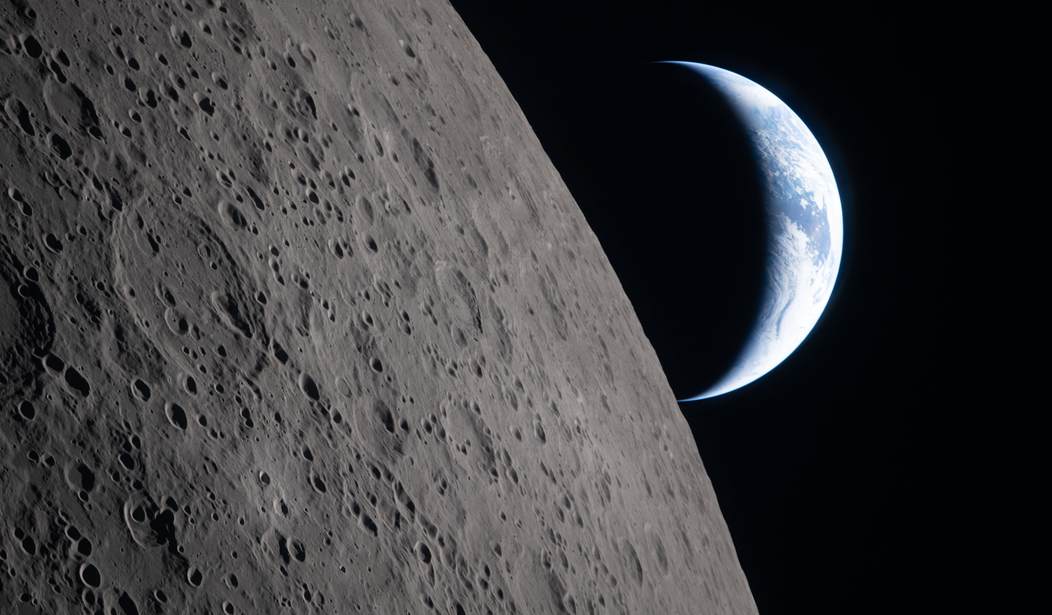
On Monday, Artemis II made history.
According to The Wall Street Journal, the astronauts aboard NASA's Orion spacecraft traveled more than 248,655 miles from Earth — farther than any human beings have ever gone.
It is worth repeating: farther than any human beings have ever gone.
Not in science fiction. Not in a theoretical model. In real life. In real time. With Americans at the controls.
President Donald Trump called the crew to congratulate them, and what followed was a reminder of how far beyond our daily politics the American project really reaches.
"Tell me, what is the most unforgettable part of this really historic day?" the president asked. "The whole world is watching and listening. Please tell me."
Commander Reid Wiseman responded with the kind of awe you would expect from someone looking at the universe from a vantage point no human being has ever had before. He spoke of seeing the moon from a new perspective, of witnessing sights "no human has ever seen before," even during Apollo. He described an eclipse — the sun, the moon, darkness outside the window, the corona visible — and even the "planet train" lining up in the distance.
Then he said something that sounded less like an astronaut's report and more like a statement of national destiny: America, he said, was becoming part of the story of a "two-planet species."
That is what the United States is doing right now.
And it is not happening in isolation. It is happening alongside a broader national posture that is unmistakably American: an insistence that the country is not merely capable of greatness but obligated to pursue it.
For years, Americans have been trained to speak about their own country in tones of apology. The national mood has been one long exercise in self-criticism, as if confidence itself were a moral failing.
But there is a reason the rest of the world still looks at the United States as the place where things happen.
People don't just come here because we have jobs. They come because America still offers something rare: the opportunity to build, to create, to rise. The system is imperfect, but it remains the most powerful engine for human advancement ever constructed.
And that same system, the same country capable of sending astronauts a quarter-million miles into space, is also the guarantor of global security — whether people want to admit it or not.
That brings us to Iran.
For decades, the Iranian regime has played the same game: fund terrorism, destabilize the Middle East, pursue nuclear weapons, develop long-range ballistic missiles, brutalize its own population, and then demand to be treated as a legitimate member of the international community.
The Trump administration's position is simple: That game is over.
What critics conveniently ignore is that Iran has been offered an off-ramp repeatedly. The United States has not demanded cultural surrender or humiliation. The requirements are basic: Stop pursuing nuclear weapons, stop developing long-range missiles, and stop funding terrorism.
That is it.
Iran could have chosen that path at any time — not just in recent years but over nearly half a century. They could have been reintegrated into the world economy. They could have normalized relations. They could have chosen prosperity over fanaticism.
Instead, they chose escalation.
They chose theocracy. They chose regional domination. They chose to bankroll terror groups and accelerate toward nuclear capability. They chose to become a permanent source of instability.
And now, they are facing the consequences.
The United States has unleashed military power with a level of dominance that has few parallels in history. The Iranian navy has been devastated. Its air force has been neutralized. Missile-launching capacity has been pushed toward collapse. Key industrial targets have been hit. Nuclear facilities have been bombed. Checkpoints and regime infrastructure have been struck with precision.
This is not a stalemate. This is not a quagmire. By any reasonable historical standard, it is a superpower dismantling a hostile regime's military capacity in real time.
And still, the president continues to offer Iran a way out: Open the Strait of Hormuz, abandon the nuclear program, and the war ends.
The question Americans should ask is not why the United States is acting. The question is why the Iranian regime would rather watch its military collapse than abandon the tools of terror.
The answer is not complicated. The regime's power depends on oppression at home and aggression abroad. It cannot survive as a normal government because it was never designed to be one. It was designed to rule through fear, religious absolutism and violence — not through legitimacy.
That is why it needs nuclear weapons. That is why it funds terror groups. That is why it must constantly menace the region.
It is not simply a government defending itself. It is a revolutionary ideology seeking expansion.
The comforting Western myth — that radical Islamist aggression would vanish if only the United States stopped "provoking" it — collapses under even minimal historical scrutiny. Expansionist religious movements do not stop because they are left alone. They stop when they are defeated.
Trump was asked whether he believes God supports America's actions.
"I do," he said, "because God is good. ... God doesn't like what's happening."
He added that he takes no pleasure in war.
That comment will be mocked by the same class of people who mock anything resembling moral clarity. But the underlying point is one Americans should not be afraid to state plainly: Removing tyrants and dismantling terror networks is not immoral. Allowing them to metastasize is.
America is not perfect. No nation is. But the United States remains something rare in human history: a country capable of extraordinary power and, at its best, willing to use that power against evil.
Whether it is sending human beings farther into space than any civilization ever has, or confronting regimes that spread violence across continents, the United States continues to occupy a role no other country can fill.
And Americans should feel proud of that — not in a shallow, flag-waving way but in the serious way that comes from recognizing what we are watching unfold.
The world is watching.
And, like it or not, history is still being written in English.
Ben Shapiro is a graduate of UCLA and Harvard Law School, host of "The Ben Shapiro Show," and co-founder of Daily Wire+. He is a three-time New York Times bestselling author.
Editor’s Note: Do you enjoy Townhall’s conservative reporting that takes on the radical Left and woke media? Support our work so that we can continue to bring you the truth.
Join Townhall VIP and use promo code FIGHT to receive 60% off your membership.



Join the Conversation
VIP members get the ability to comment on articles.