





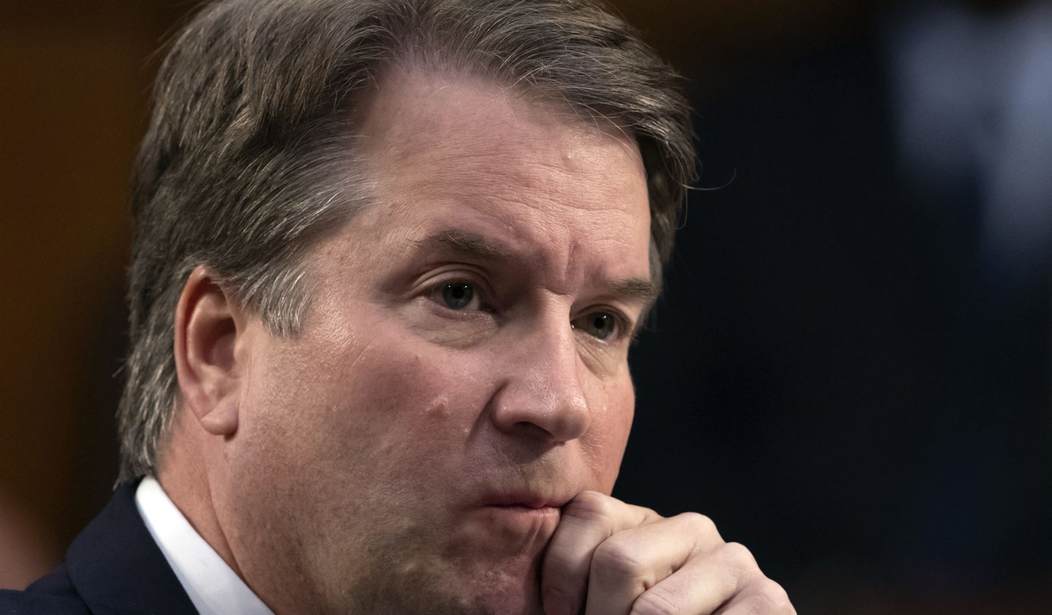
This week, Judge Brett Kavanaugh was hit with accusations of sexual abuse from Christine Blasey Ford, a professor at Palo Alto University. According to Ford, some 36 years ago, when Kavanaugh was 17 and she was 15, Kavanaugh took her into a room at a pool party -- along with another high school classmate, Mark Judge -- and then proceeded to lie on top of her and try to disrobe her, even putting his hand over her mouth to prevent her from screaming.
These are serious allegations. Kavanaugh has denied them completely. He denies he was at such a pool party; he denies he has ever engaged in such behavior. Ford, for her part, only came forward months after sending letters to Sen. Dianne Feinstein, D-Calif., and Rep. Anna Eshoo, D-Calif., and contacting the Washington Post. She originally didn't want to reveal her name or her story. Feinstein didn't ask Kavanaugh about it in writing, or in closed or open hearings; she didn't inform her fellow Democratic senators about the allegations; now she's reportedly attempting to prevent Republican senators from asking questions of Ford.
So, how in the hell is Kavanaugh supposed to defend himself?
This has always been the key question the #MeToo movement has adamantly refused to answer: What should the standard of proof, or even the standard of believability, be? Should the standard be criminal liability? Presumably not, since most accusers are emerging to speak long after alleged incidents. Should the standard be credibility of the individual telling the story combined with supporting details that lend additional credibility? Perhaps, but that apparently isn't enough for some. The standard promoted by many in the #MeToo movement is the far-too-simplistic and outright dangerous "believe all women" standard. By that standard, former President Bill Clinton is a rapist. So are the Duke lacrosse players, the members of a University of Virginia frat house and a foreign exchange Columbia University student -- all of whom were exonerated.
Kavanaugh's accuser didn't tell anyone about the incident at the time; she didn't go to the police. Her first retelling of the story came in 2012, three decades after the alleged incident, in a spousal counseling session with a therapist. She told the Washington Post that she doesn't remember key details of the night in question. She doesn't remember the location or how she got there or the date. The notes of her therapist conflict with her statements about the evening.
There are real questions to be asked about her account -- and about Feinstein's political maneuvering. But instead, many on the left insist that the "believe all women" standard be applied to accusers against those on the right but that the general credibility standard should be applied to their own favorites. That's nonsensical, and insulting. What's more, it deliberately undermines the bulwark of universal approval with which #MeToo should be met. We should all be able to agree that some standard beyond mere belief is required here -- and we should all be willing to hear evidence that implicates our favorite political figures. But if we insist on applying a politically motivated double standard in the name of #MeToo, the support for #MeToo will crumble.
That would be a tragedy, but it would also be a familiar tragedy. All too often, movements that should draw broad public support are undermined by fringe cases used as clubs by members of politically driven groups. We should all agree that any racist police shootings must be stopped -- but such agreement falls apart when some insist that questionable shootings be treated as racist shootings. We should all agree that sexual abuse must be stopped -- but such agreement disintegrates when some insist that unsubstantiated sexual abuse allegations be treated just like substantiated allegations.
Politics should not be allowed to override basic human decency. Yet again, that's what's happening.

Join the Conversation
VIP members get the ability to comment on articles.