





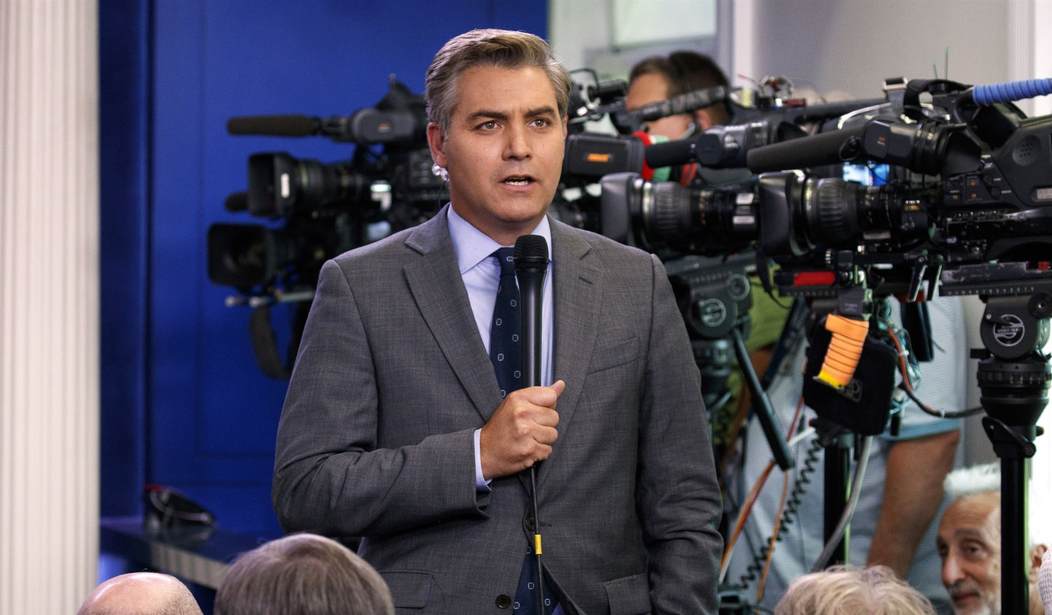
For many decades of our modern era, it's been an article of faith that our Founders enshrined the profession of journalism into the “freedom of the press” clause of the Bill of Rights. That understanding is wrong.
It’s clear from the dictionaries of the day, as well as the writings of the Founders and other authors of the era, that what this First Amendment freedom refers to is the printing press, the device which made the wide dissemination of written speech possible, and which was the target of censorship and confiscation efforts by British authorities, both before and after the signing of our Declaration of Independence. Nowhere were journalists denoted. That meaning slipped into the language only well into the 19th century, decades after the Bill of Rights was written, and never as a primary definition.
Samuel Johnson, who many consider the most distinguished man of letters in English history, authored what would be for well over a century the authoritative English lexicon. The first edition of his classic A Dictionary of the English Language, printed in 1755, shows the pertinent definitions for the noun “press” as 1. The instrument by which any thing is crushed or squeezed. 2. The instrument by which books are printed [italics added]. The sixth edition, published in 1785 and in use during the formation of the Constitution and Bill of Rights, adds wine and cider presses. No mention of journalists or newsmen.
The Oxford English Dictionary, first published late in the 19th century, cites the first reference of “press” to journalists and newspaper reporters collectively as not occurring until 1868.
James Madison, the author of the Bill of Rights, wrote in his Report on the Virginia Resolutions that “… no persons or presses are in the habit of more unrestrained animadversions on the proceedings and functionaries of the State governments than the persons and presses most zealous in vindicating the act of Congress …” [italics added] Madison, as well as all the founders, understood “press” or “presses” as machines, not as a profession, institution or industry.
In 1789, the same year that the Bill of Rights was submitted by Congress to the States, David Ramsay, a major historian of the revolutionary era, wrote, “in establishing American independence, the pen and press had merit equal to that of the sword,” clearly equating the two instruments as physical devices.
The Kentucky Constitution of 1799, states, “ printing-presses shall be free to every person who undertakes to examine the proceedings of the legislature or any branch of government, and no law shall ever be made to restrain the right thereof.”
Noah Webster’s 1828 dictionary says of press as a noun, 1. An instrument or machine by which any body is squeezed, crushed or forced into a more compact form; as a wine-press, cider-press or cheese-press. 2. A machine for printing; a printing-press. Press as the art or business of printing is mentioned in the third definition, but no reference to journalists or newsmen is to be found. At the end of the listing he further states that “Liberty of the press in civil policy, is the free right of publishing books, pamphlets or papers without previous restraint …”
Previous or prior restraint was the press freedom issue of the 1760s and ‘70s. Attempts at censorship and seizure were made, both in the colonies and in Britain. The Stamp Act of 1765 sought to restrict printed materials, including newspapers, by requiring them to be printed on revenue-stamped paper produced in London. The levy had to be paid in British, not colonial currency and gave rise to the revolutionary phrase, “no taxation without representation,” as the colonies had no members in parliament.
One near-victim was Isaiah Thomas, another early American historian, author, printer and publisher of the Massachusetts Spy, a weekly paper supporting independence. Some consider Thomas the foremost printer in colonial America. As such, he was a target of the British. They considered Thomas so dangerous that he later recalled “he had the honor of being included with John Hancock and Samuel Adams in a list of twelve persons who were to be summarily executed when taken.” Three days before the Battles of Lexington and Concord in April of 1775, Thomas fled Boston with his presses and a few sets of type and set up shop in Worcester, Mass. All his other property was destroyed or stolen during the British occupation of Boston. Other printers and pamphleteers had been fanning the flames of revolution to the point that the Brits sought to terminate their press freedoms as well.
The establishment media “press” of today has arrogated to itself a freedom belonging to all Americans and has used that theft to elevate itself to constitutionally protected status. The implications of this error are profound: those preening and self-righteous media elitists have no more rights or privileges under the Constitution than any other citizen and merit no special consideration from any other American, including elected officials. The same crowd which perpetrates fake news on us has perpetuated a fake meme about their own existence. It’s not quite stolen valor, but it’s at least stolen position, authority and reputation.
President Trump has taken an appropriate step by cutting off access to propaganda purveyors from CNN and NPR. He should replace them and others with more writers from web-based publications which have track records of getting the story right, the Washington Post and New York Times be damned. Likewise, other elected officials from governors and senators on down ought to follow suit. The current lying media has gotten literally an undeserved pass for far too long. It should be payback time.
Let the griping begin!
Join the Conversation
VIP members get the ability to comment on articles.