





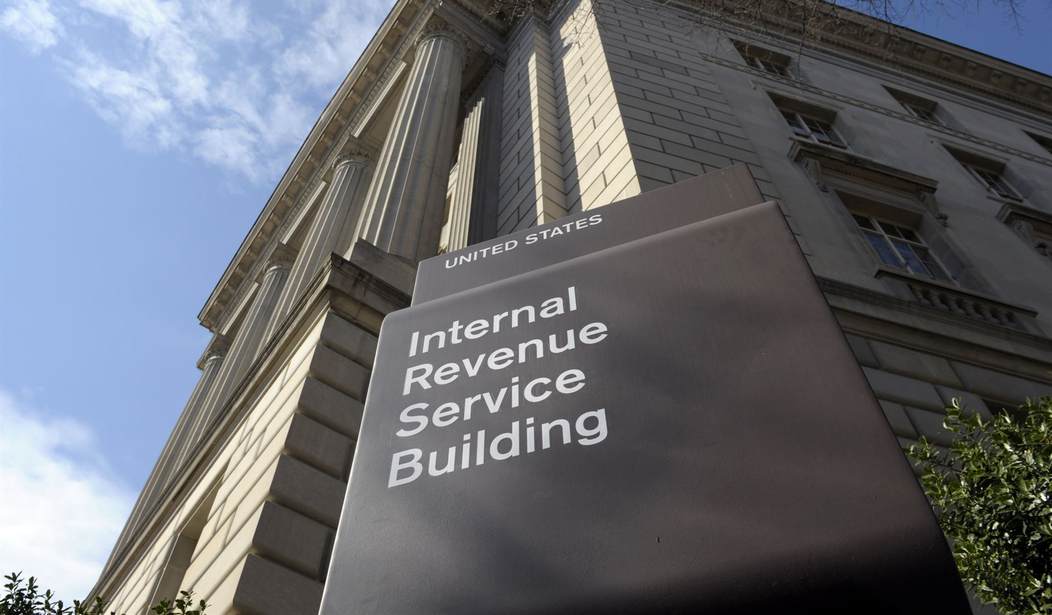
Lost in the shuffle of all the potential revenue-raising proposals being put forward by Democrats to pay for legislation that could end up costing taxpayers more than $5 trillion is a provision that would drastically expand the federal government’s power to monitor Americans’ finances. In light of Uncle Sam’s failures to responsibly safeguard — and tendency to sometimes abuse — the powers he already has over your wallet, giving him even further authority to snoop is a recipe for disaster.
The provision in question would require all types of financial institutions to report gross inflows and outflows from any account with a cash flow of $600 or more over the course of the year. In other words, it proposed to give the IRS details on almost every financial account, be it a traditional checking account, a savings account, or an investment account.
This would represent a massive compliance burden for all but especially for smaller financial institutions, which would be required to report this information on an annual basis. Perhaps even more importantly, it would be an unprecedented intrusion on Americans’ financial privacy.
Of course, you may be thinking this is a problem for tax cheats and deadbeats, not an upstanding citizen such as yourself. You pay your taxes every year, following the letter of the law to the best of your ability. Unfortunately, this proposal could still cost you — quite literally.
For one thing, the IRS has not exactly proved in recent years that it can keep taxpayer data secure. Over just the last five years, at least two times has valuable taxpayer data been compromised and used in an identity fraud scheme — once due to a data breach into an IRS database and once because of an IRS employee. More recently, investigative outlet ProPublica made headlines with a report based on a trove of tax filings it never should have been able to access (the source of which is still unknown).
The agency’s internal controls are a mess. A report last year by the Treasury Inspector General for Tax Administration found that 67 requests for taxpayer data should have been monitored for unauthorized access. Instead, less than half were, and only six received complete and accurate audit trails.
While IRS data security is lacking now, it could get even worse when paired with other proposals from the administration. Where the IRS is fairly dysfunctional at its current size, struggling to process tax returns, provide taxpayer services, and even keep its printers functional, the Biden administration has proposed to nearly double the agency’s funding by $80 billion over the next ten years. It’s very likely that a rapidly expanding agency handed a huge increase in the data it has access to would struggle even more to keep it all secure.
Furthermore, following the law isn’t always a protection against government agencies initiating legal proceedings or seizing assets. A report by the Institute for Justice shows that, between 2000 and 2016, Department of Homeland Security agencies have seized over $2 billion in cash from air travelers — over two-thirds of whom were never convicted of any crime.
Most of these travelers did nothing wrong. There are plenty of innocuous reasons for flying with large amounts of cash — one man had $39,500 that he was planning to use to buy a big-rig to start his trucking business, while another woman was flying home and planning to put her father’s life savings of $82,373 in a joint bank account. Both were flying domestically, where there is no obligation to report flying with large amounts of cash. The government seized it anyway under the disturbing practice known as civil asset forfeiture, which gives agencies the power to keep property they allege is involved in a crime.
The Institute for Justice estimates that governments have seized $68.8 billion over the last 20 years within the country, much of which came from Americans carrying large amounts of cash that had an innocent explanation.
If the federal government had the power to snoop on Americans’ bank accounts, it does not take much to imagine this power being used to expand civil asset forfeiture even further. Americans depositing much larger amounts of money in their accounts one year than the previous one could face the same treatment as citizens flying with cash — interrogation and even seizures.
When it comes to dealing with law enforcement, sometimes being innocent of any crime isn’t good enough. Taxpayers have a right to a reasonable level of financial privacy, and losing that right could have real costs.



Join the Conversation
VIP members get the ability to comment on articles.