





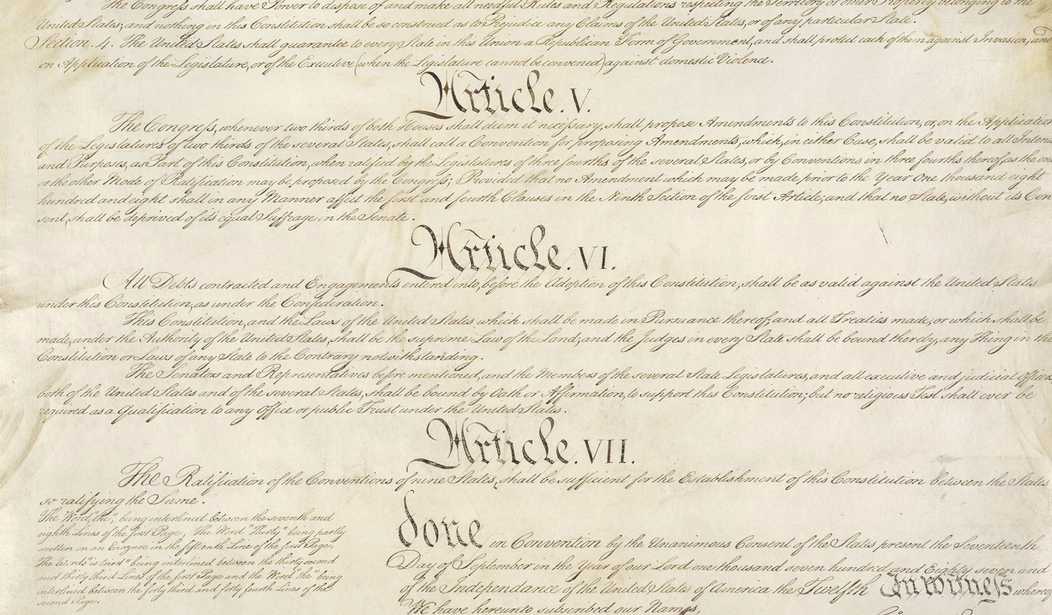
Sorting through the various reading lists for “doing the work,” that is, educating oneself about race and equality in America, there’s one piece that’s conspicuously absent: The Constitution. As the nation’s most important document devoted to equality, it should top the list.
Throughout history, civil rights leaders have relied on the Constitution in speeches, in protests, and in court. Frederick Douglass called it a “glorious liberty document.” Susan B. Anthony argued that if she “could get a practical application of the Constitution” it would protect her “and all women in the enjoyment of perfect equality of rights everywhere.” Why then, when deciding whether our nation is fundamentally good or fundamentally flawed and how to build a more just society, not one of the popular reading lists suggest consulting the Constitution?
Since our founding, civil rights advocates have relied on the Constitution in their campaign for equality. Perhaps the most influential advocate for equality in all of history, Martin Luther King, Jr., repeatedly referenced the document in his addresses. In his “Mountaintop speech,” King said that when people were “sitting in” at lunch counters to protest segregation, “they were really standing up for the best in the American dream and taking the whole nation back to those great wells of democracy which were dug deep by the founding fathers in the Declaration of Independence and the Constitution.” These words, uttered just before the famous line that he had “been to the mountaintop” and “seen the promised land,” remind us that our constitutional tradition is one of fighting for freedom from oppressive and unjust laws. They affirm that the document is, as he later said, a “promise that all men, yes, black men as well as white men, would be guaranteed the unalienable rights of life, liberty, and the pursuit of happiness.”
The Constitution protects minorities of all kinds, from religious to political to racial minorities. The very reason our government was structured as a representative republic rather than a direct democracy was to ensure that minority rights would not be subverted to the will of the majority. Given its explicit protections for freedom of conscience, free speech, privacy, and equal treatment before the law, the Constitution has been the driving force of nearly every civil rights victory at the Supreme Court. Indeed, as one historian said, “No marginalized group in modern American history could have appealed to the Federal government for redress without it.”
Yet, it’s in vogue to say our country is irredeemably flawed, or even racist. That might explain why people are trying to tear everything down ? both the bad and the good. There’s no doubt that serious injustices continue to be perpetuated and that there’s work to do. But rather than correcting those injustices, some advocates have begun maligning constitutional principles like individualism, economic freedom, and property rights as unimportant, or even unjust.
The framers of Reconstruction Amendments (the 13th, 14th, and 15th Amendments), by contrast, believed these constitutional guarantees to be the surest path to protecting minority rights in the post-Civil war era. They knew there could be no equality without vast protections for individuals to be able to structure their lives to their own liking, to earn, to make contracts, to hold property, and to pursue their own conception of happiness.
Maybe if people read the Constitution and constitutional history, they’d shudder at the thought of burning everything down, especially our nation’s most treasured principles. Far from eschewing the Constitution, we should be revisiting it. It should be a central part of “doing the work,” because it’s inspiring, it’s relevant to any fight against abusive government, and it shows us how we can do better.
There’s a reason other countries have modeled their constitutions after our own: people who lack our freedoms know how precious they are. The closer we get to the ideals enshrined in our Constitution, the closer we’ll get to a world full of opportunity for everyone. It’s your Constitution. Today’s the day to sit down and read it.
Anastasia Boden is a senior attorney at Pacific Legal Foundation, which litigates nationwide to achieve court victories enforcing the Constitution’s guarantee of individual liberty.



Join the Conversation
VIP members get the ability to comment on articles.