





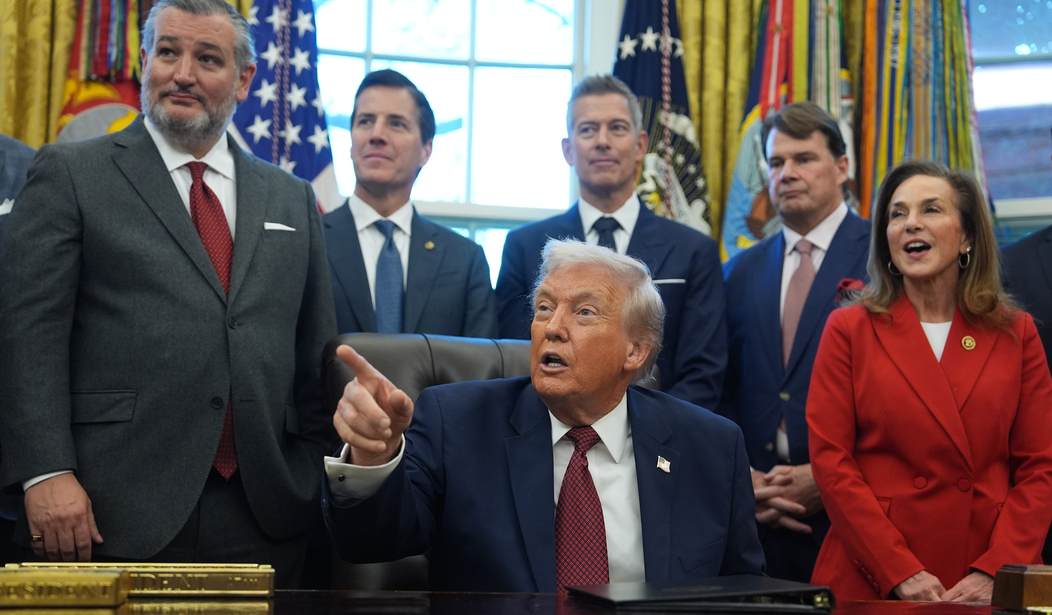
President Trump is not shy about getting involved in the economy. What are the limits of such interventions?
Recently, I wrote an article touching on the destructive effects of offshoring America’s industrial and manufacturing capabilities. President Trump has made a major point of getting factories working again in the United States and has used his personal persuasion, taxes, and tariffs to get production back in the United States. It seemed clear that having manufacturing in the U.S. had multiple advantages: healthy communities of well-paid workers, know-how residing in the U.S., and an alternative to college, where a person could make a good living and learn valuable skills.
The comments were mostly positive regarding the president’s efforts. One reader noted that a friend told him that at their firm, they needed to reverse-engineer their own products, as there is nobody still around who actually designed and made the originals. Having know-how and critical materials like weapons and drugs made in the U.S. seemed like a no-brainer. But not everyone agreed. There were those who argued that if offshoring of production meant cheaper products and higher corporate profits, then that is the way to go. They argued that the market knows best and that attempts to bring production back to the U.S. would only strengthen corrupt unions and lead to higher-priced products for consumers.
I was thinking about the two sides of this argument as Donald Trump once again showed his willingness to tinker with markets for a greater good. The first topic was defense. Pete Hegseth wants more and faster production of America’s war material. The amount of bombs, missiles, and interceptors potentially needed in a future conflict could empty out the arsenal in no time. The president told defense contractors to stop paying dividends and executing stock buybacks until they had gotten their production rates significantly improved. Lockheed Martin’s stock fell nearly 5 percent. The president singled out Raytheon for not dancing to his tune:
“I have been informed by the Department of War that Defense Contractor, Raytheon, has been the least responsive to the needs of the Department of War, the slowest in increasing their volume, and the most aggressive spending on their Shareholders rather than the needs and demands of the United States Military. Raytheon seems to think this is the Biden Administration, and this is ‘business as usual,’ IT’S NOT! Either Raytheon steps up, and starts investing in more upfront Investment like Plants and Equipment, or they will no longer be doing business with Department of War.”
The second subject was housing, and the president stated that he wants to stop hedge funds and the like from purchasing single-family homes. It is well-known that firms like BlackRock are buying up huge numbers of homes, with the goal of renting to people forever. The dream of owning one’s home is becoming a pipe dream, and the average age for a first-time home buyer is 40, not in the 20s as it was so long ago. People can’t afford to own a house, and not having one’s own place has an impact on family, work, and social stability. People owning their own homes has been a fundamental, bedrock concept in American society and concepts of success.
So, in three of Donald Trump’s business initiatives, he has placed homegrown manufacturing, more weapons, and more Americans owning their own homes as goals that trump pure capitalism of the market. Before one argues that the market knows best and the president should just let businesses and markets take care of themselves, he has to admit that society-approved governmental interventions are not uncommon. A company can make a lot more money if it can dump its chemical waste in the local lake or send it untreated out of its smokestack. But we as a society have empowered the EPA to set standards that allow for business while protecting human health and the environment. One could err on either extreme: close the factory, and there will be no pollution. There will also be no workers, salaries, or products for our use. Alternatively, one could let the factory do whatever it pleases and find increased rates of cancer for those living nearby. People often do not know that water standards work the same way. There should be no lead, “forever chemicals,” or other contaminants in drinking water. The reality is that some things are present, so the EPA or the WHO sets limits that reflect the maximum allowable concentration that ideally is minimally unhealthy. People also don’t know that the water providers can choose when to test, and if the results are too high, say for lead or E. coli, they can come back and test later in the day, and send the results of the cleaner sample to the authorities.
So, does one go with the purists who would argue that efforts to bring manufacturing home or determine who can own a home in the U.S. are wrong and ultimately self-defeating, or does one recognize that there are national goals that rise above pure market considerations? These kinds of debates took place 40 years ago, when Japan was considered the hot economy. People praised its “directed” approach, where it would choose sectors for investment and sectors for closure. People talked about how efficient their system was and how much smarter it was than the U.S. approach. Then Japan’s economy crashed and went through decades of a zombie economy.
It would seem to me that Donald Trump, the ultimate deal-maker, is right in recognizing that there are national interests and needs that must supersede considerations of profits/losses and stock price. One has to be very careful on the subject, as Democrats would love to control every industry down to what it serves in the factory cafeteria. Donald Trump just undid the mileage demands of the Biden administration meant to push everyone toward an electric car. It has been estimated that the Biden requirements for super-high miles/gallon added $10,000 to the price of a car. Any intervention needs to be done with great care and with a clear national goal that is reflective of a stronger America. Americans who own homes will have more children. Drugs made in the U.S. cannot be embargoed if we get into a tiff with China. And shooting a thousand HIMAR rockets a day in a major fight with China means that we have to have a mountain of rockets available for our war fighters.
Many years ago, we were in Las Vegas at the time of a 24-hour fast. It was in remembrance of the destruction of the two Temples in Jerusalem and other disasters that have befallen the Jewish people over the millennia. One of our boys told me that he had thrown up. I told him to shake up some Coke, as it’s a family tradition that gas-free cola is somehow good for an upset stomach. My father was present and was shocked by my instructions. In his view, it was a fast day, and it was forbidden to eat. I told him that he was right, but human health supersedes the considerations of a fast and even the Sabbath. If someone needs to get to the hospital in the middle of Yom Kippur, you jump in your car and take him there.
And in a similar fashion, pure economic considerations would lead to the U.S. being completely unable to produce anything, homes owned by billionaires, and the U.S. running out of bombs after a week of war. One could take the argument to its logical conclusion and say that making tanks, destroyers, and fighters is a waste of money. Fortunately, most people do not want the U.S. invaded, so we absorb the billions spent on the same. Donald Trump understands America’s needs and acts accordingly.
Editor’s Note: Do you enjoy Townhall’s conservative reporting and opinion? Support our work by joining Townhall VIP! Use the promo code FIGHT to get 60% off your VIP membership!



Join the Conversation
VIP members get the ability to comment on articles.