


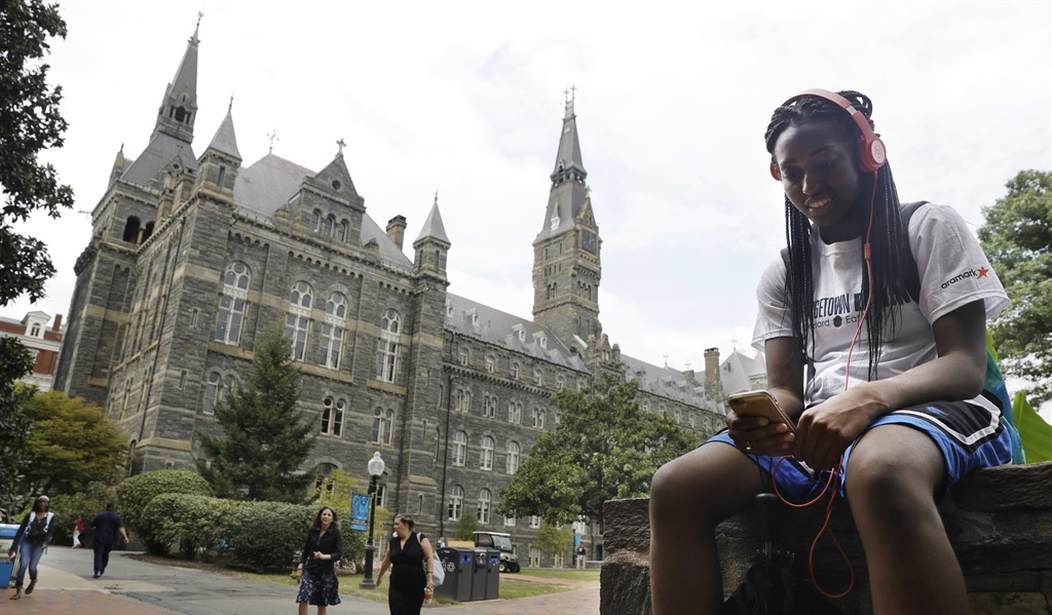
Dealing with the Wuhan coronavirus confounded many institutions of higher learning in the United States and it seems that many months into the pandemic, schools are still struggling to figure out how to cope with new variants and surging cases as President Biden's promise to "shut down the virus" falls flat.
Enter Georgetown University in our nation's capital where students have been informed that, yet again, learning in the start of the new year would be done remotely. Confusingly, though, Georgetown is allowing its undergraduate students to return to their student housing as originally planned.
Citing "the emergence and rapid spread of the Omicron variant of COVID-19 in the Washington, D.C., region, across the country, and globally," Georgetown's president John J. DeGioia announced that the school was "adjusting" its approach to "the first few weeks of the semester."
According to an email sent to students from the Office of the President, "We will begin the spring semester as scheduled and will use virtual instruction through January 30, 2022. In-person classes across the University are planned to resume on Monday, January 31," the University claims.
Anyone who remembers the earlier days of the pandemic knows that saying something is "planned to resume" often turned out to be more than a year of restrictions that just kept being extended.
Despite the remote start to the semester for learning, the email explains that "Undergraduate residential students will be able to move into their on-campus residences beginning on January 11, 2022, unless they have been approved to move in earlier." How can bringing students back to their dorms be safe while learning in a classroom is deemed unsafe?
Georgetown already has a vaccine mandate that "requires students, faculty, staff and visitors to be fully vaccinated against COVID-19 and, effective January 21, 2022, to have received a COVID-19 vaccine booster shot, or to have an approved medical or religious exemption." The school's vaccine policy is more strict than even the one Mayor Bowser announced for Washington, D.C.
When it comes to masking, Georgetown policy also states that members of its community "regardless of vaccination status, will wear a mask indoors on campus, except when eating or drinking, when alone in a private office, when in your personal residence, or when, if a faculty member who is fully vaccinated, you are actively lecturing in a classroom setting."
The school's testing protocol is strict as well, and includes a "randomly selected pool of our fully vaccinated student, faculty and staff community" who are required to get a test even as asymptomatic individuals in addition to arrival testing at the start of the semester and regular testing for those who received an exemption from the vaccine requirement.
But according to Georgetown's logic, it's simply too dangerous right now to allow students who are almost entirely vaccinated and boosted against the Wuhan coronavirus and all wearing masks to sit in a classroom to learn, but it's not too dangerous to have undergraduate students moving into their student housing. Right.
So while undergraduate students are allowed back in dorms, they — along with graduate students — are going backwards to again only learn online, a method that's less effective and less valuable than in-person instruction. Of course, Georgetown isn't reducing tuition rates, and that has at least some of Georgetown's students saying enough is enough.
The Conservative and Libertarian Student Association (CALSA) chapter of law school students — yes they exist at Georgetown — sent a letter in response to their school's plans blasting the administration for a move that "defies both science and common sense" and calling for a return to in-person classes or "an immediate tuition refund to compensate students for another compromised semester" if remote classes remain the only option.
Georgetown's move back to virtual classes defies both science and common sense. As such, CALSA is calling on Pres. DeGioia and Law Dean Treanor to re-implement in-person learning or provide an immediate tuition refund to compensate students for another compromised semester. pic.twitter.com/LCMigItDbh
— CALSA-Georgetown (@CALSAGeorgetown) December 30, 2021
The CALSA letter warns that Georgetown's "decision provides no discernible metric by which to judge when a safe return to campus is warranted" and asks "what level of Omicron dissipation is sufficient to return to in-person classes?"
"The lack of clear metrics to determine a safe return inhibits our ability as a community to hold University administrators responsible for their decisions," the letter continues. "Instead the 'wait and see' approach the administration continues to adopt provides them with complete discretion and zero accountability."
"Georgetown's constantly changing and draconian approach to COVID-19 during this school year has had real negative impacts on the education and well-being of its students that cannot be discounted," CALSA concludes:
Students are now left in a lurch. After registering for classes and paying tens of thousands of dollars in tuition and Washington-area housing costs, students are informed of—rather than consulted on—a policy inconsistent with the health and safety protocols advocated by national health experts and political leaders. Motivation, mental health, socialization, and the quality of education provided are suffering, all while the University and Law Center continue to raise tuition for an experience to which the students never consented.





Join the conversation as a VIP Member