







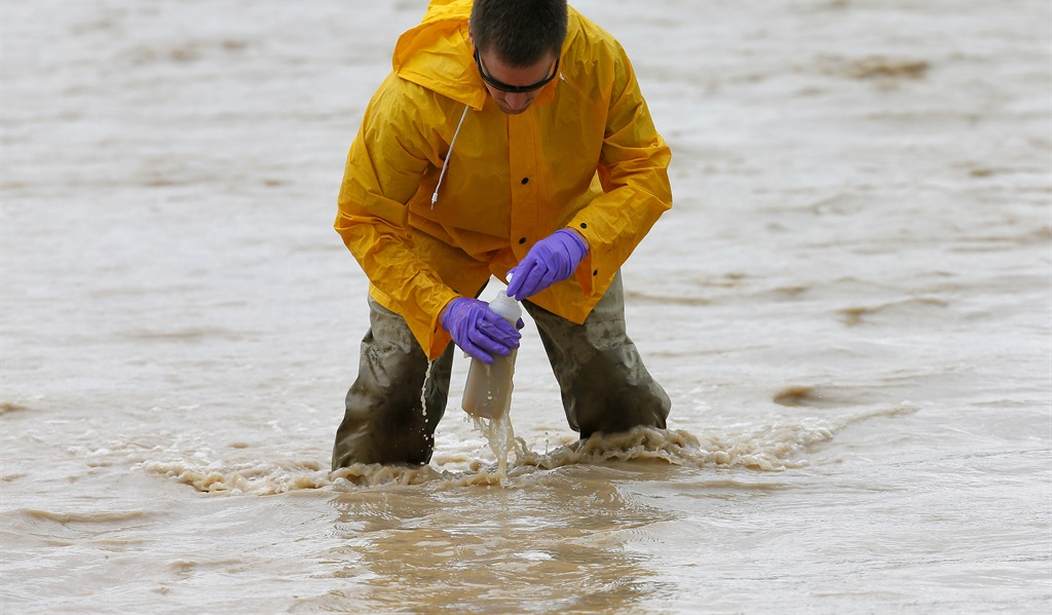
Earlier this month, the Environmental Protection Agency (EPA) royally screwed over everyone that uses the Animas River. As our former intern Daniel Davis wrote, a crackerjack* team from the EPA on cleanup duty near the Gold King Mine, which had been abandoned for 10 years, accidentally released 3 million gallons of contaminated water that had accumulated inside there. The discharge of dirty water was so great that it turned the river orange. Arsenic levels are 300 times normal levels, with lead levels surging to 3,500 times above healthy levels. In other words, stay away from the water.
Regarding the cleanup of this mess, it ranged from hundreds of million to tens of billions of dollars. American Action Forum cited the high-end cleanup scenario, where costs could soar to $16.3 billion. Yet, these figures were taken from projections conducted by the Department of the Interior that analyzed the costs of an oil spill in the Beaufort and Chukchi seas in the Arctic. Oil spills and toxic metals are different animals, but it provides a ballpark figure.
The mid-range cost projection is slightly better, slightly less expensive, but unknown variables remain:
In its controversial “Waters of the United States” (WOTUS) rule, the Environmental Protection Agency (EPA) estimated annual clean water benefits of $338 million to $349 million. However, these benefits were to the nation as a whole and not just one or two states.[…]
EPA estimates annual benefits of $424 million through a 0.47 billion-pound reduction of toxic discharges. These numbers are instructive because the regulation is designed to prevent the release of arsenic and lead, toxic metals that were also released into the Animas River. This spill released more than three million gallons into the river, which translates into more than 25 million pounds. Assuming a monetary equivalent of 90 cents per gallon of toxic wasted avoided ($424 million/470 million gallons) would yield at least $2.7 million in costs for the Animas River spill.
However, EPA’s affluent discharge rule was not designed to regulate acute pollution events, but rather the gradual effects of water pollution. For example, the Animas River had 300 to 3,500 times the normal levels of arsenic and lead. In addition, the figure of $2.7 million probably does not account for the value of “non-use” benefits that EPA and DOI have attempted to quantify in the past. Here, there are direct use costs because thousands of local residents, farmers, anglers, and tourists cannot use the river in its polluted state.
[…]
The full costs of the Animas spill might range between $2.7 million, $424 million, or $16.3 billion, but it will probably take months to assess the full damage. From qualitative non-use costs, a direct environmental toll, to the commercial losses from a damaged river, EPA’s clean-up task will involve more than just talk.
To make things worse, the EPA didn’t immediately inform Colorado, New Mexico, or Utah of the dangers of the spill. And now the Navajo reservation, which spans those states and parts of Arizona, is threatened by this spill.

*Of course, I’m being sarcastic



Join the Conversation
VIP members get the ability to comment on articles.