





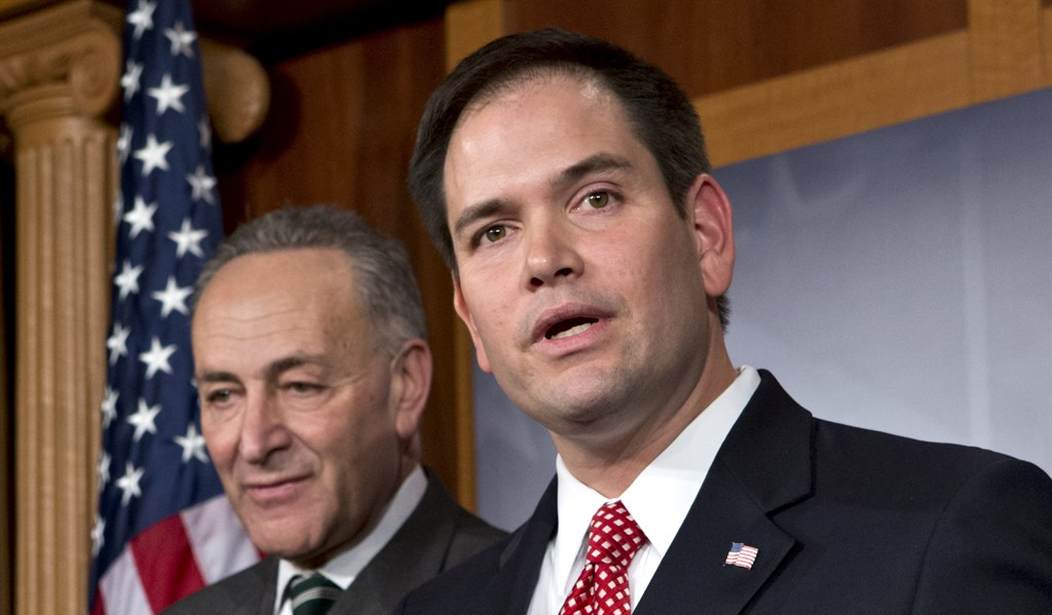
President Obama is in Saudi Arabia today and will meet with King Abdullah about a slew of issues facing the region, prompting lawmakers like Senator Marco Rubio to ask the president to address the country's terrible human rights record. Specifically, Rubio has asked President Obama to press Abdullah on the issue of religious freedom.
The latest appeal came from Sen. Marco Rubio, R-Fla., who wrote Obama a letter expressing concern over Saudi Arabia’s “systematic, ongoing and egregious” infringements against what he called basic religious freedoms.
Rubio also urged the president to push for the release of religious prisoners and to “end persecution of individuals charged with apostasy, blasphemy and sorcery.”
In May 2013, Saudi religious police announced they had arrested more than 200 people during the prior year on charges of sorcery, Rubio said.
“High school textbooks in Saudi Arabia contain highly inflammatory passages that dehumanize or call for violence against non-Wahhabi religious groups such as Christians, Jews, Hindus, Shi’ites and Sufis,” the senator added.
“Sustained interventions at the highest-levels of the U.S. government are required to make progress on this issue with our Saudi partners,” Rubio wrote. “I hope you can state such an engagement with the Saudi leadership during your meetings in Riyadh this week.”
Before Obama headed out for his trip, 70 lawmakers wrote him a letter detailing the country's concerning record which includes, "violations targeting women, religious minorities and peaceful political reformers."
Earlier this week, Washington D.C. Jerusalem Post Bureau Chief Michael Wilner, an Israeli based newspaper, was denied entrance into Saudi Arabia to cover President Obama's visit because of his religious affiliation as a Jew. After condemnation from the White House about the discrimination against Wilner, Saudi Arabia did not reverse their decision.
"I am an American journalist covering the travel of an American president. We consider it unfortunate that Saudi Arabia would deny any legitimate reporter the ability to complete that work -- much less one properly credentialed, in the White House press corps, expressly invited on the trip," he said in an email. "We have little doubt that my access was denied either because of my media affiliation or because of my religion. That is a grave disappointment, and a lost opportunity for the Kingdom."
According to Pew Research, the vast majority of Americans and people around the world have a poor view of Saudi Arabia's record and current policies on human rights. Countries that approve of the Saudi's record include Jordan, Egypt, Nigeria, Senegal, Indonesia and Pakistan.
The American public also gives the kingdom poor marks for how it treats its citizens. Roughly seven-in-ten (72%) said the government of Saudi Arabia does not respect the personal freedoms of its people, up slightly from 64% in 2008. Only 11% said it does respect personal liberty, essentially unchanged from the 13% registered five years prior.
And in case you're wondering, women in Saudi Arabia are still banned from driving.
Join the Conversation
VIP members get the ability to comment on articles.