





Earlier this week we brought you the story about the Obama campaign's "mom can I borrow $18,000 for birth control" ecard.
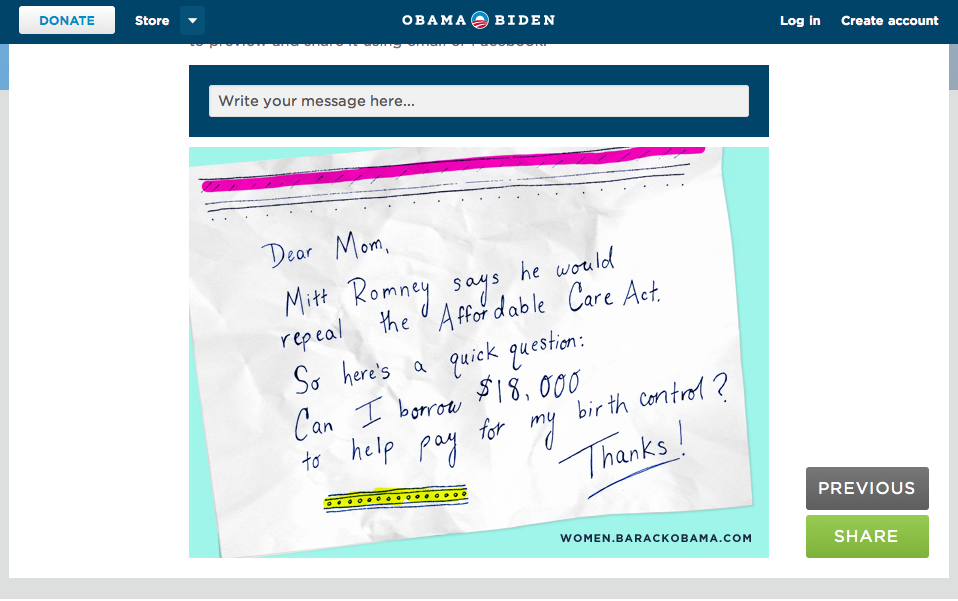
I pointed out the $18,000 figure was clearly given to the campaign by Planned Parenthood and is the total cost some women spend on birth control throughout an entire lifetime.
Now, the Washington Post is giving Team Obama three pinocchios for their $18,000 birth control claim.
As for the $18,000 figure, it comes from Planned Parenthood, which has said “some women” could save that much on birth control “over a lifetime” through the Affordable Care Act’s contraception requirement.
Why just “some women”? Because Planned Parenthood estimated a range between $5,400 and $18,000 for birth control over a lifetime, depending on co-pays. That means women with the highest co-pays could spend $18,000, but others would pay far less.
Let’s assume these number are correct. One problem is that the e-card doesn’t tell readers it’s using a lifetime number. They could easily assume that the $18,000 represents just one year’s worth of co-payments for contraceptives.
Furthermore, the estimate assumes 30 years of birth-control use. So what we’re really talking about here is an annual cost of between $180 and $600, according to the Planned Parenthood figures.
That’s a burden, but it doesn’t sound as backbreaking as $18,000. It’s also doubtful that the average woman would need a parental loan to pay for annual birth-control costs beyond her college years and perhaps the start of her professional life.
Another problem is that the e-card cited only the high end of the estimate, giving readers the impression that all women would pay that much without the Affordable Care Act’s contraceptive provision. But some women would pay just $5,400 over a lifetime.

WAPO also mentions the ridiculous idea of a young woman asking her mother to pay for her birth control for her entire life.
Finally, it’s striking that the daughter asked for the full lifetime amount, as in: Hey Mom, will you spot me some cash for a lifetime supply of birth control? This is an absurd request on multiple levels. For example, some women already cover their contraceptive co-payments without breaking the bank.
The Obama campaign’s e-card cited Planned Parenthood’s high-end estimate for out-of-pocket birth-control costs without explaining what the low-end number could be or mentioning that the $18,000 figure refers to lifetime costs.
We question whether many young women have asked their parents to cover a lifetime’s worth of contraceptive co-payments before the coverage requirement took effect (it still hasn’t taken effect for some women), and it’s no more likely that they’ll do so if Republicans repeal the Affordable Care Act.
And no, the GOP doesn't want to ban contraception and the repeal of ObamaCare won't ban it either.
Overall, the e-card message implies that women couldn’t afford birth control without the health-care law. That may be true for some women, but certainly not all.
As it stands, greater than half of all states already require insurers to provide contraceptive coverage if they offer prescription-drug coverage at all, according to a report from the Guttmacher Institute, a non-profit group that advocates for women’s reproductive rights. On top of that, some insurers offer contraceptive coverage voluntarily.
Keep voting with those lady parts, ladies.













Join the conversation as a VIP Member