




Here's a taste:
Recession-fueled federal spending and deficit growth caught the public unaware, but awareness is growing, welling up like a primal scream. Inarticulate now, the public is searching for its voice.
Fiscal conservatives must be that voice, but this opportunity has taken them by surprise too. It's an opportunity for leadership, not partisanship, and it's not simply enough to oppose. At some point, public demand switches from style to substance, and a solution must be offered.
Fortunately, an answer can be found in a few basic steps — for those knowing where to look.
It's easy to see how America has been fiscally surprised. In 2008, federal spending was 21% of GDP and the deficit was 3.2%. Now, a year later, federal spending is projected to be 26.1% of GDP and the deficit 11.2%. Neither percentage has been so high since during World War II.
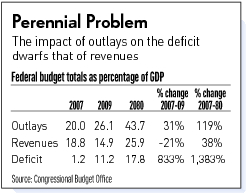
But before conservatives can address the deficit problem, they must understand it. Put simply, the deficit is the creation of federal spending. As the nearby table shows, federal revenues have fallen 21% as a percentage of GDP from 2007 to 2009, but much less than the 31% that federal spending has risen. And if the present is not persuasive enough, then try the future.
Advertisement
Read it all here.












Join the conversation as a VIP Member