





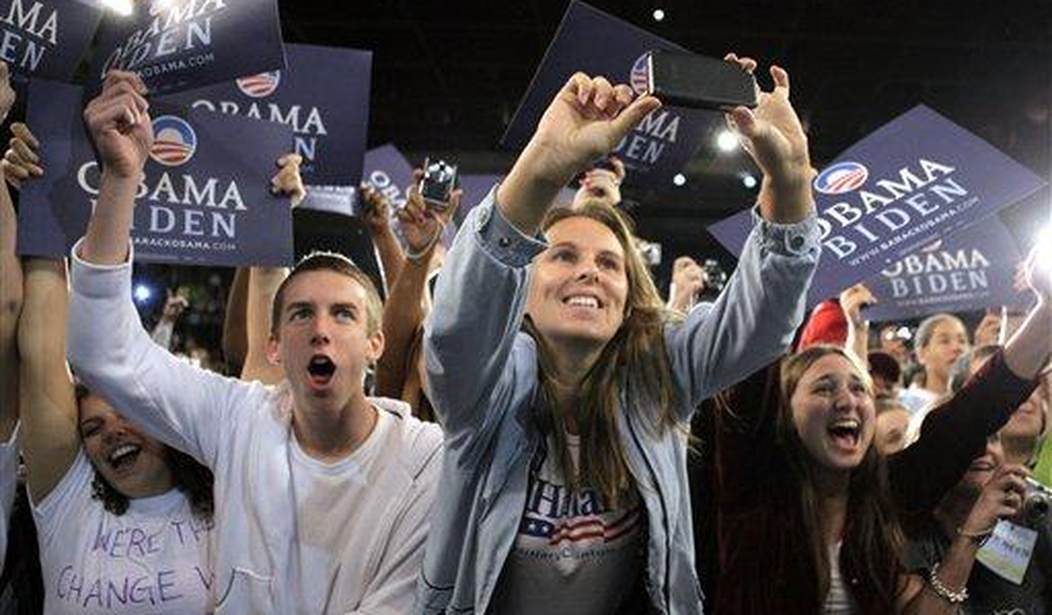
My generation is a disaster, politically. They typically hold views that either are in direct contradiction of one another, or make zero sense altogether. As The Atlantic noted in 2014, Millennials support President Obama and the concept of universal health care, but oppose Obamacare. They hate political parties, but are the demographic that give Congress its highest marks of approval. We’re also the only age group, where a majority–53 percent–holds socialism in high regard. Yet, there is a silver lining, as both The Washington Post and The Atlantic noted that once Millennials get jobs–their support for socialism drops dramatically as they become more economically conservative. Fancy that; once you start getting an actual paycheck after working yourself to death–and see how much is taken out by Uncle Sam–income redistribution really doesn’t seem like a charming idea, huh (via WaPo):
Are millennials ushering in a sea change of public opinion? Do they signal the transformation of the United States into a Scandinavian social democracy.[…]
The expanded social welfare state Sanders thinks the United States should adopt requires everyday people to pay considerably more in taxes. Yet millennials become averse to social welfare spending if they foot the bill. As they reach the threshold of earning $40,000 to $60,000 a year, the majority of millennials come to oppose income redistribution, including raising taxes to increase financial assistance to the poor.
Similarly, a Reason-Rupe poll found that while millennials still on their parents’ health-insurance policies supported the idea of paying higher premiums to help cover the uninsured (57 percent), support flipped among millennials paying for their own health insurance with 59 percent opposed to higher premiums.
When tax rates are not explicit, millennials say they’d prefer larger government offering more services (54 percent) to smaller government offering fewer services (43 percent). However when larger government offering more services is described as requiring high taxes, support flips and 57 percent of millennials opt for smaller government with fewer services and low taxes, while 41 percent prefer large government.
Millennials wouldn’t be the first generation to flip-flop. In the 1980s, the same share (52 percent) of baby boomers also supported bigger government, and so did Generation Xers (53 percent) in the 1990s. Yet, both baby boomers and Gen Xers grew more skeptical of government over time and by about the same magnitude. Today, only 25 percent of boomers and 37 percent of Gen Xers continue to favor larger government.
Now, that doesn’t mean conservatives should just stop emphasizing the importance of free markets and economic liberty because the tide of history seems to be with us once young Americans become employed and start making money. The good news is that the notion of Millennials becoming less economically left leaning once they start making $40k and more remains steady. Additionally, younger Millennials (18-20 year olds) aren’t as liberal as their older peers. So, alas, maybe there is hope for Millennials the economic front; they just need to find jobs.

Join the Conversation
VIP members get the ability to comment on articles.