





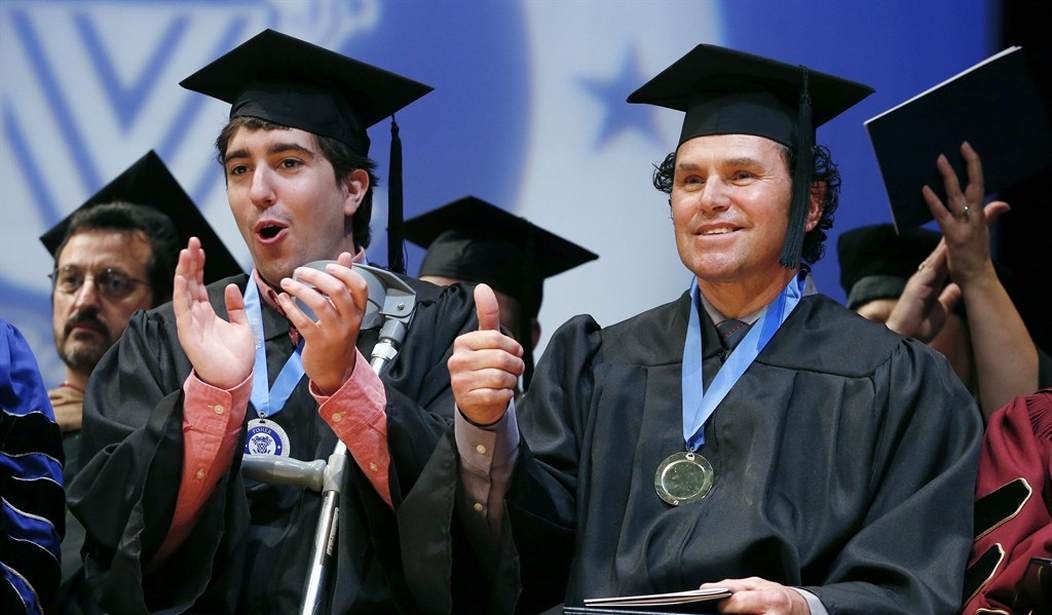
According to College Board, average tuition and fees for the 2013-14 school year totaled $30,094 at private colleges, $8,893 for in-state residents at public colleges and $22,203 for out-of-state residents. Many schools, such as Columbia University and George Washington University, charge yearly tuition and fees close to $50,000. Faced with the increasing costs of higher education, parents and taxpayers might like to know what they're getting for their money.
Campus Reform documents outrageous behavior at some colleges. Mark Landis, a former accounting professor at San Francisco State University, frequently entertained students at this home. He now faces 15 charges of invasion of privacy. Police say he was discovered with dozens of graphic videos he had made of students using his bathroom.
Mireille Miller-Young -- professor of feminist studies at the University of California, Santa Barbara -- recently pleaded no contest to charges of theft of banners and assault on a pro-life protester last March.
Every so often, colleges get it right, as the University of Illinois at Urbana-Champaign did when it withdrew its teaching offer to Steven G. Salaita. He had used his Twitter account to tell followers they are awful human beings if they support Israel, saying he supports the complete destruction of Israel, as well as calling for the decolonization of North America.
Then there are some strange college courses. At Georgetown University, there's a course called Philosophy and Star Trek, where professor Linda Wetzel explores questions such as "Can persons survive death?" and "Is time travel possible? Could we go back and kill our grandmothers?"
At Columbia College Chicago, there's a class called Zombies in Popular Media. The course description reads, "Daily assignments focus on reflection and commentary, while final projects foster thoughtful connections between student disciplines and the figure of the zombie."
West Coast colleges refuse to be left behind the times. University of California, Irvine physics professor Michael Dennin teaches The Science of Superheroes, in which he explores questions such as "Have you ever wondered if Superman could really bend steel bars?" and "Would a 'gamma ray' accident turn you into the Hulk?" and "What is a 'spidey-sense'?"
The average person would think that the major task of colleges is to educate and advance human knowledge. The best way to do that is to have competition in the marketplace of ideas. But Michael Yaki, head of the U.S. Commission on Civil Rights, disagrees. During a July 5 briefing on sexual harassment law in education, Yaki explained that college free speech restrictions are necessary because adolescent and young adult brains process information differently than adult brains.
Fortunately, the Foundation for Individual Rights in Education has waged a successful campaign against college restrictions on free speech. Some of its past victories include eliminating restrictions such as Bowdoin College's ban on jokes and stories "experienced by others as harassing"; Brown University's ban on "verbal behavior" that produced "feelings of impotence, anger or disenfranchisement," whether "unintentional or intentional"; the University of Connecticut's absurd ban of "inappropriately directed laughter"; and Colby College's ban on any speech that could lead to a loss of self-esteem. Some colleges sought to protect female students. Bryn Mawr College banned "suggestive looks," and "unwelcome flirtations" were not allowed at Haverford College.
Greg Lukianoff, president of FIRE and author of "Unlearning Liberty," argues that campus censorship is contributing to an atmosphere of stifled discourse. In 2010, an Association of American Colleges and Universities study found that only 17 percent of professors strongly agreed with the statement that it is "safe to hold unpopular positions on campus." Only 30 percent of college seniors strongly agreed with that statement. The First Amendment Center's annual survey found that a startling 47 percent of young people believe that the First Amendment "goes too far."
The bottom line is that many colleges have lost sight of their basic educational mission of teaching young people critical thinking skills, and they're failing at that mission at higher and higher costs to parents and taxpayers.

Join the Conversation
VIP members get the ability to comment on articles.