





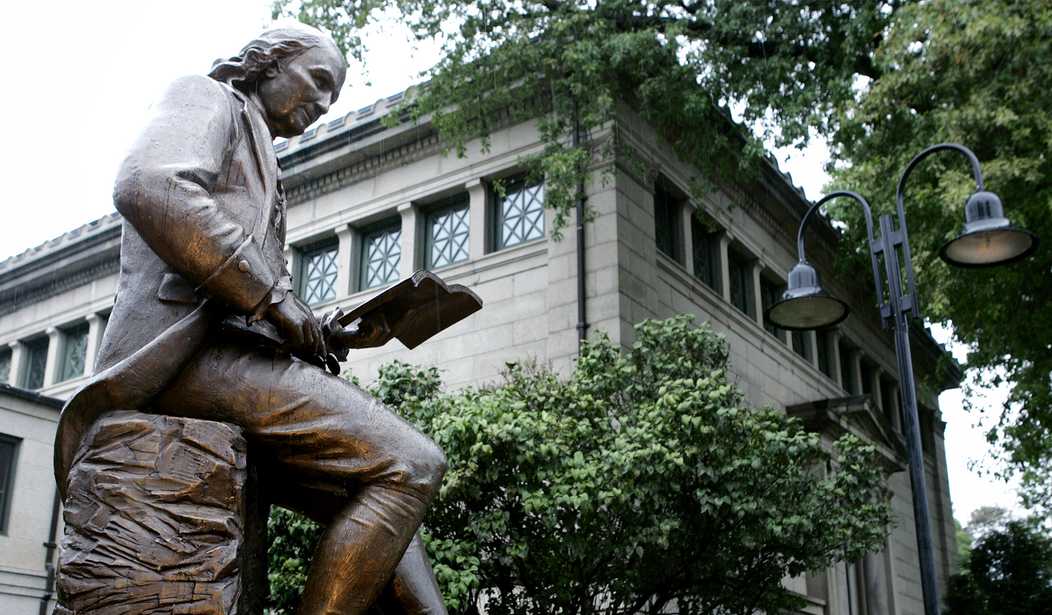
Why was America in the Revolutionary War era, with 3 million people, able to generate leaders of the quality of Benjamin Franklin and George Washington, while today's America, with 333 million people, generates the likes of President Joe Biden and former President Donald Trump?
That's a question I keep asking as I alternate between writing about current affairs in this space and reading about the Revolution and the early republic for my book "Mental Maps of the Founders."
I think I've found clues to answers in a seemingly unrelated quarter, in my Washington Examiner colleague Tim Carney's book "Family Unfriendly." Carney argues that more people should have more children, that governments and employers should make that easier, and that parents should, as the title of his first chapter reads, "have lower ambitions for your kids."
My research on the Founders produced several surprises, including the fact that most of them did not come from cultures of rigid primogeniture -- in which not only inheritances but families' hopes were concentrated on oldest sons.
On the contrary, among large families -- seven children seems to have been the median family size -- parents and even the children themselves were on the lookout for brothers with exceptionally high talents and concentrated on developing them. Many outstanding leaders had such backgrounds.
Washington, for example, was the son of a second marriage and, after his father died when he was 11, did not get the English education his older half-brothers did. But he became the favorite of his oldest brother, Lawrence, who, when he died of tuberculosis, left George in line to inherit the house above the Potomac River he named after his Royal Navy commander, Adm. Edward Vernon.
Recommended

Franklin was the 15th of 17 children of a Boston candlemaker who was apprenticed to an older brother who was a printer. Underappreciated for the droll, anonymous essays he wrote, Franklin absconded while a teenager to Philadelphia, set up his own print shop, started founding civic associations and retired a rich man at 42. An example of Carney's argument: If Franklin's father had stopped after his 14th child, there'd have been no "Poor Richard's Almanack," no electricity experiments and no original proposals for colonial unity.
Or take Andrew Jackson. His mother, though an immigrant to the frontier, was from a landholding family and literate though characteristically irregular in her spelling. She spotted her third son, Andrew, as something special and wanted him educated for the ministry. Wrong profession, but he exceled as a general. He was smarter than opposition caricatures made him out to be, and the Democratic Party, the world's oldest political party, was founded to elect him president.
His precise contemporary, occasional ally and frequent opponent, John Quincy Adams, was the first born of several brothers, raised to be president, chided by his mother for his laziness and indolence, though he was fluent in seven languages and kept a daily diary from age 12 to his death at 81. With no political flair, he was elected president once and had an important public career from 1794 to 1848.
Sometimes an extended family chipped in to provide an advanced education and early political backing for what they considered a dazzlingly talented younger son. That's the story of John C. Calhoun, whose grandmother in upcountry South Carolina was killed in a Cherokee raid and who was sent to Yale College and, subsequently, law school in Connecticut. Similarly, James A. Garfield, born in a log cabin in Ohio, was schooled and promoted by admiring parents and older siblings.
I find Calhoun an unattractive character, not just because he defended slavery as a positive good, and Garfield's promising career as a supporter of civil rights was cut short by a crazed assassin and a doctor who refused to wash his own hands. But both were able and consequential political actors with positive achievements whose careers were made possible by family members who perceived their exceptional talents.
None of these leaders would ever have been born if their parents, like typical people today, had no more than two children. Today's aspirational upscale parents, Carney writes, "worry that they are failing if their kids are not prodigies by age 8, or aren't on the path to dominance in violin, tennis, or math." But the odds that any one child will -- like Washington and Franklin, Jackson and Adams, Calhoun and Garfield -- have exceptional talents are less than if their parents had had a houseful of children.
Demographers worry that adults aren't producing enough taxpayers to pay for Social Security and Medicare. Reading Carney and about the Founders has me worried that people, unlike their forebears, aren't producing enough exceptional leaders.








Join the conversation as a VIP Member