A Conversation With Clarence

It’s the opening day of the Supreme Court term and Justice Clarence Thomas has snuck away from the Supreme Court press corps, citing the old adage about teaching a pig to sing. “You’ll just irritate the pig and waste your time,” he says with a smile.

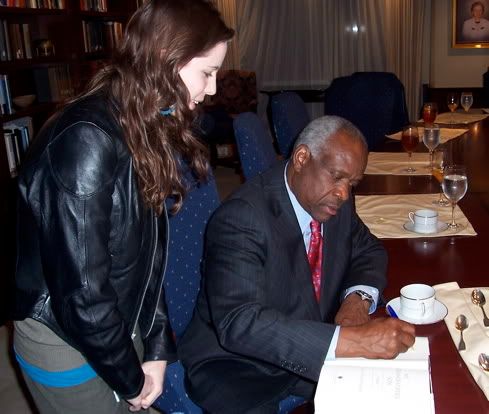
Instead, he’s meeting with a group of conservative commentators about his memoir, “My Grandfather’s Son.” It’s been 16 years since Thomas first took his seat at the bench after the nasty fight and nastier allegations that clouded his confirmation. In recounting a story, he stumbles on the vote tally. “How many votes did I get? 51?”

The rest of the room, almost all of which except me were integral in the 1991 fight for the Justice piped up simultaneously, “52-48!”

It becomes very clear in listening to Thomas, and in reading his new book, what is really important to the Justice, and it is most certainly not the Anita Hill controversy that has unfortunately come to define him for some Americans.

It is also not the fawning affection of media and D.C. elites:

“Hey, I’d have to become a Middle Eastern dictator with nuclear weapons to be invited to Columbia. I’m just not interested in that.”

When asked if it was painful to write his raw and moving memoir, to relive the tragedy of the Anita Hill controversy, he quickly puts it in perspective.

“That wasn’t a real tragedy; that was being set upon by bad people,” he said. The real tragedies were losing his grandmother and grandfather, who raised him, and then his younger brother eight years ago. The deaths of all the members of his childhood home prompted him to make sure their story was told and, along with it, his own story.

“I didn’t want to leave the telling to those with careless hands and malicious hearts,” he said.

The result is a book that is as frank and self-assured as the Justice himself, as clear as his baritone voice, and that pulses with the grit and glory of the race-scarred, Christ-haunted South he calls home. It’s a story of bigotry beaten, of racism, then radicalism and then redemption.

Thomas still calls the interest groups who set upon him during his 1991 confirmation hearing “clowns,” but chuckles at the media’s assertion in early reviews of his book that he is still so “angry” about Anita Hill.

“They don’t know me. How do they know I’m angry?”

He knows well the media’s and his political enemies’ tendency to create a picture of him that is not always accurate and sometimes recklessly unfair. He noted that in all of his travels, all of his speeches, he’s never had a negative incident. There have been protests—“The black law professors at the University of N