




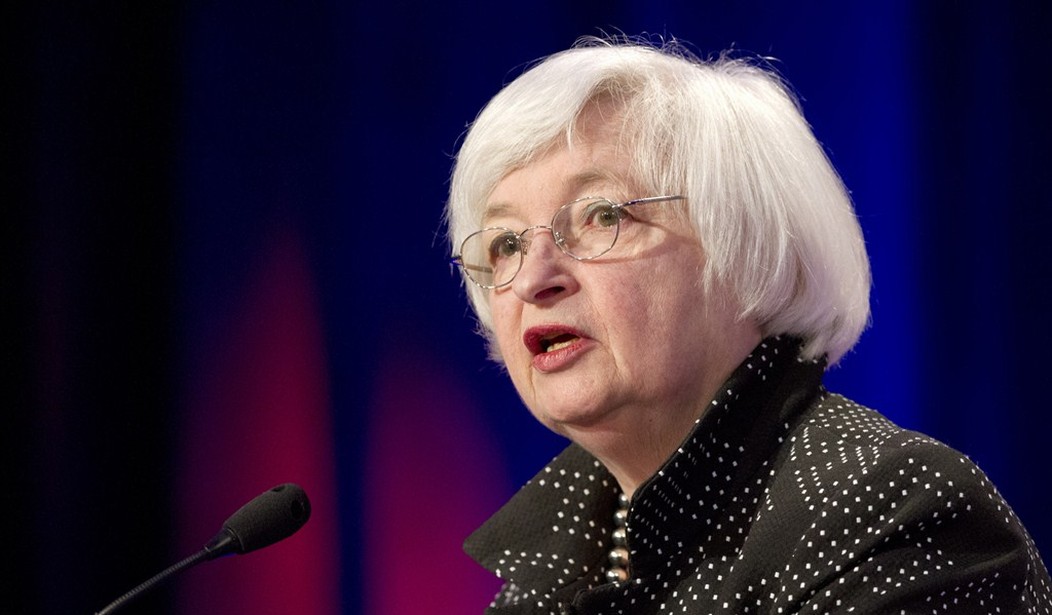
Federal Reserve Chairwoman Janet Yellen told us recently that the target for the federal funds rate will be raised slightly later this year. But after that, future rate hikes will be small and gradual over the next several years. In fact, we may never have true normalization (4 percent). In my view, Yellen is offering a back-to-the-'50s approach to interest rates. And she's right, though for many wrong reasons.
For average folks, what might this policy mean? I'll take a guess: No boom and no bust. No inflation and no recession. All the post-World War II recessions have been preceded by an inverted Treasury yield curve, in which short rates are higher than long rates. That won't happen for many years. Plus, we're now in a downward energy price cycle, and oil price spikes lead to recessions.
What's the back-to-the-'50s part? Well, during the Eisenhower administration, short rates averaged between 1 and 2 percent; inflation was roughly 1.5 percent; the dollar was tied to gold; long-term Treasury bonds ranged from 2 to 3 percent; and real growth was only 2.5 percent. And despite Ike's three recessions, the stock market roughly doubled (from very low levels) on his watch.
So that was then, and this is now. Things are different. But the ultralow interest rates are quite similar, along with low inflation and virtually stagnant real growth.
As for fiscal policy in the 1950s, the top personal tax rate was 91 percent (effectively about 70 percent), and the top corporate tax rate was over 50 percent. And the economy was heavily regulated. Sound a bit similar? It wasn't until the '60s that John F. Kennedy slashed tax rates and launched a huge economic and stock market boom. But that's another story.
Meanwhile, why might Yellen get it right today for the wrong reasons? Well, for one, she wants higher inflation, which is a mistake. We used to think that lower inflation promoted faster economic growth. And we should be watching the value of the dollar as indicated by commodity indexes, including gold. Fortunately, the dollar is trending higher and commodities lower.

So let me say this: A sound dollar and price stability should be the Fed's only task. But Yellen is a Phillips-curver who sees a trade-off between inflation and growth. She obsesses about the jobs market as a Fed-tightening indicator. Wrong target. Having more people working does not cause inflation. Bad money does.
But Yellen is right in pointing out employment problems. We have a 5.4 percent U-3 unemployment rate, the commonly watched measure. But in this cycle, the broader U-6 measure may be closer to the truth at 10.8 percent. U-6 includes part-time people who want full-time work, discouraged people who are sometimes looking for work and people who have left the labor force.
And when you add up U-6 and U-3, you get something like 16 million people out of work. And then the government's welfare assistance programs (including disability insurance, food stamps and Obamacare) pay people not to work, which is a key reason the labor force participation rate is rock bottom, at 62.8 percent, and the employment-to-population ratio is only 59.3 percent. This will not be fixed by the Fed. It's a fiscal issue of tax, regulatory and welfare reform.
So Yellen is right about an incomplete jobs recovery. She is also right about the lack of capital investment by businesses; more capital would boost productivity. But that's not the Fed's job. The most important pro-growth policy today would be major corporate tax reform -- slashing tax rates and moving to a territorial system that would bring home roughly $2 trillion stashed overseas for mostly tax reasons. Think how much better the jobs picture would be if that money came home.
Putting that aside, the Fed is right to go slowly with rate hikes. Back in the '50s, we had ultralow interest rates for long periods of time, and it was not a bad thing. The trick is to avoid Ike's mistakes of overtaxing and overregulating the economy.
And that brings us back to the future -- namely, the 2016 presidential election.
To find out more about Lawrence Kudlow and read features by other Creators Syndicate writers and cartoonists, visit the Creators Syndicate Web page at www.creators.com.
COPYRIGHT 2015 CREATORS.COM








Join the conversation as a VIP Member