





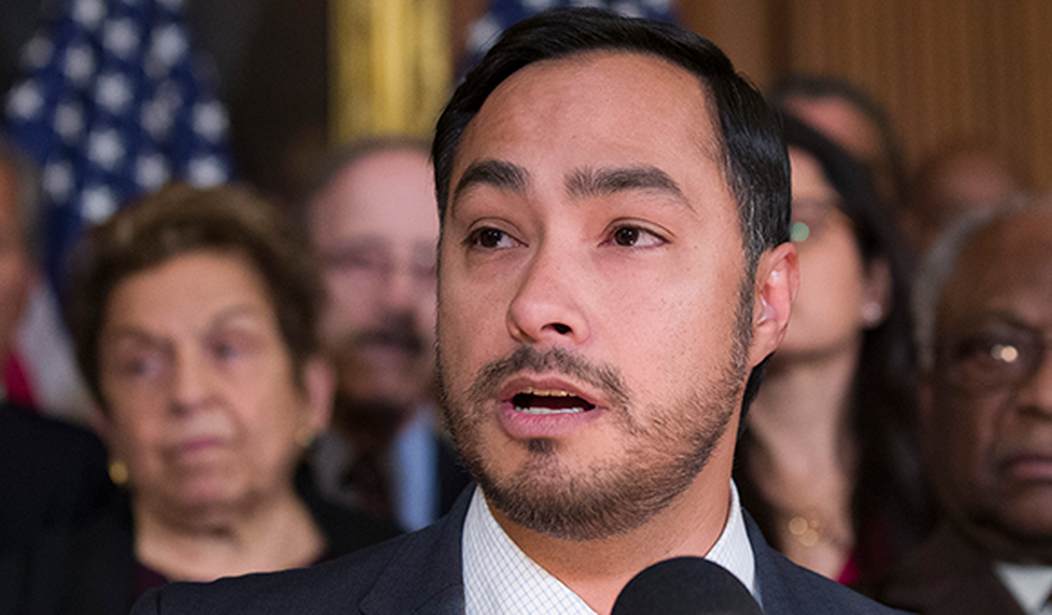
This week, Democratic Texas Rep. Joaquin Castro, who chairs the presidential campaign of his twin brother, Julian, tweeted the names and employers of more than 40 San Antonians who maxed out their donations to President Donald Trump's reelection campaign.
Mind you, the federal maximum is $2,800 per individual, so we're not talking about nefarious millionaires and billionaires or political activists or public figures. The congressman curated a list of retirees and business owners whose only sin was displeasing Castro.
The congressman claims he was targeting voters who "are fueling a campaign of hate that labels Hispanic immigrants as 'invaders.'" First of all, if Castro disagrees with his fellow Texans on whether illegal immigrants are "invaders," then he is free to try to change their minds. Six of the people he targeted turned out to have donated to him, as well. Instead, he decided to sic every unhinged progressive activist in Texas on these businesses, which, one imagines, employ and serve plenty of people in his community that doesn't even care about politics.
Then again, Castro has no clue if those he singled out support Trump's rhetoric on immigration or even if they support his position on the borders. Maybe some of his victims maxed out because they're happy with the unemployment rate or like the GOP's tax policy. Or maybe they see the election as a binary choice and prefer a demagogic president to a leftist congressman who feels comfortable "doxxing" his own constituents. Who knows?
Not that it really matters, of course. I may believe that Castro is a lightweight authoritarian, but it still doesn't mean I should post his family's business addresses on Twitter. Not even if it's in the public record.
Recommended
Democrats like Castro have adopted a political zealotry that rationalizes virtually any tactic they deem necessary to fight Trump. Pretending every Republican is abetting Nazism gives partisans like Castro the space to rationalize maximalist, illiberal positions. This, I guess, now includes intimidation. Because the purpose of tweeting those names wasn't merely to bully those who have already donated to Trump's reelection but also to warn anyone in his district thinking about contributing to consider potential retaliatory public attacks on their businesses (or worse).
Leftist groups have become quite adept at destroying the lives of those who back causes they dislike. Most notably there is the case of former Mozilla CEO Brendan Eich, who had the audacity to dissent from prevailing opinions in California. He's not alone. While Eich can weather such an event, I wonder what the Texans on Castro's list will do if their businesses go under, all for the sin of expressing a political opinion.
It is true, as some readers will no doubt point out, that anyone could look up these names, as they are a matter of public record. That's a problem, indeed. For one thing, campaign finance laws are meant to keep politicians honest, not to be used as "enemies" lists by politicians. Castro, who has a far bigger megaphone than most, makes a strong case for expanding anonymity in political speech.
The obsession with transparency in campaign money is a byproduct of an obsession with controlling speech. The idea that citizens should be expected to report to the IRS before expressing their political opinions has been normalized over the years, but it's un-American and undermines free expression.
"Anonymity is a shield from the tyranny of the majority," the 1995 Supreme Court ruling in McIntyre v. Ohio Elections Commission famously noted, because it "exemplifies the purpose behind the Bill of Rights and of the First Amendment in particular: to protect unpopular individuals from retaliation ... at the hand of an intolerant society."
The intolerant force, in this case, is Castro, but there will be more to come.




Join the conversation as a VIP Member