







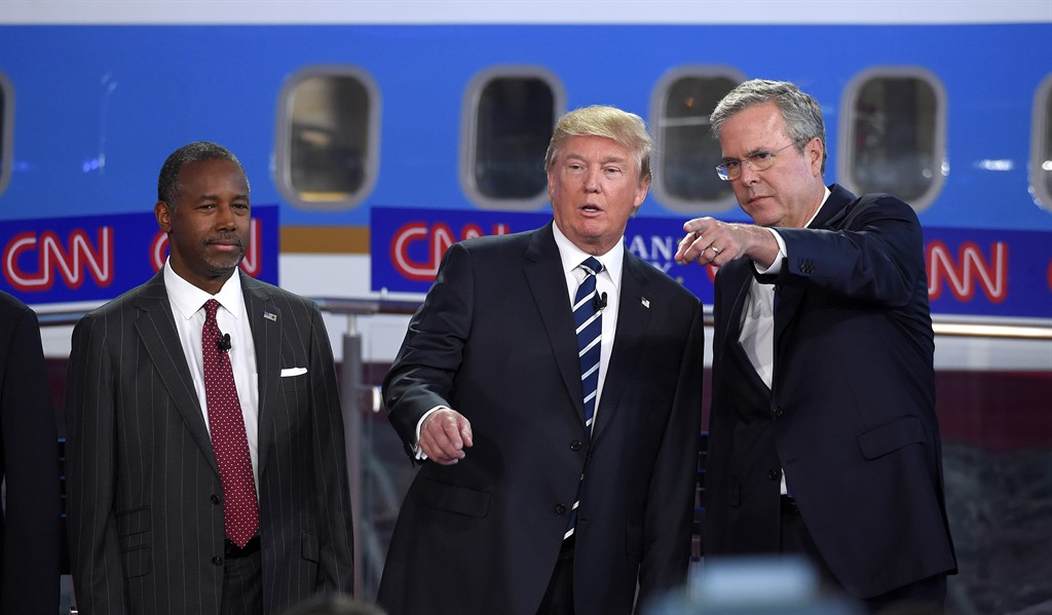
The Sept. 16 prime-time Republican debate at the Reagan Library went on for three hours. The CNN moderators asked more than three dozen questions on topics ranging from birthright citizenship to climate change to the safety of vaccines. Of the candidates, Donald Trump talked the most, taking up nearly 19 minutes, with Jeb Bush at nearly 16 minutes, and Ben Carson, Carly Fiorina, and Chris Christie at about 13 minutes each.
Yet in all that time, with all those words spoken, the issue that remains the most important concern of voters across America -- jobs and the economy -- received scant attention.
Republican pollster David Winston has undertaken a project in which he analyzes all the questions at GOP debates -- he has already published a study covering all the 2012 sessions -- and compares those media-generated questions with voter concerns. Looking at the CNN debate, Winston says there were 41 questions, with just four of them -- a grand total of 9.8 percent -- related to jobs and the economy.
Polls regularly show that a far higher number -- between 35 percent and 40 percent -- of voters name jobs and the economy as their most pressing worry for the coming election.
Winston found that 14.6 percent of the CNN questions related to a candidate's electability. Another 14.6 percent were questions that asked one candidate about another candidate. An even 22 percent of the questions focused on foreign policy and national security, and 9.8 percent of the questions centered on social issues. In other words, the public's number one concern, jobs and the economy, tied for fourth place in the questioning.
Among the other topics that took up the bulk of the debate time: Trump's suitability to handle the nation's nuclear codes; whether Trump is a serious candidate; whether Carson is a politician; whether Bush is a puppet of donors; Russian troops to Syria; the White House and China; Kim Davis and gay marriage; Planned Parenthood and a government shutdown; Bush and women's health; Fiorina's face; Trump and immigration; Bush's wife and immigration; Carson and birthright citizenship; Kasich, Fiorina, and attacks on Hillary Clinton; Bush's father's foreign policy advisers; Trump's foreign policy advisers; Carson and the war in Afghanistan; Walker and the Islamic State; Bush and the Supreme Court; Christie and marijuana legalization; Bush and the Second Amendment; Rubio and climate change; Trump and Carson and vaccines; a woman on the $10 bill; and possible Secret Service code names for each candidate.
The questions were so far removed from many voter concerns that one candidate, Chris Christie, stepped in to bring economic issues up himself. During a squabble between Trump and Fiorina about their business records, Christie interrupted, telling them, "You're both successful people. Congratulations. You know who's not successful? The middle class in this country who's getting plowed over by Barack Obama and Hillary Clinton. Let's start talking about those issues tonight and stop this childish back-and-forth between the two of you."
Pollsters have for many years asked Americans what they believe the most important issue facing the country today is. To look at some recent results, a Gallup survey this month found that 37 percent named economic problems as the most important issue, with other concerns in single digits. A Quinnipiac survey in July found that 37 percent named the economy as the most important issue, followed by healthcare at 13 percent and terrorism at 12 percent. A CNN poll at the same time found 40 percent named the economy, while 20 percent named healthcare and 12 named terrorism.
It is true that Republican audiences are more concerned about national security than Democratic ones, and the Reagan Library event was a Republican debate. But even among Republicans, the economy remains the top issue.
Winston found similar numbers after the first Republican debate, televised by Fox News in August. According to Winston's analysis of that two-hour debate, 10.4 percent of questions focused on jobs and the economy, while 25.0 percent focused on foreign policy and national security, 20.8 percent focused on electability, and 16.7 percent focused on social issues. Just 4.2 percent of the questions in the Fox News debate involved asking one candidate about another candidate.
The bottom line is that debate questions have often focused on issues that voters don't list among their top concerns. And the CNN debate, with its heavy emphasis on questions concerning electability and other candidates, and its relative lack of discussion on economic issues, was a particularly telling example of that problem.
Join the Conversation
VIP members get the ability to comment on articles.