





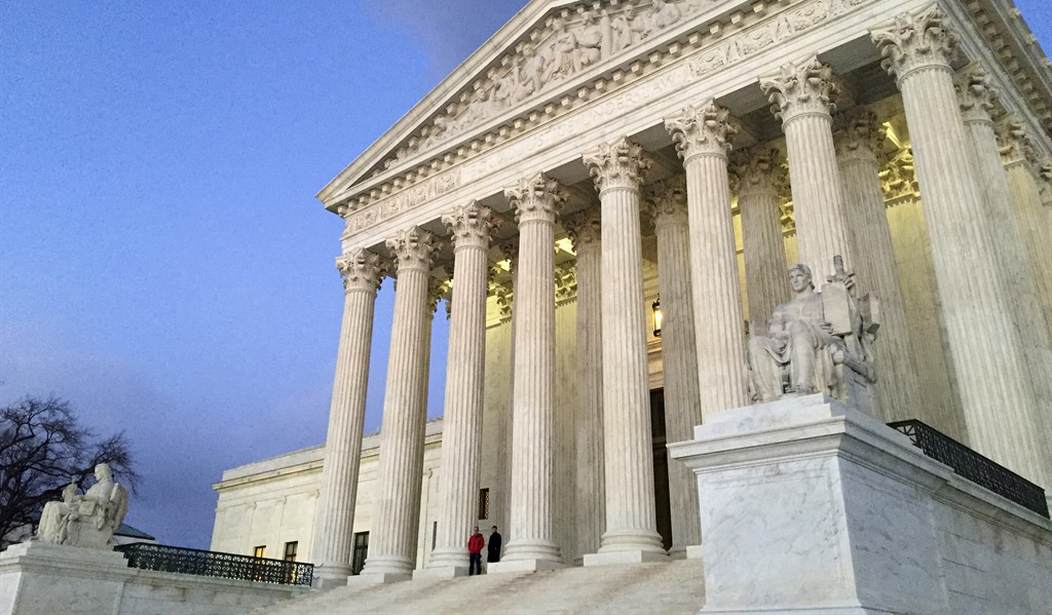
Our national government's judicial branch matters in a way it shouldn't. The political outlook that controls the judiciary controls the country, to a degree never contemplated by the founders. What the Supreme Court says goes -- particularly as to the rights asserted by this group or bloc or faction, or by another one. Abortion, gun ownership, contraception, speech, the meaning of marriage: The justices sort out various competing claims, then, thank you very much, here's the fatherly/motherly word. No, you can't take the car! That hem's too short! Your math grade's lousy!
In theory, various checks to Supreme Court power do exist; in reality, they don't work. Constitutional amendments to reverse the court never pass Congress; impeachment ("a mere scarecrow," said Jefferson) doesn't happen; Congress never seriously considers changing the court's appellate jurisdiction or slashing the justices' pay. The Supreme Court is supreme. A 5-4 decision chokes off debate. That's it. Shut up, everybody!
Congressmen and presidents rail at the court. So what? Nothing changes, except membership on the court -- the very reason many voters have identified the Supreme Court as the determinative factor in the choice between Donald Trump and Hillary Clinton. We know exactly the kind of jurists Clinton would nominate -- whomever she wants to carry on the federal-power-expanding work of Ruth Bader Ginsburg.

Justice Ginsburg has said she'll retire when a Democratic president is available to name her successor. What we can look for in that case is a Ginsburg successor infinitely more like Ginsburg than like Clarence Thomas: that is to say, friendly to the use of federal power to bring conservative recalcitrants in line with liberal/progressive aims. Among these: the overturning of a recent high court decision allowing unions and corporations to voice their own political aims, using their own money. As other high-court vacancies occurred, President Clinton would add new progressive sympathizers to the mix.
How come? Because as Clinton said in the third presidential debate, "The Supreme Court should represent all of us. ... And the kind of people that I would be looking to nominate to the court would be in the great tradition of standing up to the powerful, standing up on behalf of our rights as Americans." It sounds delightful, as far as rhetoric goes -- which isn't far. The Supreme Court's mission is assessing, weighing, (SET ITAL) judging (END ITAL) -- according to constitutional, as opposed to political, standards -- the claims of competing parties.
It's a different matter entirely from "representing," as Mrs. Clinton puts it, the views of constituents -- a function that belongs to the legislative and the executive branches of government. The court's constituency is everybody: the strongest, the weakest and all in between. Did the lady really graduate from Yale Law School with so little knowledge of the judiciary's role in democratic government? Or, likelier, does she see her job as significantly modifying that role?
That we've gotten to this point in the campaign -- treating jurists as legislators -- shows how far the constitutional order has deviated from the design of the founders. "I formally combatted," wrote Thomas Jefferson in 1821, "(the) heretical doctrine that the judiciary is the ultimate expounder and arbiter of all constitutional questions." He ought to have "combatted" harder. A president's power to drive the nation along a particular course by allying himself -- or, all right, herself -- with similarly minded judges is a power that just sort of evolved. And will keep evolving, we can assume, on the basis of how Clinton reads the road map to power.
Justice Antonin Scalia held his finger in the constitutional dike for nearly three decades. Then he died, leaving the Supreme Court in a place of greater peril than before: a hair or two off the center of the deepening battle for national power.





Join the conversation as a VIP Member