





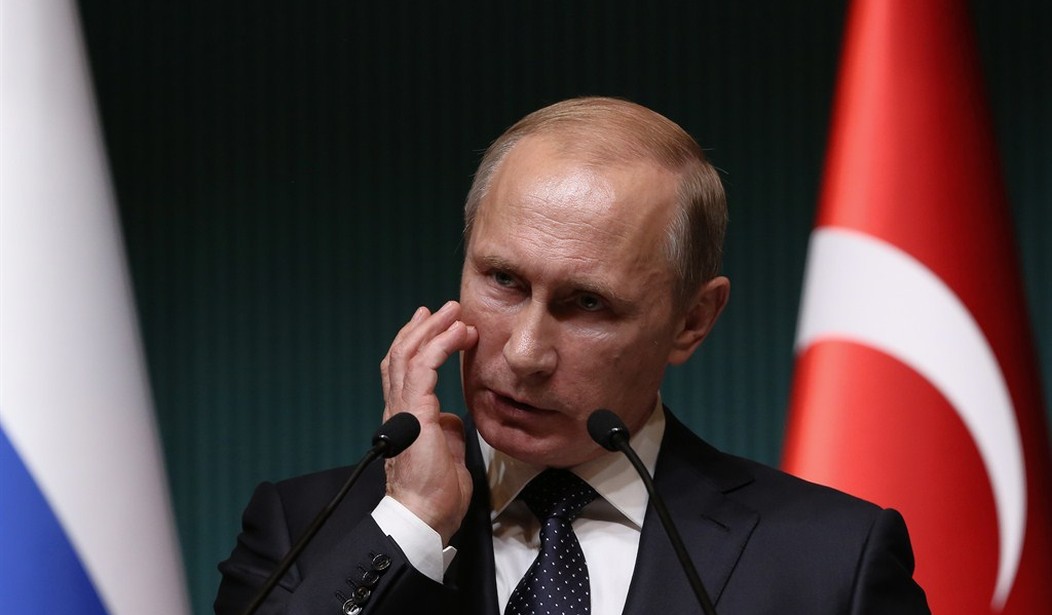
Moscow's February 2014 invasion of Ukraine's Crimean peninsula and its immediate annexation drastically altered international diplomatic calculations. In a year marked by the homicidal rise of the Islamic State and Chinese probes of East Asian maritime borders, Putin's destruction of post-Cold War security arrangements is the most dangerous challenge to global peace.
Yet U.S. and Western European attempts to penalize the Kremlin its Crimean theft and blunt its relentless "slow war of moral attrition" in Eastern Ukraine have been erratic. Though France's decision to halt its sale of assault ships to Russia sent the message that business is not as usual, it was seven months late in coming. E.U. and Obama administration government-directed economic sanctions have been incrementally effective. Financial sanctions directed at key oligarchs in Putin's inner circle might undermine his power base, but that remains speculative.
However, the free market attack on Russian energy exports has hit the Kremlin hard.
The stunning surge in U.S. and Canadian energy production spurred the assault. Improved drilling and production techniques created the surge. The key technique is hydraulic fracturing, better known by its media nom de plume, fracking.
Fracking has opened previously untapped "tight" gas and oil reservoirs. The U.S. has reduced its energy imports and in some markets is now exporting energy.
Oil has dropped from $110 to $75 a barrel. Even low-information American car owners see the wallet-level payoff. A gallon of gas now costs about a buck less than it did last year.
Private investment and commercial companies spurred the fracking revolution. If anything, the Obama administration, kowtowing to its hard-left environmentalist base, has attempted to hamstring the U.S. energy industry innovation. Radical enviro hypocrisy pollutes rational debate; at one time, many in their clan touted natural gas as a wonder fuel.
Well before Crimea, European nations resented Russian natural gas price gouging. The Kremlin used pricing threats to bully Ukraine, Poland and even Germany into political concessions.
After the Crimean travesty, the Baltic States and Poland demanded alternative gas supplies. The Obama administration quietly agreed to permit U.S. gas exports and the development of a liquefied natural gas exporting facility.
American LNG supplies might reach Poland in three years. That's good news. Here's the bad news: Putin has three years to exploit E.U. divisions and politically split NATO.
Or he had three years. Enter Saudi Arabia. America's "fracking" success challenges Saudi global oil dominance. What's the price point where fracking becomes unprofitable? Estimates run from $55 to $70 a barrel for oil. The Saudi oil ministry intends to find out and says it will not cut production. The market will determine price.
Though Russia can strangle Ukraine by denying gas supplies, the stunted and corrupt Russian economy survives on energy sales. Without its cash crop of oil, and gas, Russia is a big cabbage farm with a second-rate armaments industry. Cabbage, tanks, ICBMS and nuclear weapons mean Russian is not quite a petro-emirate writ large, but the cruel analogy has instructive utility.
If Russian nukes mean open war with Moscow is too risky, then attacking the Kremlin's cash generator is war by appropriate means.
Are the Saudis trying to defend Ukraine? I doubt it. The Saudis suspect they will be fencing with North American frackers for decades. It is very much in the Saudis' economic interest to retard the fracking revolution. It is also in their geo-political interest. Lowering oil prices sends a message to Washington that the Saudis matter; it also harms rival Iran.
The geo-political damage to Russia in ancillary but so welcome and so richly deserved. If the Obama administration wants to practice some truly smart diplomacy, it should expand oil and gas exploration on U.S. federal lands.


Join the Conversation
VIP members get the ability to comment on articles.