





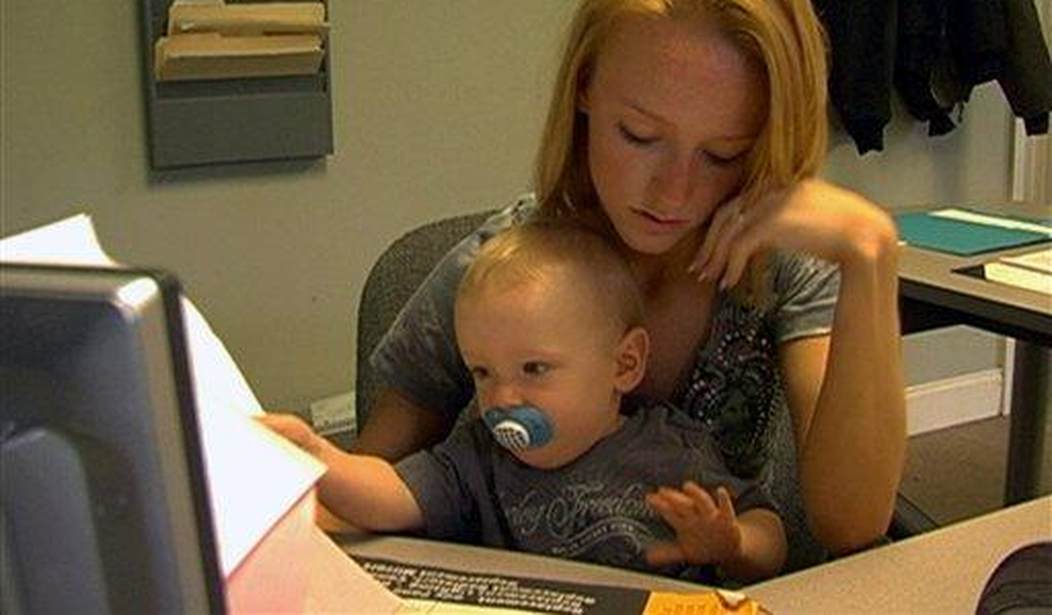
Our kids, at least many of them, are not doing very well. The reason, writes Harvard professor Robert Putnam in his just-published "Our Kids: The American Dream in Crisis," is the "two-tier pattern of family structure" that emerged in the 1970s and 1980s and continues to prevail today.
Starting in the late 1960s, rates of divorce, unmarried births and single parenthood rose sharply among all segments of society. About a decade later, they fell and leveled off among the college-educated, who almost entirely raise their kids in Ozzie-and-Harriet style families today (except that Mom usually works outside the home).
Among the bottom third of Americans in education and income, however, the negative trend accelerated. In 1965, Daniel Patrick Moynihan was alarmed that 26 percent of black births were to unmarried children. The rate is about twice that for the least educated third of Americans of all races today.
This shouldn't come as a surprise. Charles Murray's 2012 book "Coming Apart" describes the same phenomenon among white Americans. Curiously, Putnam refers only glancingly to Murray's work. But Putnam agrees with Murray (perhaps grudgingly) that this is bad for the kids involved.
They're careful to concede that single parents have a hard job and that some do well at it. But the data says those are the exception rather than the rule. On average and by a wide margin, children raised in such households do worse in school, have more trouble with the law and make less money and gain less satisfaction in life than those from the stable families of the upper third.
Putnam is troubled by the resulting inequality and lack of upward mobility. He begins "Our Kids" in Port Clinton, Ohio, where he grew up in the 1950s in a community unequal in income, but egalitarian in manners and mores. Since then, Port Clinton's factory jobs have mostly disappeared and the town seems riven between the gleaming condominiums on the now-clean waters of Lake Erie and gritty neighborhoods where many kids grow up in disorderly homes.
Recommended
With a corps of researchers, Putnam fanned out across the country and found similar trends from fast-growing Bend, Oregon, to the down-at-the-heels Kensington neighborhood of Philadelphia. He tells the stories and quotes the words -- often heart-wrenching, sometimes heart-warming -- of specific kids identified by first names.
"America's poor kids do belong to us and we to them," he concludes. "They are our kids." The nation as a whole has to do something to help them. But what?
Send them money is one answer. But as the Manhattan Institute's Scott Winship points out, low-level wages and incomes, taking into account proper inflation measures and fringe benefits, have not fallen over the last 40 years. Food and clothing has become less expensive (thanks, Wal-Mart) and most households classified as poor have smartphones, microwaves and big-screen TVs that did not exist in the 1960s.
Like Sen. Mike Lee and other reform conservatives, Putnam would increase the Earned Income Tax Credit and expand the child tax credit. Marginal help. He hails the bipartisan support for reducing incarceration for minor offenses and helping ex-convicts. And let's, he says, eliminate pay-for-play fees for extracurricular activities.
Other proposals sound unavailing, like moving low-education households to more upscale suburbs; Section 8 housing subsidies already do that. And Putnam's faith that child care centers and mandatory pre-school can make a difference haven't been supported by research, except for two experiments more than 40 years ago whose results haven't been replicated.
Putnam doubts the chances of "a reversal of long-established trends in private norms," though they're common in history: The gin-soaked mobs of 18th-century London became the orderly Victorian masses. Like most high-education Americans, he doesn't want to denounce people for breaking old moral rules even when that hurts their kids.
The libertarian Murray doubts that government can do much. But he thinks that high-education elites, with their strong family structures, can. They need to "preach what they practice." Bloomberg's Megan McArdle, agreeing, nominates Hollywood for a lead role. Midcentury America's universal media -- radio, movies, television -- celebrated the old rules.
There are signs this is happening. Teenage birth and violent crime rates have been falling. Younger millennials may be learning delayed gratification and self-restraint. Maybe, as they grow older, divorce and single parenthood will become less common, too. Few kids in broken homes will read "Our Kids or Coming Apart." But they already know the story.









Join the conversation as a VIP Member